What Size Outboard Motor for a Jon Boat?

What Size Outboard Motor Do You Need for a Jon Boat?
Choosing the right size outboard motor for a jon boat is not as simple as picking the biggest engine that fits your budget. The right motor depends on the boat’s length, width, hull rating, transom design, passenger load, gear weight, water conditions, and how you plan to use the boat.
A small jon boat used on a farm pond may only need a lightweight portable outboard. A larger aluminum fishing jon with a wide beam, livewell, batteries, electronics, and multiple passengers may need more horsepower to perform safely and comfortably. A hunting setup loaded with decoys, dogs, blinds, and cold-weather gear may need a different motor than a simple two-person fishing rig.
For boaters in Virginia, Pennsylvania, Maryland, West Virginia, and nearby areas, local use matters too. Rivers, lakes, reservoirs, shallow ramps, tidal areas, and seasonal conditions can all influence the best jon boat and outboard setup.
MotoMember helps customers compare jon boats, G3 aluminum boats, Yamaha outboards, trailers, accessories, financing, trade-ins, and service support. Current inventory and available rigging options can vary, so check MotoMember or contact the team before choosing a setup.
Start With the Capacity Plate
The first rule is simple: never exceed the boat’s rated horsepower.
Most small outboard-powered boats include a capacity plate that lists maximum weight, maximum number of people, and maximum horsepower. Discover Boating explains that boats under 20 feet carry capacity plates labeled “U.S. Coast Guard Maximum Capacities,” while boats up to 26 feet may carry “Maximum Capacities” wording. The plate is commonly located near the helm or operator area. (discoverboating.com)
Boat-ed also notes that on outboard boats, the capacity plate displays the recommended maximum horsepower rating, and the motor should never exceed that rating. (boat-ed.com)
That maximum rating is not a suggestion to ignore. It reflects the manufacturer’s design limits for safe operation, including weight, flotation, handling, and transom strength.
Maximum Horsepower Is Not Always the Best Choice
A common question is, “Should I just buy the maximum horsepower listed on the plate?”
Sometimes that makes sense. If you carry heavier loads, run bigger water, travel longer distances, or want stronger acceleration, a motor near the top of the rating may be a smart choice.
But for some owners, maximum horsepower may be unnecessary. A smaller motor may be lighter, easier to handle, simpler to transport, more fuel-efficient, and better matched to low-speed fishing, pond use, or short trips.
The goal is not just horsepower. The goal is the right match.
Common Jon Boat Outboard Size Ranges
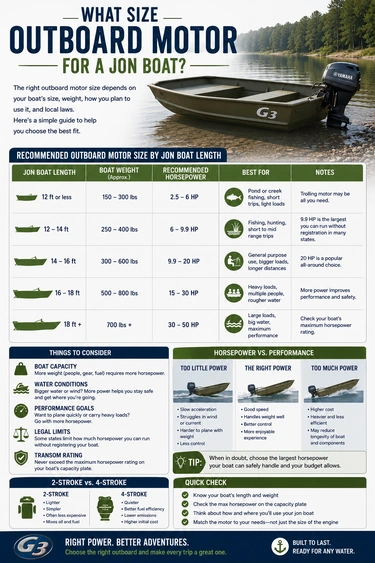
Exact recommendations depend on the specific boat, but these general ranges can help shoppers understand where to start.
10- to 12-Foot Jon Boats
Small jon boats are often used on ponds, calm lakes, narrow creeks, and protected waters. Many owners pair them with a small portable outboard or even an electric trolling motor.
A lightweight outboard in the 2.5 to 6 horsepower range may be enough for basic movement, depending on the boat’s capacity plate, load, and conditions. Yamaha’s small portable four-stroke outboard series includes 2.5, 4, and 6 horsepower options for light-duty boats. (yamahaoutboards.com)
These setups are usually not about speed. They are about portability, simplicity, and easy operation.
14-Foot Jon Boats
A 14-foot jon boat is one of the most popular sizes because it can still be manageable while offering more space than a smaller utility boat.
Depending on the hull width, transom rating, passenger load, and intended use, many 14-foot jon boats may be paired with outboards in the lower to mid horsepower range. Some lightweight boats may run well with modest power, while wider or heavier fishing layouts may benefit from more.
Yamaha describes its 25-to-15 horsepower portable outboard series as suitable for heavier-load boats and specifically mentions jon boats and 14-foot aluminum fishing boats in that category. (yamahaoutboards.com)
Before choosing, compare your actual load. Two anglers, a trolling motor, a deep-cycle battery, a cooler, tackle, fuel, safety gear, and an anchor can add up fast.
16-Foot Jon Boats
A 16-foot jon boat usually gives you more flexibility. Many shoppers move into this size because they want better stability, more room, and more capability for rivers, larger lakes, hunting, or all-day fishing.
Outboard needs vary widely in this range. A basic open 16-foot utility jon may not need the same power as a wide fishing jon with flooring, livewell, electronics, batteries, and a heavier trailer package.
This is where dealership guidance becomes especially helpful. Our team can help you compare hull width, horsepower rating, tiller vs. console steering, weight distribution, fuel capacity, trailer fit, and how the boat will actually be used.
17- to 18-Foot Jon Boats
Larger jon boats and modified-V aluminum fishing boats often need more motor to handle gear, passengers, current, wind, and longer runs.
At this size, the right outboard depends heavily on the manufacturer’s rating and the package design. Do not assume two 18-foot boats need the same motor. A narrow utility hull, a wide-body jon, and a fully equipped fishing model can behave very differently on the water.
If you are shopping this size range, compare the complete package, not just the motor horsepower.
Factors That Determine the Right Outboard Size
Horsepower matters, but it is only one part of the decision.
Boat Length and Width
Longer boats usually require more power than shorter boats. Width matters too. A wider jon boat often carries more weight and offers better stability, but it may need more horsepower to perform well with passengers and gear.
A narrow flat-bottom boat may move easily with less power, but it may not feel as stable with a heavy outboard or uneven load.
Hull Weight
A stripped-down utility jon boat is lighter than a fully equipped fishing model. Flooring, storage, seats, livewells, steering consoles, batteries, trolling motors, electronics, and accessories all add weight.
That extra weight affects acceleration, top speed, fuel use, and how quickly the boat gets on plane.
Passenger and Gear Load
Many shoppers underestimate load. The capacity plate’s maximum weight includes people, gear, and motor weight. Boat-ed explains that maximum weight capacity includes passengers, gear, and motors. (boat-ed.com)
Before choosing an outboard, think about your real-world setup:
Are you usually alone, or do you carry two or three people? Do you bring a cooler, tackle, anchors, decoys, dogs, firearms, blind material, fuel, batteries, or camping gear? Do you fish all day with electronics and a livewell?
A motor that feels fine with one person may feel underpowered when the boat is fully loaded.
Water Conditions
A jon boat used on a calm private pond has different needs than one used on rivers, large reservoirs, or tidal water.
Current, wind, chop, long runs, shallow flats, and boat traffic can all affect performance. More power may help with control and acceleration, but only within the manufacturer’s rating and with proper setup.
Tiller vs. Console Steering
Many jon boats use tiller steering, especially smaller and simpler setups. Tiller motors keep the boat open and reduce console weight, but the operator sits at the stern, which can affect weight balance.
Console steering can be more comfortable for some users and may make sense on larger fishing jon boats, but it adds components, weight, rigging complexity, and cost.
Transom Height and Shaft Length
The outboard must match the boat’s transom height. A motor with the wrong shaft length can perform poorly, ventilate, drag, or create handling issues.
Do not choose horsepower without also confirming shaft length, mounting height, controls, fuel setup, and propeller selection.
Electric Trolling Motor vs. Gas Outboard
Many jon boats use both. A gas outboard moves the boat from launch to fishing area, while a trolling motor handles quiet positioning.
A trolling motor alone may be enough for small ponds, restricted waters, or short-distance fishing. But it may not be ideal for longer runs, current, wind, or larger water.
If you are deciding between electric-only and gas power, consider:
How far do you need to travel? How often do you fight current or wind? How much battery capacity do you need? Are gas motors allowed on the water you use? How heavy is the full setup?
Check local waterway rules before assuming any motor type is permitted.
Is More Horsepower Always Better?
No. More horsepower can improve acceleration, handling under load, and travel speed, but it can also add weight, cost, fuel use, and transom stress.
A motor that is too heavy for the boat can hurt balance. Stern-heavy boats may sit low, handle poorly, take on water more easily at the transom, or struggle at low speed.
The right outboard should feel controlled, balanced, and appropriate for the boat’s job.
Is Less Horsepower Better for Beginners?
Not always. A smaller motor may feel less intimidating, but underpowering a boat can also create problems.
If the motor is too small for the loaded boat, it may struggle in wind or current, take too long to reach safe speed, burn more fuel while working hard, or make longer trips frustrating.
For new boaters, the best setup is one that is properly rated, predictable, easy to control, and matched to the water and load.
Choosing a Yamaha Outboard for a Jon Boat
Yamaha offers portable and midrange outboard options that may fit many jon boat and aluminum fishing boat applications, depending on the boat’s rating and rigging needs.
For smaller boats, Yamaha’s portable lineup includes lightweight 2.5, 4, and 6 horsepower options. (yamahaoutboards.com) For heavier small-boat applications, Yamaha’s 15, 20, and 25 horsepower portable series may be relevant depending on the boat. (yamahaoutboards.com)
For larger aluminum boats, Yamaha’s broader lineup includes additional horsepower classes, controls, gauges, and rigging options. The right choice should be based on the boat’s rating, the manufacturer’s package recommendations, and dealer guidance.
MotoMember can help you compare Yamaha outboard options with G3 jon boats, trailers, accessories, and service support.
What About G3 Jon Boats?
G3 builds aluminum boats for fishing, hunting, utility, and recreational use. Because G3 models vary by size, layout, and package, the correct outboard depends on the specific model and rating.
Do not choose a motor based only on another owner’s setup. A 14-foot utility jon, a wide-body jon, and a more equipped fishing model may all have different ratings and performance needs.
Before choosing a G3 jon boat and outboard package, compare:
Boat length, beam, hull weight, maximum horsepower, maximum weight capacity, transom design, steering type, storage, livewell, battery needs, trailer, and intended water conditions.
Current availability can vary, so check MotoMember inventory or contact the team for model-specific guidance.
Jon Boat Outboard Size by Use Case
Pond Fishing
For small ponds and calm private water, lightweight power may be enough. Portability, low-speed control, and easy storage often matter more than top speed.
River Fishing
River use may require more attention to current, shallow areas, ramps, rocks, and return distance. You may want enough power to maintain control, but the setup still needs to match the hull rating.
Duck Hunting
Duck hunting rigs often carry heavy gear: decoys, blind material, dogs, extra clothing, firearms, coolers, and passengers. That added weight can make a boat feel underpowered if the motor is too small.
Larger Lakes and Reservoirs
Bigger water can mean wind, chop, longer runs, and heavier weekend traffic. A wider, properly powered jon boat may offer more confidence than a small narrow setup.
Utility Work
For farm, pond, dock, and property use, durability and low-speed handling may matter more than speed. A smaller outboard may be practical if the load is light and the water is protected.
MotoMember Expert Tip
Before choosing an outboard, write down your real load.
Include people, fuel, trolling motor, batteries, anchor, tackle, cooler, safety gear, electronics, hunting gear, and anything else you normally carry. Then compare that total with the boat’s capacity plate and the motor options available for that hull.
Many shoppers focus on horsepower first. Our team usually starts with the full use case: where you boat, how many people you carry, how much gear you bring, whether you need tiller or console steering, and how you plan to trailer and store the boat.
That approach helps you choose a jon boat and outboard package that feels right after the sale, not just on paper.
Call to Action
Your jon boat and Yamaha outboard headquarters starts at MotoMember.
For boaters across Virginia, Pennsylvania, Maryland, West Virginia, and nearby areas, MotoMember can help you compare jon boats, G3 aluminum boats, Yamaha outboards, trailers, accessories, financing, trade-ins, and service needs.
Visit MotoMember, explore financing options, or contact the team to compare current jon boat and outboard options.
Large selection. Straightforward shopping. Real powersports and marine expertise.
Conclusion
The right outboard motor size for a jon boat depends on more than boat length. Start with the capacity plate, never exceed the maximum horsepower rating, and think carefully about load, water conditions, steering style, transom setup, and how you actually use the boat.
A small pond boat may need only lightweight portable power. A wider fishing or hunting jon boat may need more horsepower to carry passengers and gear comfortably. The best choice is a balanced package that matches the hull, handles predictably, and supports your real boating habits.
MotoMember can help you compare options before you buy so your jon boat, motor, trailer, and accessories work together from day one.
FAQ
What horsepower outboard do I need for a 12-foot jon boat?
It depends on the boat’s capacity plate, transom rating, load, and water conditions. Many small 12-foot jon boats use lightweight portable outboards, but you should never exceed the manufacturer’s maximum horsepower rating.
Is a 9.9 HP motor enough for a jon boat?
A 9.9 HP outboard may be enough for some smaller jon boats, especially with lighter loads and protected water. It may feel underpowered on a wider, heavier, or fully loaded boat. Always compare the motor with the boat’s rating and your real-world load.
Can I put a 25 HP outboard on a jon boat?
Only if the boat is rated for that horsepower and the transom, shaft length, controls, and overall setup are appropriate. Some jon boats may be compatible with 25 HP power, while others are not.
What happens if I overpower a jon boat?
Overpowering can create unsafe handling, excess transom stress, insurance problems, and possible legal issues. It can also make the boat harder to control. Never exceed the capacity plate’s maximum horsepower rating.
Can MotoMember help me choose a jon boat motor?
Yes. MotoMember can help customers compare jon boats, G3 models, Yamaha outboards, trailers, accessories, financing, trade-ins, and service support across VA, PA, MD, WV, and nearby areas.