What Size ATV Do You Need? 400cc to 1000cc

What Size ATV Do You Need? 400cc to 1000cc
One of the first questions ATV shoppers ask is also one of the hardest to answer with a single number:
What size ATV do I actually need?
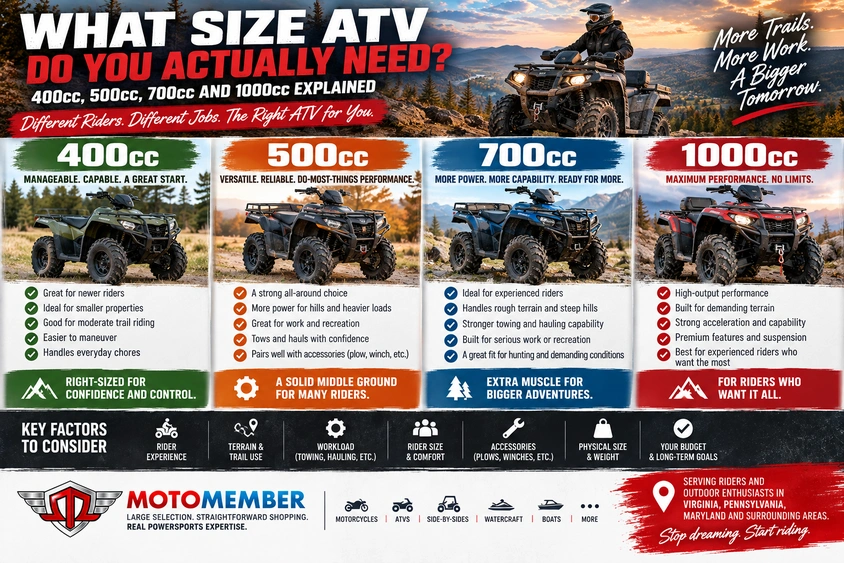
A 400cc-class machine may be exactly right for property chores and relaxed trail riding. A 500cc-class ATV can add useful versatility without jumping into big-bore territory. Around 700cc, riders generally move into stronger recreational and utility capability. At the 1000cc end of the market, performance becomes much more serious—and not every rider needs it.
The key is understanding what those engine-size categories actually mean.
Bigger does not automatically mean better. Horsepower, torque delivery, vehicle weight, gearing, four-wheel-drive systems, suspension, tires, power steering, cargo capacity, towing capability, and rider experience all influence how an ATV performs.
There is another important complication: the number in an ATV's model name does not always equal its exact engine displacement.
For example, Yamaha's current Kodiak 450 uses a 421cc engine, while the Grizzly and Kodiak 700 models use a 686cc engine. Polaris' Sportsman 570 uses a 567cc engine. Even more dramatically, Can-Am's current Outlander 500 and Outlander 700 both use a 650cc single-cylinder engine with different output calibrations.
So instead of shopping strictly by the badge, think of 400cc, 500cc, 700cc, and 1000cc as useful ATV capability classes.
For riders and property owners across Virginia, Pennsylvania, Maryland, and surrounding areas, MotoMember can help compare those classes around the work and riding you actually plan to do.
Here's how to decide.
First: ATV Engine Size Is Only Part of the Story
Engine displacement—usually expressed in cubic centimeters, or cc—describes the volume displaced by an engine's cylinders.
It is useful information, but it does not tell you everything about performance.
Two ATVs with similar displacement can feel significantly different because manufacturers use different:
- Engine designs
- Transmission calibrations
- Gear ratios
- Throttle mapping
- Vehicle weights
- Four-wheel-drive systems
- Tires
- Suspension setups
- Electronic riding features
A good example comes directly from Can-Am's current lineup. Its 2026 Outlander 500 and 700 models both list a 650cc single-cylinder Rotax engine, but Can-Am rates the 500 configuration at 40 horsepower and the 700 at 50 horsepower.
That is why comparing ATVs by model number alone can be misleading.
Shop for Capability, Not Just CC
Before deciding that you "need a 700," ask what you expect the ATV to do.
Consider:
- Your riding experience
- Rider size and comfort
- Trail versus work use
- Terrain
- Hills
- Mud
- Snow
- Cargo
- Towing
- Passenger needs
- Plow use
- Hunting or farm work
- How aggressively you like to ride
- Storage and transportation limitations
Our team can help you compare those factors along with the engine.
What Is a 400cc ATV Good For?
The roughly 400cc ATV category can be a great starting point for buyers who want manageable size and useful capability without stepping immediately into a high-output machine.
Today's machines in this range are not simply "small ATVs."
For example, the current Kawasaki Brute Force 450 uses a 443cc liquid-cooled single-cylinder engine, while Yamaha's Kodiak 450 uses a 421cc engine.
A 400cc-Class ATV May Be Right If You:
- Are relatively new to full-size ATVs
- Ride trails at moderate speeds
- Maintain a residential or smaller rural property
- Hunt or access wooded property
- Carry moderate cargo
- Want manageable power delivery
- Navigate tighter trails
- Value maneuverability over maximum power
- Want an ATV for general-purpose chores
This category can make a lot of sense for someone who primarily needs transportation around acreage rather than a high-performance trail machine.
Why Smaller Can Be an Advantage
Extra power is not useful if it makes a machine more difficult for you to control.
A moderate-displacement ATV can feel less demanding in tight woods, around buildings, when loading onto a trailer, or while performing slow-speed property tasks.
Rider fit also matters. Yamaha's 2026 Kodiak 450 EPS, for example, has a listed 33.7-inch seat height and 650-pound wet weight. Those physical measurements can be just as important as its 421cc displacement when determining whether the machine feels comfortable to a particular rider.
Sit on the ATV before deciding.
Handlebar reach, seat height, foot placement, brake controls, and steering effort all matter.
What Is a 500cc ATV Good For?
Around the 500cc class, shoppers often find a particularly useful middle ground.
These machines can offer enough capability for significant property work and varied trail riding without automatically moving into the size, output, or cost associated with bigger-bore ATVs.
But remember the naming issue.
A current Polaris Sportsman 570, for example, actually uses a 567cc engine, while—as noted above—the Can-Am Outlander 500 badge currently identifies a 650cc engine in a lower-output configuration.
So when we discuss "500cc ATVs," we are really talking about the general mid-displacement utility/recreation segment.
A 500cc-Class ATV May Be Right If You:
- Want one ATV for work and recreation
- Regularly ride hills or varied terrain
- Need additional towing or hauling capability
- Plan to install a plow
- Own several acres
- Want more power without jumping to a big-bore machine
- Are an experienced rider who does not need maximum performance
This is often one of the first classes our team would encourage a general-purpose ATV shopper to compare.
Not because a 500-class ATV is universally correct, but because it sits near the center of many real-world ATV use cases.
A Good "Do-Most-Things" Category
Look at the Polaris Sportsman 570 as an example.
The 2026 Sportsman 570 EPS uses a 567cc single-cylinder engine rated at 44 horsepower and includes on-demand AWD/2WD. Polaris lists a 1,350-pound towing capacity for that particular configuration.
Those specifications demonstrate why this displacement neighborhood appeals to property owners: you can get substantial working capability without moving into a 850cc or 1000cc performance machine.
Specifications vary considerably by manufacturer and model, so always compare the exact ATV you're considering.
What Is a 700cc ATV Good For?
The 700cc class is where many shoppers start entering serious all-around recreational and utility territory.
These machines can make sense for experienced riders, larger properties, demanding terrain, frequent work, or riders who simply want stronger performance.
Yamaha's current Grizzly EPS provides a useful real-world example. Despite the familiar "700" category associated with Yamaha's big-bore single-cylinder utility ATVs, it uses a 686cc engine paired with selectable 2WD, 4WD, and locked 4WD.
Kawasaki's current Brute Force 750 similarly sits in this general big-bore utility neighborhood with a 749cc V-twin.
A 700cc-Class ATV May Be Right If You:
- Have previous ATV experience
- Ride challenging trails regularly
- Deal with steep terrain
- Use your ATV heavily for work
- Frequently tow or haul within manufacturer limits
- Ride in mud or difficult conditions
- Want stronger acceleration and response
- Expect to keep the ATV for many different uses
For many experienced owners, this class can provide a strong balance between capability and manageability.
700cc Doesn't Necessarily Mean Huge
Engine size and physical size are related only loosely.
Yamaha's 686cc Grizzly EPS, for example, is 48.4 inches wide according to Yamaha. That can still make it suitable for many established ATV trails where overall vehicle dimensions matter.
This is another reason to avoid choosing exclusively by displacement.
A buyer concerned about narrow trails should compare width and wheelbase. A rider concerned about loading into a pickup bed or trailer should measure those spaces. Someone with limited mobility may care more about seat height and mounting effort.
What Is a 1000cc ATV Good For?
A 1000cc-class ATV is a different proposition.
These machines sit toward the high-performance end of the utility and recreational ATV market. They can offer significantly stronger acceleration, greater output, more sophisticated suspension options, and equipment intended for experienced riders with demanding use cases.
Polaris' current Sportsman XP 1000 lineup, for example, includes machines in the roughly 90-horsepower range, while Can-Am's 2026 Outlander 1000R uses a 999cc V-twin and is offered in configurations rated at up to 101 horsepower.
That is a substantial step beyond many mid-size ATVs.
A 1000cc ATV May Make Sense If You:
- Are an experienced ATV rider
- Specifically want high performance
- Ride demanding terrain
- Want strong acceleration
- Participate in aggressive recreational riding
- Need features found on premium big-bore trims
- Understand and are comfortable managing significantly greater power
Do You Need 1000cc for Farm Work?
Usually, engine displacement alone should not decide that question.
A 1000cc machine may offer useful capability, but many property-maintenance tasks can be handled effectively by lower-displacement ATVs.
For hauling, towing, plowing, or farm chores, pay closer attention to manufacturer ratings, gearing, drivetrain design, cooling, traction, rack capacity, hitch equipment, and compatibility with the accessories you need.
Buying the most powerful ATV in the showroom simply because you plan to work with it can mean paying for performance you rarely use.
400cc vs 500cc ATV: Which Should You Buy?
This can be a close decision.
Choose toward the 400cc class if maneuverability, manageable power, lighter-duty property work, and casual trail riding dominate your needs.
Move toward the 500cc class if you want additional flexibility for towing, hills, snow removal, larger properties, or more varied recreational riding.
For a first-time adult buyer, do not automatically assume bigger is better because you expect to "grow into it."
A machine you feel confident controlling from the beginning can deliver a much better ownership experience.
500cc vs 700cc ATV: Is the Bigger Engine Worth It?
This may be the most common meaningful comparison for experienced utility ATV shoppers.
A mid-size machine can already accomplish a surprising amount.
Move toward 700cc when you have a reason.
That reason might be steeper property terrain, frequent heavy use, more demanding trails, stronger acceleration preferences, or simply wanting the features that come with a particular higher-displacement model.
Do not upgrade solely because 700 sounds better than 500.
Compare complete machines.
700cc vs 1000cc ATV: How Much Power Is Enough?
For most buyers choosing between these categories, the question changes from "Can the ATV handle my needs?" to "How much performance do I actually want?"
A roughly 700cc-class ATV already represents serious capability.
A 1000cc machine becomes most compelling when the rider specifically values big-bore performance, premium suspension or drivetrain features, aggressive recreational use, or other capabilities unique to the model.
For perspective, Polaris currently lists its Sportsman 850 at 78 horsepower, while the Sportsman XP 1000 family reaches around 90 horsepower depending on configuration.
That illustrates how quickly the performance level can rise beyond the middle of the ATV market.
More power also deserves more respect from the rider.
Don't Forget About Rider Experience
Engine size should match experience as well as workload.
The ATV Safety Institute emphasizes training, protective equipment, appropriate supervision for younger riders, and riding an ATV appropriate for the operator. Kawasaki likewise warns that ATVs can be hazardous to operate and recommends rider training.
A powerful ATV cannot compensate for limited experience.
If you're new to ATVs, consider taking formal rider training and becoming comfortable with basic skills before focusing on maximum output.
ATV Safety Institute rider resources
Think About ATV Size Beyond the Engine
Before buying, compare these specifications in addition to displacement.
Physical Dimensions
Check:
- Width
- Length
- Wheelbase
- Seat height
- Ground clearance
- Vehicle weight
These determine where the ATV fits and how it feels much more directly than the engine badge.
Power Steering
Electronic power steering can reduce steering effort, particularly during long rides, low-speed maneuvering, rough terrain, or when using certain accessories.
Do not assume every trim includes it.
4WD and Differential Systems
If mud, snow, hills, rocks, hunting trails, or property maintenance are important, understand how each manufacturer's drivetrain works.
The terminology and operation differ between brands.
Towing and Cargo Capacity
Never estimate towing capability from engine displacement.
Use the exact rating supplied by the manufacturer for your model and configuration.
Accessories
If you plan to add:
- A plow
- Winch
- Cargo box
- Handguards
- Heated grips
- Lighting
- Protection
- Hunting equipment
verify compatibility before buying the ATV.
A slightly smaller machine with all the equipment you need may be far more useful than a larger ATV without the right accessory support.
Which ATV Size Is Best for Snow Plowing?
More displacement is not automatically the solution.
Successful ATV plowing depends on a combination of:
- Compatible plow system
- Traction
- Four-wheel drive
- Tires
- Appropriate blade size
- Winch or lift setup
- Vehicle weight
- Surface conditions
- Plowing technique
A mid-size utility ATV may be perfectly appropriate for many residential driveways.
Larger or more demanding properties may justify a bigger machine, but start by evaluating the complete winter job.
Which ATV Size Is Best for Hunting?
For hunting, riders often benefit more from maneuverability, traction, cargo capability, range, and predictable low-speed control than maximum horsepower.
A 400cc- to 700cc-class utility ATV can cover a broad range of hunting-property use cases.
Consider trail width, terrain, gear, game-retrieval needs, and how far you travel from your vehicle or camp.
Quiet, controlled operation may matter more to you than outright acceleration.
Which ATV Size Is Best for Trail Riding?
There is no universal answer.
For slower wooded trails, a manageable mid-size ATV may be ideal.
For more demanding recreational riding, experienced riders may prefer the added performance of larger-displacement machines.
Yamaha's 686cc Grizzly is specifically designed as a trail-oriented big-bore utility ATV, while Polaris offers everything from its Sportsman 570 to 850 and XP 1000 variants for progressively higher performance levels.
The terrain and your riding style should drive the decision.
MotoMember Expert Tip
Choose the smallest ATV that comfortably handles everything you realistically expect to do—not the biggest ATV your budget allows.
Many shoppers walk in thinking they need 1000cc because they plan to tow, plow, hunt, or ride hills.
Sometimes they do.
Often, a 450-, 500-, 570-, or 700-class ATV already provides the combination of capability, maneuverability, comfort, and accessory support they need.
Our team can help you compare exact models based on your acreage, terrain, riding experience, trailer or storage dimensions, work requirements, and recreational plans.
And remember: model names do not always represent actual displacement. Always compare the manufacturer's full specifications.
A Simple ATV Size Guide
If you want a starting point rather than an absolute rule:
400cc class: Consider it for manageable general-purpose use, smaller properties, hunting, moderate trail riding, and buyers who do not need big-bore performance.
500cc class: A strong place to start for mixed work and recreation, property maintenance, trail riding, and buyers wanting more versatility.
700cc class: Worth considering for experienced riders, demanding terrain, frequent work, stronger recreational performance, and owners who want more capability without automatically moving to 1000cc.
1000cc class: Best considered by experienced riders who specifically want big-bore performance or features available on high-output premium machines.
Use those as shopping categories—not rigid rules.
Helpful ATV Manufacturer Resources
Exact specifications change by model and year, so verify current information before purchasing.
Explore Polaris Sportsman ATVs
Explore Kawasaki ATVs
Current models, specifications, accessories, and availability can vary.
Call to Action
Still wondering what size ATV you actually need?
That is exactly the kind of comparison worth making in person.
Visit MotoMember to explore current ATV inventory, or contact the MotoMember team for help comparing available machines.
For shoppers throughout Virginia, Pennsylvania, Maryland, and surrounding areas, our team can help compare ATVs based on rider fit, experience, property size, trail use, towing, hauling, hunting, plowing, accessories, financing, trade-ins, and long-term ownership needs.
Current inventory can vary, so check MotoMember inventory or contact the team for current options.
Large selection. Straightforward shopping. Real powersports expertise.
Conclusion
So, what size ATV do you need?
For some riders, a 400cc-class machine is plenty.
Others will find the roughly 500cc category to be the ideal combination of work capability and manageable performance. Experienced riders and demanding property owners may appreciate what a 700cc-class ATV adds. And for buyers specifically looking for serious big-bore performance, the 1000cc category exists for a reason.
But do not buy by displacement alone.
Compare fit, weight, drivetrain, power steering, towing and cargo ratings, suspension, accessories, terrain capability, and your own riding experience.
Most importantly, compare actual models—not just the numbers printed on their bodywork.
The right ATV is not necessarily the one with the biggest engine.
It is the one that fits you and does the jobs you actually need it to do.
FAQ
Is a 500cc ATV big enough for an adult?
For many adult riders, yes. Rider fit, intended use, experience, terrain, and the ATV's complete design matter more than displacement alone. Current mid-size models such as the 567cc Polaris Sportsman 570 demonstrate how much utility and recreational capability can exist in this category.
Is a 400cc ATV enough for trail riding?
It can be. A roughly 400cc-class ATV can work well for moderate recreational riding, wooded trails, hunting, and property use. Terrain and riding style matter, so riders looking for more aggressive performance may prefer a larger-displacement class.
Do I need a 700cc ATV for plowing snow?
Not necessarily. Plowing effectiveness depends on traction, plow compatibility, blade size, drivetrain, tires, vehicle setup, and conditions as much as engine displacement. Many mid-size utility ATVs can be configured for snow removal when approved equipment is available.
Is a 1000cc ATV too much for a beginner?
A 1000cc-class ATV can offer very high performance, so newer riders should carefully consider whether that level of power matches their experience and intended use. Rider training and choosing a machine you can confidently control are more important than buying maximum displacement.
Why doesn't the ATV model number match the engine size?
Model naming is determined by the manufacturer and does not always represent exact displacement. Yamaha's Kodiak 450 currently uses a 421cc engine, its Grizzly 700 uses a 686cc engine, Polaris' Sportsman 570 uses 567cc, and Can-Am's current Outlander 500 and 700 configurations both use a 650cc engine with different outputs.