Jon Boat Trailer Maintenance Checklist

Jon Boat Trailer Maintenance Checklist
A jon boat trailer may not be the most exciting part of boat ownership, but it is one of the most important. Your aluminum jon boat can be clean, fueled, and ready to fish, but if the trailer has a flat tire, bad bearing, broken light, loose bunk, or weak winch strap, your trip can end before you reach the ramp.
For boaters in VA, PA, MD, WV, and nearby areas, trailer maintenance matters year-round. Spring potholes, summer heat, muddy ramps, shallow river launches, brackish water, winter road salt, and long periods of storage can all wear down a jon boat trailer.
Many shoppers focus on the boat, outboard, trolling motor, electronics, and accessories first. That makes sense. But experienced boat owners know the trailer is part of the full package. It affects safety, convenience, launch time, road confidence, and long-term protection for the hull.
MotoMember helps customers compare jon boats, aluminum boats, G3 models, trailers, Yamaha outboards, accessories, financing, trade-ins, and ownership support across Virginia, Pennsylvania, Maryland, and nearby areas. Current availability can vary, so check MotoMember or contact the team before visiting.
Why Jon Boat Trailer Maintenance Matters
A jon boat trailer does more than move your boat from home to the water. It supports the hull, keeps the boat aligned during towing, helps you launch and retrieve smoothly, and protects your investment during storage.
A neglected trailer can cause serious problems. Low tire pressure can lead to heat buildup and tire failure. Worn wheel bearings can overheat on the road. Broken lights can create safety and legal issues. Loose bunks can damage the aluminum hull. Corroded wiring can make a simple evening trip frustrating.
Discover Boating recommends checking trailer tire pressure, tire wear, wheel bearings, brakes, coupler lubrication, and trailer lights as part of basic boat trailer maintenance.
The good news is that most trailer checks are simple. You do not need to be a mechanic to spot many common problems. A consistent checklist before each trip, after each launch, and at the start and end of each season can prevent most trailer-related surprises.
Before Every Trip: Quick Jon Boat Trailer Check
The best trailer maintenance habit is a quick pre-trip inspection. It only takes a few minutes, and it can save you from roadside stress.
Check Tire Pressure
Trailer tires should be checked when they are cold, before towing. Trailer Safety Week notes that tire pressure should not be checked immediately after towing and that tires should be allowed to cool first.
Use the tire sidewall, trailer placard, or trailer owner’s manual to confirm the correct pressure. Do not guess. Trailer tires often require higher pressure than passenger vehicle tires.
Low pressure creates heat. Heat can damage the tire and lead to failure at highway speeds. Discover Boating also notes that trailer tires naturally lose air over time, which makes pressure checks especially important after winter storage.
Inspect Tire Condition
Look for cracks, bulges, uneven wear, exposed cords, flat spots, dry rot, or sidewall damage. Trailer tires may age out before the tread looks worn, especially if the trailer sits outside in sun and weather.
Check the spare tire, too. A spare with low pressure or dry cracking will not help when you need it.
Check Lug Nuts
Before towing, confirm that the lug nuts are secure. Use the torque specification from the trailer or wheel manufacturer.
This is especially important after installing new wheels, replacing tires, or servicing hubs. Trailer Safety Week advises re-torquing wheels on new trailers after early mileage intervals or as the manufacturer recommends.
Test Trailer Lights
Hook up the trailer wiring and test running lights, brake lights, and turn signals before leaving. Discover Boating recommends checking trailer lights every time you hook up the trailer.
If a light does not work, check the tow vehicle connection, ground wire, bulb or LED unit, wiring, and plug. Corrosion at the connector is common on boat trailers because they are repeatedly submerged.
Inspect the Coupler and Hitch
Make sure the trailer coupler is fully seated on the hitch ball and locked. Confirm the hitch ball size matches the coupler.
Check for worn latch parts, rust, cracks, binding, or missing safety clips. Lubricate the coupler as recommended by the trailer manufacturer.
Cross and Secure Safety Chains
Safety chains should be crossed under the trailer tongue and connected to the tow vehicle. They should have enough slack for turning but not so much that they drag on the road.
Inspect chains and hooks for rust, bending, cracks, or worn links.
Confirm the Winch Strap and Bow Eye Are Secure
The boat should be pulled snug against the bow stop. Inspect the winch strap or cable for fraying, cuts, rust, broken stitching, or weak spots.
The winch should crank smoothly and lock properly. If the strap looks questionable, replace it before towing.
Use Transom Straps
A jon boat should be secured at the stern for towing. Transom straps help keep the boat from bouncing or shifting on the trailer.
Check strap condition, hooks, buckles, and attachment points. Replace straps with cuts, fading, stiff webbing, or damaged hardware.
After Every Launch: Rinse and Inspect
Boat trailers live a hard life. They get backed into water, exposed to mud, covered in road grime, and then asked to tow safely at highway speeds.
After each launch and retrieval, rinse the trailer when possible. This is especially important after saltwater, brackish water, muddy ramps, or winter road salt exposure. Mercury Marine recommends rinsing trailer brakes and wheels with fresh water after saltwater launches to help prevent corrosion.
Rinse These Areas Carefully
Focus on the axle, hubs, wheels, brakes if equipped, leaf springs, frame joints, bunk brackets, rollers, winch post, coupler, safety chains, wiring connectors, and lights.
A freshwater rinse does not replace maintenance, but it helps reduce corrosion and buildup.
Look for New Damage
After retrieving the boat, take a quick walk around the trailer. Look for bent brackets, loose bunks, broken lights, hanging wires, damaged tires, missing clips, or shifted straps.
Ramp damage often happens quietly. A trailer can hit a curb, rock, ramp edge, stump, or pothole without the driver noticing right away.
Monthly During Boating Season: Deeper Trailer Inspection
A monthly trailer check is smart if you use your jon boat often. It is even more important if you tow long distances or use rough ramps.
Inspect Wheel Bearings
Wheel bearings carry the trailer load and allow the wheels to turn smoothly. When they fail, the trailer may not be towable.
Check for bearing noise, looseness, heat, or grease leakage. After towing, carefully feel near the hubs without burning yourself. One hub that is much hotter than the other may indicate a problem.
Discover Boating recommends checking inside trailer fenders for grease, because visible grease may point to a bad bearing seal that should be fixed before road travel.
Grease or Service Bearings as Needed
Some trailers use grease fittings or bearing protectors. Others may require disassembly and repacking. Follow the trailer manufacturer’s instructions.
Do not overfill bearing protectors. Too much grease pressure can damage seals. If you are not sure how to service the bearings, schedule professional trailer service.
Check the Axle and Springs
Inspect the axle, leaf springs, spring hangers, U-bolts, shackles, and mounting hardware. Look for cracks, heavy rust, bent parts, missing bolts, or uneven ride height.
A trailer that leans to one side or wears tires unevenly needs attention.
Inspect Brakes if Equipped
Many small jon boat trailers do not have brakes, but some trailers do depending on size, weight, and state requirements.
If your trailer has brakes, inspect them regularly. Look for corrosion, fluid leaks, weak braking, dragging brakes, worn pads or shoes, damaged lines, and poor breakaway system function.
Discover Boating recommends keeping trailer brakes clean and checking brake fluid if the trailer has a hydraulic brake system.
Bunk and Roller Maintenance
The bunks or rollers support your jon boat. If they are damaged or misaligned, they can scrape, dent, or stress the aluminum hull.
Check Bunk Carpet
Bunk carpet should be secure and smooth. Look for torn carpet, exposed staples, loose boards, rotted wood, or metal brackets touching the hull.
If the aluminum hull rests directly against rough hardware or exposed fasteners, fix it before the next trip.
Inspect Bunk Boards
Bunk boards should be straight, solid, and properly positioned. Loose or rotted bunks can shift during towing or retrieval.
When replacing bunk boards, use materials appropriate for aluminum boats and trailers. Avoid direct contact between aluminum and incompatible treated lumber or hardware. If you are not sure what to use, ask the MotoMember team before replacing parts.
Check Rollers
If your trailer uses rollers, inspect them for cracks, flat spots, missing washers, rusted shafts, or binding. Rollers should turn freely and support the boat evenly.
A stuck roller can scuff or damage the hull during launch and retrieval.
Trailer Frame and Corrosion Checklist
Jon boat trailers are often exposed to water more than any other part of the setup. Corrosion prevention is part of ownership.
Inspect the Frame
Look for rust, cracks, dents, bent crossmembers, loose welds, damaged brackets, and weak mounting points.
Surface rust can often be managed early. Heavy corrosion, cracked welds, or structural damage should be inspected before towing.
Check Galvanized or Painted Surfaces
Galvanized trailers and painted trailers age differently. Galvanized trailers are popular around water because they resist corrosion, but they still need rinsing and inspection. Painted trailers may need touch-up where paint is chipped or scratched.
Pay attention to areas where water sits, such as inside channels, around brackets, under bunks, and near hardware.
Protect Hardware
Inspect bolts, nuts, washers, U-bolts, clips, pins, and brackets. Replace heavily rusted or weakened hardware with appropriate trailer-rated parts.
Do not substitute random hardware without checking strength, fit, and corrosion compatibility.
Wiring and Light Maintenance
Trailer wiring problems are common because water and electricity do not get along well.
Inspect the Wiring Harness
Follow the wiring from the plug back to the lights. Look for cuts, pinch points, loose clips, cracked insulation, corrosion, or wires hanging low enough to drag.
Secure wiring away from sharp edges, moving suspension parts, and hot exhaust.
Clean the Connector
The trailer plug should be clean and secure. Corroded contacts can cause dim lights, intermittent signals, or total failure.
Use dielectric grease where appropriate to help protect electrical connections. Replace damaged plugs instead of fighting the same problem every weekend.
Upgrade When Needed
If your lights are old, cracked, dim, or unreliable, upgrading to sealed marine trailer lights may be worthwhile. Choose lights designed for boat trailer use and install them correctly.
Winch, Jack, and Tongue Maintenance
The front of the trailer takes a lot of abuse during launching, retrieving, parking, and storage.
Maintain the Winch
Inspect the winch gears, handle, pawl, strap, hook, and mounting bolts. The winch should crank smoothly and hold the boat securely.
A frayed winch strap is a simple replacement that can prevent a major problem.
Inspect the Tongue Jack
The tongue jack should raise, lower, and swivel smoothly. Check the wheel, handle, bracket, and pin. Lubricate according to the manufacturer’s instructions.
A weak jack can make hitching and storage frustrating.
Check the Tongue and Coupler Area
Inspect for cracks, bent metal, rust, loose bolts, or signs of impact. The tongue carries critical towing forces, so damage here deserves immediate attention.
Seasonal Jon Boat Trailer Maintenance Schedule
A clear schedule helps you stay ahead of problems.
Before Spring Launch Season
Check tire pressure, tire age, wheel bearings, lights, wiring, bunks, winch strap, coupler, safety chains, registration, and spare tire. NATM recommends checking trailer and tow-vehicle tires, inspecting tread, verifying pressure, and not forgetting the spare when getting a trailer ready after winter.
This is also a good time to clean the trailer, tighten hardware, and schedule service if you are unsure about bearings or brakes.
During Summer Use
Rinse the trailer after each launch. Check lights before every trip. Watch tire pressure during hot weather. Listen for bearing noise. Inspect straps and bunks frequently.
Summer heat can expose weak tires and dry bearings fast, especially on longer highway trips.
Before Fall Hunting or Fishing Season
Many jon boats get heavy use in fall. Check the trailer before early morning trips, duck hunting runs, river fishing, or cooler-weather travel.
Make sure lights work well, because fall trips often start before sunrise or end after dark.
Before Winter Storage
Wash the trailer thoroughly. Let it dry. Check rust, tires, bearings, wiring, bunks, winch, coupler, and jack. Store the trailer on stable ground and consider protecting tires from long-term UV exposure.
If the boat and trailer will sit for months, take pressure off the tires when appropriate and keep the setup positioned so water drains away.
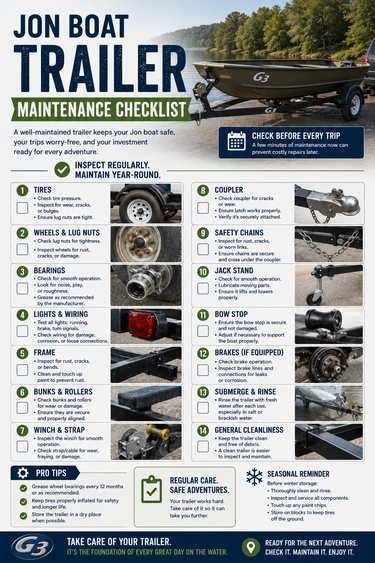
Jon Boat Trailer Maintenance Checklist
Use this checklist before towing, throughout the season, and before storage.
Tires and Wheels
Check cold tire pressure. Inspect tread and sidewalls. Confirm lug nut torque. Check the spare. Look for uneven wear. Replace damaged or aged tires.
Bearings and Hubs
Inspect for grease leaks. Check hub temperature after towing. Listen for grinding. Check for wheel play. Service or repack bearings as required.
Lights and Wiring
Test running lights, brake lights, and turn signals. Inspect the plug. Clean connections. Secure loose wiring. Replace cracked or dim lights.
Coupler and Hitch
Confirm correct hitch ball size. Lock the coupler. Use a safety pin. Lubricate moving parts. Inspect for wear or rust.
Safety Chains
Cross chains under the tongue. Check hooks and links. Make sure chains do not drag. Replace damaged chains.
Winch and Straps
Inspect winch strap, bow hook, pawl, handle, and mounting bolts. Secure the bow. Use transom straps. Replace worn straps.
Bunks and Rollers
Check carpet, boards, brackets, rollers, fasteners, and alignment. Make sure no metal hardware is touching the hull.
Frame and Suspension
Inspect the frame, axle, springs, hangers, U-bolts, and welds. Look for rust, cracks, bends, or loose hardware.
Brakes if Equipped
Check brake function, brake fluid if applicable, breakaway system, lines, pads or shoes, and corrosion.
Jack and Storage
Inspect the tongue jack, wheel, handle, swivel, and mounting bracket. Store the trailer level or positioned for drainage.
Common Jon Boat Trailer Problems
The most common trailer problems are usually preventable.
Flat tires often come from age, low pressure, road damage, or neglect. Bearing failures often come from water intrusion, lack of grease, or worn seals. Light failures often come from corrosion, poor grounds, or damaged wiring. Bunk damage often comes from worn carpet or loose brackets.
The easiest way to avoid these issues is to inspect the trailer before the season, before each trip, and after rough launches.
MotoMember Expert Tip
Many jon boat owners upgrade the boat first and forget the trailer.
Before adding a larger trolling motor, extra batteries, flooring, storage boxes, duck hunting gear, electronics, anchors, or fuel capacity, think about total weight and how the trailer supports the hull. A trailer that worked well for a bare utility jon boat may need attention once the boat is loaded with accessories.
Our team can help you compare jon boat packages, G3 models, trailer fit, Yamaha outboard setups, accessory weight, service needs, and trade-in options before you build out your next fishing or hunting setup.
Call to Action
Your jon boat headquarters starts at MotoMember.
For boaters across Virginia, Pennsylvania, Maryland, West Virginia, and nearby areas, MotoMember can help with jon boat shopping, G3 aluminum boats, Yamaha outboards, trailers, accessories, financing, trade-ins, and ownership support.
Visit MotoMember, explore financing options, or contact the team to compare current boat and trailer options.
Large selection. Straightforward shopping. Real powersports and marine expertise.
Conclusion
A jon boat trailer maintenance checklist helps you protect your boat, your tow vehicle, your passengers, and your time on the water.
Check tires, bearings, lights, wiring, safety chains, coupler, winch, straps, bunks, rollers, brakes, frame, suspension, and storage setup. Rinse the trailer after use. Inspect it before every trip. Service it before small problems become roadside problems.
A well-maintained trailer makes boating easier. It helps every launch start smoother, every retrieval feel more controlled, and every trip home feel more confident.
FAQ
How often should I check my jon boat trailer tires?
Check trailer tire pressure before every trip when the tires are cold. Also inspect tread, sidewalls, spare tire condition, and lug nuts before towing.
How do I know if my trailer bearings are bad?
Warning signs include grinding noise, wheel play, grease leakage, hot hubs, vibration, or uneven towing. If you are unsure, schedule bearing inspection before towing long distances.
Should I rinse my jon boat trailer after every launch?
Yes, rinsing is a good habit, especially after saltwater, brackish water, muddy ramps, or winter road salt. Focus on the wheels, hubs, brakes, frame, bunks, and hardware.
Can worn trailer bunks damage an aluminum jon boat?
Yes. Torn carpet, exposed staples, loose brackets, or rotted boards can scrape or stress the hull. Inspect bunks regularly and repair damaged support points before towing.
Can MotoMember help with jon boat trailer questions?
Yes. MotoMember can help customers compare jon boat packages, trailers, G3 models, Yamaha outboards, accessories, financing, trade-ins, and service needs across VA, PA, MD, and nearby areas.