
How to Clean and Care for a G3 Gator Tough Jon Boat

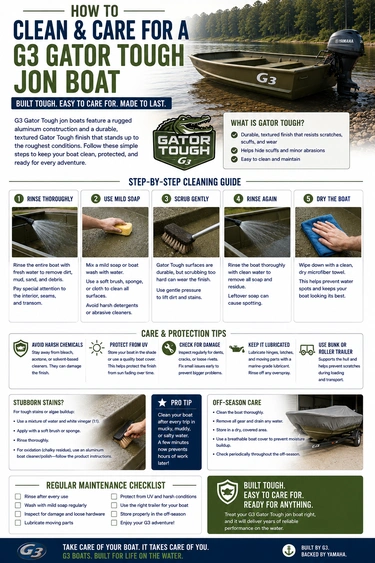
How to Clean and Care for a G3 Gator Tough Jon Boat
A G3 Gator Tough jon boat is built for real work on the water. Anglers use them for lakes, rivers, and backwaters. Hunters use them for duck season, shallow runs, and gear-heavy mornings. Landowners use them for ponds, docks, property work, and utility tasks. Weekend boaters like them because they are practical, durable, and straightforward.
But even a tough aluminum jon boat needs the right cleaning and care.
Mud, weeds, fish residue, spilled fuel, brackish water, stump fields, gravel ramps, wet carpet, batteries, outboard use, and trailer dunking can all affect long-term ownership. A consistent care routine helps protect the aluminum hull, Yamaha outboard, trailer, batteries, wiring, flooring, paint or camo finish, and resale value.
For boaters across Virginia, Pennsylvania, Maryland, West Virginia, and nearby areas, seasonal use adds another layer. Spring pollen, summer heat, muddy river launches, fall hunting gear, road salt, freezing weather, and off-season storage can all leave their mark.
MotoMember helps customers compare G3 jon boats, Yamaha outboards, trailers, accessories, financing, trade-ins, and service support. Current availability can vary, so check MotoMember or contact the team before choosing a boat, motor, trailer, or accessory setup.
Why G3 Gator Tough Jon Boat Care Matters
G3 describes its Gator Tough jon boats as durable, dependable aluminum boats for hunting, fishing, and other uses. G3’s official Gator Tough Jon Series page also notes that package jon models are offered as boat, motor, and trailer packages in center-console or side-console options, with duck boat options in several sizes.
That package approach matters because care is not only about the hull. A G3 Gator Tough jon boat may include the boat, Yamaha outboard, trailer, wiring, batteries, lighting, flooring, livewell, trolling motor, electronics, and storage components.
G3’s owner resources remind owners that their boat is supplied with component manufacturer information, including instructions, warranties, and other important materials, and that those materials should be read carefully.
That is the best starting point. Your exact cleaning and care routine should match your specific G3 model, finish, outboard, trailer, accessories, and use case.
Rinse the Boat After Every Trip
The simplest habit is also one of the most important: rinse your G3 Gator Tough jon boat after each use.
Use fresh water to rinse the hull, interior floor, transom area, trailer bunks, wheels, axle, winch, outboard exterior, and any areas exposed to mud, weeds, fish slime, brackish water, saltwater, or road grime.
Discover Boating explains that aluminum boat maintenance is usually less demanding than older wooden boat maintenance, but routine care still matters for the hull, motor, trailer, and seasonal readiness.
Pay Attention to Mud and Plant Debris
Mud and weeds hold moisture. That moisture can sit against seams, rivets if applicable, welds, hardware, carpet, flooring, and trailer bunks.
After each trip, remove:
Fishing line
Leaves
Grass and weeds
Bait containers
Fish residue
Shells or gravel
Mud from the floor
Wet decoy line
Trash and food wrappers
A clean boat dries faster, smells better, and is easier to inspect.
Use Mild, Aluminum-Safe Cleaning Products
A G3 Gator Tough jon boat may have bare aluminum, painted aluminum, camo finishes, decals, vinyl, carpet, non-skid surfaces, or accessory-mounted areas. Do not treat every surface the same.
Use mild soap, fresh water, soft brushes, sponges, and microfiber towels. Avoid harsh acids, abrasive pads, aggressive solvents, and household cleaners unless the product is specifically approved for aluminum boats and the surface you are cleaning.
If you are unsure, test a small hidden area or ask MotoMember before applying a product to a painted or camo finish.
What to Avoid
Do not use steel wool on aluminum. Do not use abrasive grinding pads for routine cleaning. Do not pressure wash close to decals, wiring, carpet edges, livewell fittings, or seals. Do not spray high pressure directly into electrical connectors, switches, or outboard openings.
A strong cleaner may save a few minutes today and create finish damage later.
Clean the Interior Floor and Compartments
The inside of a jon boat takes abuse. Boots, hooks, fish, dogs, decoys, coolers, anchors, fuel tanks, batteries, and muddy gear all end up on the floor.
Start by removing loose gear. Sweep or vacuum debris if needed. Rinse with fresh water. Use mild soap and a soft brush for stubborn dirt. Let the boat drain and dry fully.
Open Storage Areas
Open storage lids, seat boxes, livewells, battery compartments, and gear compartments after cleaning. Airflow helps prevent mildew, odor, and corrosion.
Do not store wet life jackets, gloves, decoys, tackle bags, or hunting gear in closed compartments. Soft gear should be dried separately.
Drain the Boat Correctly
After cleaning or boating, remove the bilge drain plug and let the boat drain completely.
G3’s fish boat owner’s manual states that once the boat is removed from the water, the bilge drain plug should be removed immediately. The manual also advises storing the drain plug in a plastic bag and taping it to the throttle control so it can be found later.
For long-term storage, the same manual advises positioning the boat so rain or snow can drain, using a cover to prevent debris buildup, allowing ventilation under the cover, and never covering or plugging the bilge drain hole.
Keep a Spare Drain Plug
A missing drain plug can ruin a launch day. Keep a spare plug in the boat, tow vehicle, or dry box.
Inspect the plug for cracking, hard rubber, damaged threads, corrosion, or poor fit. Replace it before it becomes a problem.
Inspect the Aluminum Hull Regularly
Cleaning is the best time to inspect the hull.
Look for dents, deep scratches, worn paint, corrosion around hardware, cracked welds, loose rivets if applicable, trailer bunk marks, transom movement, damaged drain fittings, and signs of water intrusion.
A Gator Tough jon boat may be used in shallow areas where rocks, stumps, logs, gravel, and ramps can cause damage. Small scrapes are common. Deeper gouges near seams, welds, rivets, or the transom should be taken seriously.
Check High-Wear Areas
Pay special attention to:
Bow contact area
Keel or centerline
Bottom near trailer bunks
Transom corners
Drain plug area
Trolling motor mount area
Battery tray area
Hardware and fasteners
Livewell fittings
Console or seat base mounts
If you notice new water inside the boat after each trip, identify the source before continuing normal use.
Prevent Corrosion
Aluminum does not rust like steel, but it can corrode. Corrosion often appears as white powdery oxidation, pitting, bubbling under paint, or staining around fasteners and hardware.
Corrosion risk increases when moisture is trapped against aluminum or when dissimilar metals contact the hull in wet conditions.
Reduce Corrosion Risk
Rinse after each use. Dry the boat thoroughly. Open compartments. Remove wet gear. Keep batteries clean and secured. Inspect hardware. Use marine-grade fasteners and isolation materials when adding accessories.
Be careful when installing rod holders, trolling motor brackets, lights, storage boxes, anchor systems, or blind hardware. Drilling into aluminum should be planned, sealed, and done with the correct hardware.
Care for Painted or Camo Finishes
Many G3 jon boats are used by anglers and hunters, so finish care matters. Paint and camo coatings help with appearance and protection, but they can be scratched by anchors, boots, gravel, decoys, dogs, and trailer bunks.
Wash gently. Avoid harsh cleaners. Do not use abrasive pads unless the finish manufacturer recommends them. Touch-up needs should be handled with compatible products and proper prep.
If you beach your boat frequently, use shallow ramps, or run rocky water, inspect the bow and bottom often. Repeated abrasion can wear through coatings over time.
Clean and Maintain the Yamaha Outboard
Many G3 packages are paired with Yamaha outboards. Always follow the owner’s manual for your exact motor.
Yamaha’s Maintenance Matters guidance notes that some maintenance, such as engine flushing, is done continually, while other tasks, such as oil changes, are interval-based. Yamaha also advises owners to refer to their owner’s manual or consult an authorized Yamaha Marine dealer for specific requirements.
Flush the Outboard When Needed
Yamaha explains that flushing an outboard’s cooling system with clean fresh water helps prevent corrosion and removes debris that could damage the engine.
Flushing is especially important after saltwater, brackish water, muddy water, or sandy conditions. Use the correct flushing method for your motor. Do not assume every outboard flushes the same way.
Inspect the Propeller
After shallow-water use, inspect the propeller and lower unit.
Look for bent blades, chips, fishing line around the prop shaft, damaged skeg, gear oil leaks, vibration, or missing hardware. Rocks, stumps, sandbars, and ramps can damage the prop even when the hull looks fine.
If the motor vibrates after a strike, stop using it hard and have it inspected.
Take Care of Fuel
Fuel problems are a common reason boats run poorly after sitting.
Use fresh fuel and follow Yamaha guidance for fuel treatment, storage, and maintenance. For extended storage, Yamaha recommends running the proper storage amount of Yamalube Fuel Stabilizer & Conditioner PLUS through the fuel system before shutdown, storing with the tank 7/8 full to help prevent excess condensation, and never plugging or capping the fuel tank vent.
If your G3 jon boat uses a portable fuel tank, inspect the tank, cap, vent, primer bulb, fuel line, fittings, and connectors. Replace cracked, stiff, leaking, or questionable components.
Maintain Batteries and Electrical Systems
Fishing and hunting jon boats often carry more electrical equipment than owners realize. Trolling motors, fish finders, bilge pumps, navigation lights, interior lights, chargers, and accessories all depend on clean, secure wiring.
Battery Care Checklist
Secure batteries in trays or boxes. Clean terminals. Use terminal covers. Charge batteries fully after use. Store batteries according to manufacturer guidance. Inspect wiring for chafing, corrosion, loose connectors, and cracked insulation.
A loose battery can damage wiring, shift weight, or create a short. Do not let metal tools, anchors, decoy weights, or loose hardware contact battery terminals.
Trolling Motor Care
Rinse the trolling motor exterior after use. Check the prop for weeds or fishing line. Inspect the shaft, mount, plug, receptacle, breaker, and wiring.
If the trolling motor hits rocks or stumps, inspect it before the next trip.
Clean Livewells and Plumbing
If your G3 Gator Tough jon boat has a livewell, clean it after use. Fish residue, scales, bait, and standing water can create odor and clog pumps or drains.
Rinse the livewell with fresh water. Use mild, boat-safe cleaners only. Check screens, drains, hoses, fittings, and pump function.
Before freezing weather, drain all water from livewell systems and plumbing. Trapped water can freeze and damage pumps, hoses, and fittings.
Care for Seats, Flooring, and Accessories
Seats, flooring, mats, rod holders, storage boxes, consoles, and hunting accessories all need basic attention.
Wipe down seats after use. Remove mud and fish residue. Dry cushions before storage. Check seat bases and pedestal mounts for looseness. Clean flooring gently and allow it to dry.
If your boat has carpeted surfaces, do not store it wet. Wet carpet holds moisture against the boat and can lead to mildew, odor, and corrosion around hardware.
Maintain the Trailer
The trailer is part of your G3 boat package, not an afterthought.
Discover Boating recommends checking trailer tire pressure, carrying a spare tire, inspecting tires for wear and age, using wheel bearing protectors where appropriate, keeping trailer brakes clean, lubricating the coupler, and checking trailer lights every time you hook up.
Rinse the Trailer
Rinse the trailer after every launch, especially after saltwater, brackish water, muddy ramps, or winter road salt. Focus on the axle, hubs, wheels, bunks, brackets, winch, coupler, safety chains, lights, and wiring plug.
Inspect Bunks and Support
Trailer bunks should support the hull correctly. Worn carpet, exposed staples, loose brackets, or rotted boards can damage aluminum.
G3’s manual advises making sure trailer supports are adjusted to properly support the hull when the boat is stored on a trailer.
Store Your G3 Gator Tough Jon Boat Properly
Storage is where many small problems become big ones.
Before storage, clean the boat, drain it, dry it, open compartments, treat fuel, charge batteries, inspect the trailer, and cover the boat correctly.
G3’s manual specifically advises positioning the boat to allow rain or snow to drain, covering the boat to prevent debris collection, allowing ventilation for residual moisture and condensation, and never covering or plugging the bilge drain hole.
Outdoor Storage
Raise the bow slightly so water drains toward the transom. Remove the drain plug. Use a properly supported cover. Avoid allowing rain or snow to pool.
Check the boat after storms, heavy wind, snow, or falling leaves.
Indoor Storage
Indoor storage is ideal when available, but the boat still needs to be clean and dry. Do not seal damp compartments or store wet gear inside.
Seasonal Care Checklist
After Every Trip
Rinse the boat, outboard exterior, and trailer. Remove weeds, mud, trash, and fishing line. Drain the boat. Open compartments. Inspect the prop and drain plug. Charge batteries if needed.
Monthly During Boating Season
Inspect the hull, transom, wiring, batteries, trailer tires, trailer lights, wheel bearings, bunks, winch strap, and safety gear. Clean the interior more deeply if the boat sees heavy fishing or hunting use.
Before Long Trips
Check fuel, outboard condition, battery charge, propeller, trailer tire pressure, lug nuts, lights, spare tire, drain plug, life jackets, tools, and weather.
Before Off-Season Storage
Deep clean the boat. Drain every water-holding area. Treat fuel. Follow Yamaha storage guidance for the outboard. Charge and store batteries properly. Inspect trailer bearings, tires, and lights. Cover the boat with ventilation.
Common Cleaning and Care Mistakes
One common mistake is letting the boat sit dirty after a trip. Mud, weeds, fish residue, and wet gear are easier to clean the same day than weeks later.
Another mistake is covering the boat while it is wet. A cover protects from leaves and rain, but it can also trap moisture if the boat is not dry and ventilated.
Owners also sometimes forget the trailer. Trailer lights, tires, bearings, bunks, and winch straps are just as important as hull cleaning.
Do not use harsh cleaners without checking compatibility. Do not drill into the hull without planning. Do not ignore small leaks. Do not leave batteries discharged. Do not store fuel carelessly.
MotoMember Expert Tip
Before you buy cleaning products, accessories, or storage gear for your G3 Gator Tough jon boat, think about your actual use.
A duck hunting boat may need easier mud cleanup, decoy storage, battery planning, and cold-weather drainage. A fishing boat may need livewell care, electronics protection, trolling motor maintenance, and prop inspections. A utility boat may need tough trailer support, simple storage, and regular hull checks.
Our team can help you compare G3 jon boats, Yamaha outboards, trailers, batteries, covers, accessories, financing, trade-ins, and service needs so your care routine matches how you actually use the boat.
Call to Action
Your G3 Gator Tough jon boat headquarters starts at MotoMember.
For boaters across Virginia, Pennsylvania, Maryland, West Virginia, and nearby areas, MotoMember can help you compare G3 aluminum boats, Yamaha outboards, trailers, accessories, financing, trade-ins, and service support.
Visit MotoMember, explore financing options, or contact the team to compare current G3 boat options.
Large selection. Straightforward shopping. Real powersports and marine expertise.
Conclusion
Cleaning and caring for a G3 Gator Tough jon boat is not complicated, but consistency matters. Rinse it after use, clean with aluminum-safe products, drain it fully, inspect the hull, protect the finish, maintain the Yamaha outboard, care for batteries, clean livewells, service the trailer, and store the boat dry and ventilated.
A good care routine helps your jon boat stay ready for fishing, hunting, utility work, and weekend water time. It also helps you catch small issues before they turn into bigger repairs.
For G3 owners and shoppers in VA, PA, MD, WV, and nearby areas, MotoMember is here to help with boat comparisons, ownership questions, accessories, service planning, and long-term support.
FAQ
How often should I clean my G3 Gator Tough jon boat?
Rinse it after every trip and deep clean it as needed based on use. Muddy water, fishing trips, hunting gear, saltwater, brackish water, and long storage periods all call for more thorough cleaning.
What cleaner should I use on a G3 aluminum jon boat?
Use mild soap, fresh water, soft brushes, and aluminum-safe marine cleaning products. Avoid harsh acids, abrasive pads, steel wool, and aggressive solvents unless the product is approved for your specific surface.
Should I remove the drain plug after using my G3 jon boat?
Yes. G3’s owner manual advises removing the bilge drain plug immediately after the boat is removed from the water. Store the plug somewhere visible and keep a spare.
How do I care for a Yamaha outboard on a G3 jon boat?
Follow the Yamaha owner’s manual for your exact motor. Routine care may include flushing, fuel treatment, oil and lower-unit service, prop inspections, corrosion prevention, and seasonal storage steps.
Can MotoMember help with G3 jon boat care and accessories?
Yes. MotoMember can help customers compare G3 jon boats, Yamaha outboards, trailers, batteries, covers, accessories, financing, trade-ins, and service needs across VA, PA, MD, WV, and nearby areas.