
How to Choose the Right Jon Boat Trailer

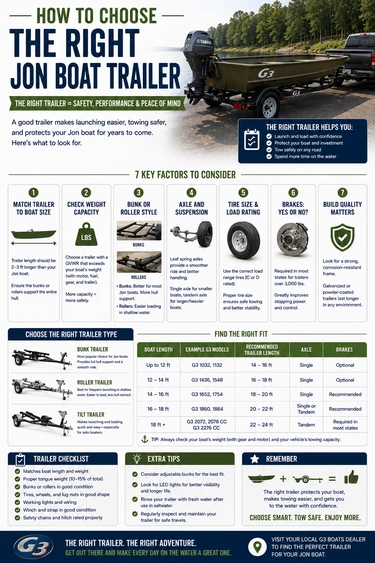
How to Choose the Right Trailer for a Jon Boat
Choosing the right trailer for a jon boat is just as important as choosing the boat itself. A jon boat trailer affects how safely you tow, how easily you launch, how well the hull is supported, how confidently you retrieve the boat, and how much maintenance you will deal with over time.
Many shoppers compare jon boats by length, horsepower, brand, seating layout, or price first. That makes sense. But the trailer is what gets the boat to the water, supports the hull in your driveway, handles potholes and highways, backs down muddy ramps, and keeps the boat stable on the ride home.
For boaters in Virginia, Pennsylvania, Maryland, West Virginia, and nearby areas, trailer choice matters because local boating conditions can vary widely. A small pond boat may only need a lightweight trailer for short local trips. A wider G3 jon boat used for river fishing, duck hunting, or longer lake trips may need a more capable trailer with stronger support, better tires, proper bunks, and more durable corrosion protection.
MotoMember helps customers compare jon boats, G3 aluminum boats, Yamaha outboards, trailers, marine accessories, financing, trade-ins, and service support. Current availability can vary, so check MotoMember or contact the team before choosing a complete boat, motor, and trailer package.
Why the Right Jon Boat Trailer Matters
A trailer is not just a metal frame with wheels. It is part of the complete boating system.
The right trailer supports the hull properly, matches the boat’s size and weight, connects safely to your tow vehicle, launches smoothly, retrieves straight, and protects the boat during storage. The wrong trailer can create hull damage, poor balance, unsafe towing, difficult ramp use, premature tire wear, lighting problems, and frustrating maintenance.
Discover Boating notes that proper trailering starts with confirming that the tow vehicle has the right towing capacity for the boat and trailer, and that the trailer hitch is rated for the weight of the boat and trailer.
That is especially important for jon boat buyers because many aluminum boats are modified after purchase. A boat that started as a simple utility hull may later gain a trolling motor, extra batteries, flooring, storage boxes, electronics, anchors, fuel, a duck blind, decoys, coolers, and more. The trailer needs to support the real loaded setup, not just the empty boat.
Start With Boat Length, Beam, and Weight
The first step is matching the trailer to the boat’s actual size.
A jon boat trailer should match the boat’s length, beam, hull shape, transom weight, and total loaded weight. Do not choose a trailer only because the boat “fits” between the fenders. Proper support matters more than a quick visual match.
Boat Length
Trailer length should allow the boat to sit correctly with the bow against the bow stop and the transom properly supported. If the trailer is too short, the stern may hang too far behind the bunks. If the trailer is too long, the boat may sit poorly or be harder to launch.
For most jon boats, the trailer should be designed for the boat length range, not forced to work because it is “close enough.”
Boat Beam
Beam is the width of the boat. Wider jon boats may need wider bunks, different fender clearance, and a trailer frame that supports the hull evenly.
A narrow trailer under a wide jon boat can make loading awkward and may support the boat poorly. A trailer that is too wide can be harder to center at the ramp.
Boat Weight
Weight is where many buyers underestimate the trailer requirement.
Start with the boat’s dry weight, then add the outboard, fuel, batteries, trolling motor, electronics, anchors, seats, coolers, tackle, hunting gear, safety gear, and any permanent accessories. Trailer capacity should comfortably exceed the actual loaded weight of the boat package.
Discover Boating explains that gross combined vehicle weight includes the boat, trailer, tow vehicle, passengers, and gear, and says weighing the full rig on a scale is the most accurate way to know the real number.
Understand Trailer Capacity Ratings
Every trailer has a capacity rating. This rating tells you how much load the trailer is designed to carry.
Do not confuse trailer capacity with total package weight. Some trailer ratings refer to how much boat weight the trailer can carry, while other labels may include gross vehicle weight rating, axle rating, or other manufacturer-specific figures. Always read the trailer label and owner’s manual.
A trailer that is overloaded can experience tire failure, bearing damage, frame stress, poor braking, unsafe sway, and accelerated wear. It may also be harder to launch and retrieve because the suspension, bunks, and tongue weight are not working as designed.
Do Not Cut Capacity Too Close
It is smart to leave margin. A jon boat gains weight quickly once you add accessories.
Common add-ons include:
Trolling motor
Deep-cycle batteries
Fish finder
Anchor and rope
Fuel tank
Livewell water
Cooler
Fishing tackle
Rod holders
Seats
Flooring
Duck blind
Decoys
Dog gear
Safety equipment
If you buy a trailer that barely matches the empty boat, you may outgrow it after one season of upgrades.
Match the Trailer to the Hull Shape
Jon boats have flat or modified-V hull designs, and trailer support should match the boat’s bottom.
The goal is to support the hull evenly without creating pressure points. Bunks or rollers should guide the boat, hold it securely, and avoid direct metal contact with the aluminum hull.
G3’s owner’s manual advises owners to make sure trailer supports are adjusted to properly support the boat’s hull when storing a boat on a trailer.
That same idea applies when choosing the trailer in the first place. Good support protects the boat during towing, storage, and retrieval.
Bunk Trailers vs. Roller Trailers
Most jon boat trailers use bunks, rollers, or a combination of both.
Bunk Trailers
Bunk trailers are common for jon boats because they provide long, stable support along the hull. Carpeted or covered bunks help the boat slide on and off while protecting the aluminum.
Bunk trailers are often simple, durable, and cost-effective. They work well at many ramps, especially when the trailer can be backed deep enough for the boat to float on and off.
The main thing is fit. Bunks should be adjusted to support the hull correctly. Worn carpet, exposed staples, rotted boards, or loose brackets can damage aluminum over time.
Roller Trailers
Roller trailers can make launching and retrieval easier in shallow or low-angle ramps because the boat rolls rather than slides. They may be helpful where you cannot back the trailer very deep.
However, rollers must be positioned correctly. Poorly placed or stuck rollers can create pressure points or scuff the hull. Roller trailers may also require more adjustment and maintenance than simple bunk setups.
Which Is Better for a Jon Boat?
For many jon boat owners, a properly fitted bunk trailer is the most practical choice. It is simple, supportive, and easy to maintain. Roller trailers can make sense for certain ramp conditions, but they should be matched carefully to the hull.
Our team can help you compare trailer support style based on your boat size, ramp conditions, storage setup, and towing distance.
Galvanized vs. Painted Jon Boat Trailers
Trailer material and finish affect corrosion resistance, appearance, cost, and long-term maintenance.
Painted Steel Trailers
Painted steel trailers are common and may be cost-effective for freshwater use. They look clean when new and can work well when maintained properly.
The downside is that scratches, chips, and rust need attention. Painted trailers exposed to ramp water, mud, road salt, and brackish conditions can corrode faster if neglected.
Galvanized Trailers
Galvanized trailers are popular around water because the zinc coating helps resist corrosion. They can be a smart choice for boaters who launch frequently, store outdoors, or occasionally deal with brackish water.
Galvanized does not mean maintenance-free. You still need to rinse the trailer, inspect hardware, check bunks, maintain bearings, and watch for corrosion at cut edges, brackets, springs, and fasteners.
Aluminum Trailers
Some boat trailers use aluminum frames. Aluminum trailers can reduce corrosion concerns and weight, but they still require proper hardware, axle, bunk, lighting, bearing, and brake maintenance.
For many small jon boat buyers, painted or galvanized steel trailers are more common. The best option depends on budget, storage, water type, and how often the trailer is used.
Check the Axle, Suspension, and Tires
The axle, suspension, wheels, and tires carry the trailer load every time you tow.
Axle Rating
The axle should be rated for the loaded boat and trailer package. If the axle is undersized, the trailer may ride poorly, wear tires unevenly, or become unsafe under load.
Leaf Springs and Hardware
Inspect springs, hangers, shackles, U-bolts, and mounting points. These parts handle road shock and trailer weight. Look for rust, cracks, bent brackets, worn bushings, and loose hardware.
Tires
Trailer tires are different from passenger vehicle tires. They should be properly rated, properly inflated, and inspected regularly.
Trailer Safety Week emphasizes that safe towing depends on properly inflated and rated tires, adequate brakes, crossed safety chains, and working lights.
Choose a trailer with tires appropriate for the package weight and expected towing distance. For frequent highway use, long trips, or heavier jon boat setups, tire quality matters.
Think About Tongue Weight and Balance
A trailer that is not balanced correctly can sway, bounce, or tow poorly.
Discover Boating recommends distributing trailer load evenly from front to rear and side to side, with 55 to 60 percent of the weight in the front half, and warns that too much rear weight can contribute to fishtailing.
For jon boats, balance is affected by the outboard, fuel tank, batteries, storage, console position, and gear. Many jon boats are naturally stern-heavy because the motor, fuel, operator, and battery may all sit near the back.
A properly matched trailer helps place the boat so tongue weight is appropriate. If the boat sits too far forward or too far back, towing can become unsafe or uncomfortable.
Make Sure the Trailer Fits Your Tow Vehicle
Before choosing a trailer, confirm your tow vehicle can handle the loaded boat and trailer package.
Check:
Tow vehicle towing capacity
Gross combined weight rating
Hitch receiver rating
Hitch ball size
Tongue weight limit
Brake requirements
Wiring connector compatibility
Vehicle payload with passengers and gear
Discover Boating recommends checking the vehicle owner’s manual for gross combined weight rating and confirming that the trailer hitch is rated for the boat and trailer weight.
This matters even with smaller jon boats. A basic aluminum boat may be light, but a larger fishing or hunting rig with outboard, fuel, batteries, trailer, and gear can weigh more than expected.
Choose the Right Trailer Width and Fender Clearance
A trailer should be easy to load at the ramp. Width affects how the boat centers, how much clearance you have, and how easy it is to see the trailer while backing.
A trailer that is too narrow may not support a wide jon boat properly. A trailer that is too wide may be harder to align at shallow ramps or narrow driveways.
Check fender clearance too. The boat should not rub the fenders while loading, unloading, or towing. Wider jon boats and modified layouts may need more careful fitting.
Consider Ramp Conditions
Where you launch should influence trailer choice.
Steep Concrete Ramps
Steep ramps often work well with bunk trailers because the boat floats on and off more easily.
Shallow Ramps
Shallow ramps may require a trailer that allows easier launching without backing the tow vehicle too far into the water. Roller support, longer bunks, or a well-positioned winch stand may help.
Muddy or Gravel Ramps
For rougher ramps, pay attention to trailer clearance, tire size, frame strength, winch performance, and how easily the boat centers during retrieval.
River Ramps
River current can make retrieval harder. Guide-ons, properly adjusted bunks, and strong winch hardware can make a big difference.
For boaters in VA, PA, MD, and surrounding areas, ramp conditions can change seasonally. Low-water late summer ramps may feel very different from spring ramps after heavy rain.
Should You Add Trailer Guide-Ons?
Trailer guide-ons can be useful, especially for jon boats used in current, wind, shallow ramps, or low-light conditions.
Guide-ons help center the boat during retrieval. They can also make it easier to see the trailer when backing an empty trailer into the water.
There are several styles, including vertical post guides and bunk-style guides. The right choice depends on hull shape, trailer design, and ramp conditions.
Guide-ons are especially helpful for solo boaters. If you often launch or retrieve alone, they may be worth adding.
Winch, Bow Stop, and Tie-Down Setup
The trailer should secure the boat properly at the bow and stern.
Winch
The winch should be rated for the boat and mounted securely. It should crank smoothly and lock properly. The strap or cable should be in good condition.
A weak winch strap is an easy problem to fix before it becomes a launch-ramp or towing issue.
Bow Stop
The bow stop helps position the boat correctly on the trailer. It should line up with the bow eye and keep the boat from moving forward during towing.
If the bow stop is too high, too low, too far forward, or too far back, the boat may not sit correctly.
Tie-Downs
The bow winch is not enough by itself. Use transom straps or stern tie-downs to secure the rear of the boat. Discover Boating recommends using rope, chain, or a turnbuckle in addition to the winch to secure the bow, and notes that additional straps may be required depending on the boat.
Trailer Lights and Wiring
Trailer lights are not optional. They are part of safe towing.
Look for a trailer with marine-appropriate wiring and lights. The plug should match your tow vehicle or be easily adapted. Wires should be secured, protected from chafing, and routed away from sharp edges or pinch points.
Discover Boating recommends checking trailer lights every time you hook up the trailer.
For boat trailers, corrosion is common because the trailer is submerged repeatedly. Sealed LED lights and good wiring practices can reduce frustration, but no system is completely maintenance-free.
Do You Need Trailer Brakes?
Some small jon boat trailers may not have brakes. Larger or heavier packages may require brakes depending on trailer weight, state rules, and tow vehicle requirements.
Do not guess. Check the trailer rating, loaded weight, tow vehicle manual, and the rules for the states where you tow.
Trailer Safety Week highlights the importance of adequate brakes as part of safe towing.
If your trailer has brakes, they need regular inspection. Boat trailer brakes are exposed to water, mud, road grime, and corrosion.
Storage Space at Home
Before choosing a trailer, think about where the boat will live.
Measure your garage, driveway, storage shed, yard area, or rented storage space. Include the full length from the trailer tongue to the rear of the boat, plus outboard clearance. Also consider trailer width, fender width, guide-ons, and tongue jack position.
A trailer with a swing-away tongue can help in tight garages, but not every trailer has one. Ask before you buy if storage length is a concern.
Outdoor Storage
If storing outdoors, consider corrosion resistance, tire protection, drainage, and cover support. Park on stable ground and position the boat so water drains out.
Indoor Storage
Indoor storage is ideal, but make sure the trailer fits through doors and around tight turns. Check height if the boat has a console, windshield, blind frame, seat pedestal, or raised accessories.
New vs. Used Jon Boat Trailers
A new trailer gives you a clean starting point, known fit, current components, and fewer unknowns.
A used trailer may save money, but it needs careful inspection. Look beyond paint and price.
Used Trailer Inspection Checklist
Before buying a used jon boat trailer, check:
Frame rust or cracks
Axle condition
Spring and hanger wear
Tire age and pressure
Wheel bearings
Hub seals
Trailer lights
Wiring condition
Coupler and latch
Safety chains
Winch and strap
Bunks or rollers
Fender clearance
Title or registration requirements
Boat fit and transom support
A cheap used trailer can become expensive quickly if it needs tires, bearings, lights, bunks, hardware, and paperwork.
Choosing a Trailer for a G3 Jon Boat
If you are shopping for a G3 jon boat, it often makes sense to compare complete boat, motor, and trailer packages rather than trying to piece everything together yourself.
G3 jon boats vary by length, width, layout, and use case. A compact utility jon does not need the same trailer as a wider fishing or hunting model. Package trailers are generally selected to match the intended boat setup, but buyers should still inspect fit, capacity, bunks, tires, and storage dimensions.
G3’s owner resources note that owners should read component manufacturer information carefully, including instructions, warranties, and other important materials.
That is good advice for trailers too. The boat, outboard, trailer, tires, winch, lights, and brakes each may have their own maintenance requirements.
Jon Boat Trailer Buying Checklist
Use this checklist when comparing trailers:
Boat length range
Boat beam compatibility
Total loaded boat weight
Trailer capacity rating
Axle rating
Tire rating and size
Spare tire
Bunk or roller support
Transom support
Frame material or finish
Corrosion protection
Winch rating
Bow stop position
Safety chains
Tie-down points
Trailer lights
Wiring connector
Brake system if required
Guide-ons if needed
Tongue jack
Coupler size
Tow vehicle compatibility
Storage length and width
Registration or title requirements
Dealer support
Common Trailer Buying Mistakes
One of the biggest mistakes is choosing a trailer that is too small because it looks like the boat fits. The trailer needs to support the hull correctly, carry the loaded weight, and tow safely.
Another mistake is ignoring accessory weight. Batteries, fuel, electronics, flooring, storage, anchors, decoys, and hunting gear can push a trailer closer to its limit than expected.
Some buyers also overlook ramp conditions. A trailer that works fine at a steep concrete ramp may be frustrating at a shallow gravel ramp.
Do not assume all trailers are equal. Tire quality, bunk setup, frame finish, wiring, winch hardware, and axle rating all affect ownership.
MotoMember Expert Tip
Before choosing a jon boat trailer, picture the boat fully loaded on your busiest day.
For an angler, that may include two people, a trolling motor, battery, fish finder, tackle, cooler, anchor, and livewell water. For a duck hunter, it may include decoys, blind material, a dog, cold-weather gear, firearms, fuel, and safety equipment. For a utility owner, it may include tools, supplies, and frequent short-distance launching.
Our team can help you compare the trailer to the actual job, not just the boat length. That can make towing, launching, storage, and long-term ownership easier.
Call to Action
Your jon boat trailer headquarters starts at MotoMember.
For boaters across Virginia, Pennsylvania, Maryland, West Virginia, and nearby areas, MotoMember can help you compare jon boats, G3 aluminum boats, Yamaha outboards, trailers, accessories, financing, trade-ins, and service needs.
Visit MotoMember, explore financing options, or contact the team to compare current boat, motor, and trailer options.
Large selection. Straightforward shopping. Real powersports and marine expertise.
Conclusion
Choosing the right trailer for a jon boat comes down to fit, capacity, support, towing safety, launch conditions, and long-term maintenance.
Start with the boat’s length, beam, loaded weight, and hull shape. Make sure the trailer capacity leaves room for real-world gear. Compare bunk and roller support. Confirm your tow vehicle rating. Think about ramp conditions, storage space, corrosion resistance, tires, lights, winch setup, and dealer support.
A well-matched trailer makes every boating trip easier. It protects the hull, reduces launch-ramp stress, improves towing confidence, and helps your jon boat stay ready for fishing, hunting, utility work, and weekend water time.
FAQ
What size trailer do I need for a jon boat?
Choose a trailer designed for your jon boat’s length, beam, hull shape, and loaded weight. The boat should sit correctly with proper transom support, bow stop alignment, and balanced tongue weight.
Are bunk trailers or roller trailers better for jon boats?
Most jon boat owners do well with a properly fitted bunk trailer because it offers simple, stable hull support. Roller trailers can help at shallow ramps, but they must be adjusted correctly to avoid pressure points.
How much trailer capacity do I need?
Trailer capacity should exceed the real loaded weight of your boat package, including outboard, fuel, batteries, trolling motor, electronics, gear, and accessories. Do not size the trailer based only on the empty hull.
Can I use a used trailer for a jon boat?
Yes, but inspect it carefully. Check the frame, axle, tires, bearings, bunks, lights, wiring, coupler, safety chains, winch, fit, and paperwork before buying.
Can MotoMember help me choose a jon boat trailer?
Yes. MotoMember can help customers compare jon boats, G3 models, Yamaha outboards, trailers, accessories, financing, trade-ins, and service support across VA, PA, MD, WV, and nearby areas.