
New vs Used Fishing Boats: Which Should You Buy?

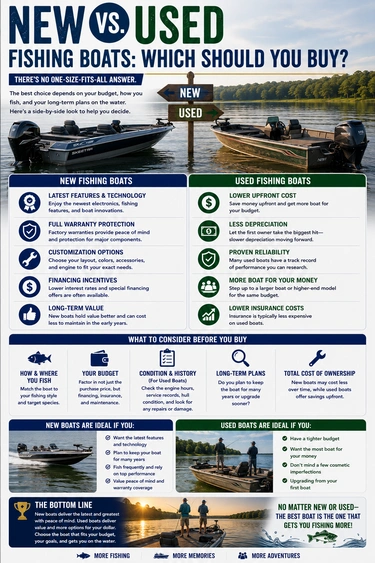
New vs Used Fishing Boats: Which Should You Buy?
Choosing between new vs used fishing boats is one of the biggest decisions a buyer can make. A new boat can offer clean ownership history, current model-year features, dealer guidance, and a fresh start. A used boat can help manage upfront cost and may already include valuable accessories like electronics, rod holders, covers, batteries, or trolling motors.
So, which should you buy?
The right answer depends on your fishing style, budget, comfort level, mechanical confidence, tow vehicle, storage plan, passengers, and how much support you want after the sale. A first-time buyer may value the confidence of a new boat and dealership guidance. A hands-on angler may find strong value in a carefully inspected used boat. A family may care more about layout and comfort than model year alone.
For shoppers in Virginia, Pennsylvania, Maryland, West Virginia, and nearby areas, MotoMember can help compare new and used fishing boats, aluminum boats, SunCatcher pontoons, Yamaha-powered packages, trailers, outboards, accessories, financing, trade-ins, and service support. MotoMember lists new powersports and marine inventory through its Purcellville, Manassas, and Chambersburg dealership network.
Quick Answer: New or Used Fishing Boat?
Buy a new fishing boat if you want a clean ownership history, current model choices, dealer support, easier package comparison, and the ability to plan accessories from the start.
Buy a used fishing boat if you want to manage upfront cost, find a package that may already include accessories, and are comfortable checking condition, service history, motor health, trailer condition, and paperwork.
Here is the simple comparison:
| Buyer Priority | Better Fit |
|---|---|
| Clean ownership history | New fishing boat |
| Lower upfront cost | Used fishing boat |
| Latest layout and features | New fishing boat |
| Existing accessories included | Used fishing boat |
| First-time buyer confidence | Often new |
| Hands-on buyer value | Often used |
| Easier condition evaluation | New |
| More inspection required | Used |
| Dealer package planning | New |
| Budget flexibility | Used |
Neither choice is automatically better. The smarter purchase is the boat that fits your water, your fishing style, your budget, and your long-term ownership plan.
Why Buy a New Fishing Boat?
A new fishing boat gives you a fresh starting point. You are not trying to decode how the previous owner maintained the motor, stored the boat, wired accessories, loaded the trailer, or treated the hull.
That matters for first-time buyers. When you are still learning boat ownership, it can be helpful to start with a boat, motor, trailer, and accessory plan that a dealership team can walk through with you.
MotoMember’s new inventory page includes marine vehicles along with other powersports categories, allowing shoppers to browse current units and compare options across locations. Current availability, model year, equipment, price, and incoming units can change, so live inventory and direct dealership contact are the best next steps before choosing a specific boat.
New Boat Advantages
A new fishing boat may make sense if you want a boat with no prior owner use. You can compare current layouts, seating, storage, livewell placement, electronics readiness, trolling motor compatibility, and trailer fit before anyone else has modified the setup.
New boats also make package planning easier. You can ask how the boat, motor, trailer, batteries, charger, electronics, safety gear, and accessories fit together before you buy.
For anglers comparing G3 aluminum fishing boats or SunCatcher pontoons, manufacturer resources can also help shoppers understand current model categories. G3’s official lineup includes aluminum boats for fishing, hunting, cruising, and family days on the water, while SunCatcher describes its pontoon lineup around cruising, fishing, entertaining, family comfort, Yamaha power, and multiple layouts.
New Boat Tradeoffs
The biggest tradeoff is cost. A new boat often costs more upfront than a comparable used boat.
New buyers should also budget beyond the boat itself. You may still need safety gear, registration, insurance, electronics, rod holders, trolling motor upgrades, covers, dock lines, anchors, batteries, chargers, trailer accessories, and seasonal service.
A new boat can be a great choice, but it still needs to fit your total ownership budget.
Why Buy a Used Fishing Boat?
A used fishing boat can be a smart purchase when the condition is right. Many used boats already include accessories that would cost extra if purchased separately. A used aluminum fishing boat may come with a trolling motor, fishfinder, batteries, rod holders, trailer guides, cover, or upgraded seating.
MotoMember’s used inventory page supports shoppers browsing pre-owned powersports and marine options, with financing resources also referenced for used vehicles. Availability changes as units are listed, sold, or traded, so used buyers should verify current condition, equipment, pricing, and location directly with the team.
Used Boat Advantages
The biggest used boat advantage is value. You may be able to step into a larger boat, better motor package, or more accessory-rich setup than your budget would allow in a new model.
Used boats can also be helpful for experienced anglers who already know what they want. If you understand hull condition, outboard maintenance, trailer inspection, battery health, electronics, and title paperwork, you may feel comfortable evaluating a pre-owned unit.
Used can also be attractive if you are buying your first boat and want to learn without starting at the highest price point.
Used Boat Tradeoffs
A used boat requires more inspection. You are not just buying a boat; you are buying its history.
You need to evaluate the hull, transom, motor, trailer, tires, wiring, batteries, electronics, steering, flooring, seats, livewell, bilge, title paperwork, and service records. BoatUS recommends a careful used-boat evaluation that includes checking cleanliness, corrosion, cracks, previous repairs, peeling paint or varnish, and other condition signs.
A used boat with a low price can still become expensive if it needs motor work, trailer repairs, battery replacement, electronics upgrades, flooring repair, seat replacement, or missing safety gear.
New vs Used Cost: Look Beyond the Price Tag
Price is important, but it is not the whole story.
A new fishing boat may cost more upfront but could require fewer immediate repairs or replacements. A used fishing boat may cost less upfront but may need service, batteries, trailer tires, wiring fixes, accessory replacement, or updated safety gear.
When comparing new and used, build a real total-cost estimate.
Costs to Include
Think about the boat, motor, trailer, taxes, registration, insurance, safety gear, fuel, oil, storage, cover, batteries, charger, trolling motor, electronics, rod holders, anchors, dock lines, maintenance, and seasonal prep.
Also consider your time. A used boat that needs constant sorting may not be the best value if it keeps you off the water during prime fishing weekends.
MotoMember’s service page lists maintenance and repair support, including routine maintenance, inspections, fluid and filter changes, battery service, accessory installation, pickup and delivery, detailing, and seasonal prep. That kind of support can matter whether you buy new or used.
Warranty and Ownership Confidence
Warranty coverage can be a major reason shoppers choose new. It can also be a reason to inspect used boats carefully, especially if a warranty transfer may or may not apply.
For example, G3’s official warranty page describes a five-year bow-to-stern boat limited warranty, limited lifetime external seams coverage, and bow-to-stern limited warranty transferability to a second owner within five years of original purchase, subject to warranty terms and eligibility. Buyers should always review the full warranty details and confirm coverage with the dealer or manufacturer before relying on any warranty claim.
A new boat may give you a clearer warranty path. A used boat may still have remaining coverage in some cases, but buyers should verify registration, transfer rules, service history, and eligibility.
Warranty is not the only factor, but it can affect peace of mind.
Financing New vs Used Fishing Boats
Financing can work differently depending on the boat, age, condition, lender, down payment, credit profile, term, location, and approval.
MotoMember offers financing resources and a prequalification path for powersports vehicles and boats across its dealership locations. Financing options and approvals vary, so shoppers should contact the team for current details rather than assuming a payment based only on a listed price.
Financing a New Boat
New boats may be easier to compare because the package is clearly defined. You can review the boat, motor, trailer, accessories, taxes, fees, down payment, estimated payment, and any current programs in one conversation.
New boat financing may appeal to buyers who want a complete, dealership-supported package from the beginning.
Financing a Used Boat
Used boat financing may still be available, but the age, condition, value, and lender requirements can matter. A used boat with strong condition, clear paperwork, and dealership support may be easier to evaluate than a private-party boat with missing information.
Before applying, gather trade-in details, identification, income information, and budget expectations. A realistic monthly payment should include ownership costs, not just the purchase price.
Trade-Ins Can Change the Decision
A trade-in can make either new or used more practical.
If you already own a motorcycle, ATV, side-by-side, personal watercraft, boat, or other powersports unit, ask MotoMember about trade-in possibilities. Trade value can help lower the amount financed or reduce the cash needed at purchase.
Trade-ins are especially helpful when you want to move from a starter fishing boat into a better-fitting setup. Maybe your jon boat worked well for solo river fishing, but now the family wants a fishing pontoon. Maybe your pontoon is comfortable, but you want a more fishing-focused aluminum boat.
The right trade-in conversation should include current condition, title status, payoff information if applicable, accessories, service history, and market demand.
Condition Checklist for Used Fishing Boats
Used boats deserve a careful inspection. Even when a boat looks clean, details matter.
Start with the hull. Look for cracks, dents, corrosion, previous repairs, soft spots, loose fittings, damaged flooring, or signs of neglect. Check the transom carefully because it supports the motor and takes stress during operation and trailering.
Then evaluate the motor. Ask about hours, maintenance records, winterization, fuel system condition, propeller condition, lower unit service, starting behavior, cooling water flow, and any warning lights or known issues.
Check the trailer. Tires, bearings, lights, bunks, rollers, winch, coupler, safety chains, tie-downs, jack, spare tire, and frame condition all matter. A great boat on a weak trailer can still create problems.
Finally, inspect batteries, wiring, electronics, livewell, bilge pump, seats, storage hatches, covers, steering, controls, and title paperwork.
A clean used boat with good records can be a strong buy. A neglected boat with vague answers should slow you down.
Accessories: New Planning vs Used Value
Accessories are one of the biggest differences between new and used fishing boats.
With a new boat, you can plan the accessory setup from scratch. That may include a trolling motor, fishfinder, GPS, battery charger, rod holders, anchor system, cover, storage organizers, trailer guides, and safety gear.
With a used boat, accessories may already be included. That can save money, but only if the accessories are in good condition and match how you fish.
Do not assume every included accessory adds value. Outdated electronics, weak batteries, poorly installed wiring, damaged rod holders, or worn covers may need replacement.
Ask which accessories are included, which are working, which are factory-installed, and which were added later.
Which Is Better for First-Time Buyers?
First-time buyers often benefit from buying new because the ownership path is clearer. You can ask the dealership to explain the boat, motor, trailer, break-in guidance, safety gear, storage, service schedule, and accessory options.
That said, a well-inspected used boat can also be a smart first purchase. The key is buying from a trusted source and avoiding boats with unclear history, questionable paperwork, or obvious repair needs.
For beginners, the best choice is usually the boat that creates the least confusion. If a used boat saves money but adds too much uncertainty, new may be worth the extra cost. If a used boat is clean, inspected, and properly matched to your needs, it may be the better value.
Which Is Better for Serious Anglers?
Serious anglers may go either way.
A new boat is appealing when you want a specific layout, current electronics compatibility, trolling motor setup, rod storage, livewell placement, and a clean rigging plan. You can build the boat around your technique from day one.
A used boat is appealing when you find a proven fishing setup with the accessories you already want. A pre-owned aluminum fishing boat with quality electronics, upgraded trolling motor, strong batteries, and a good trailer can be a smart find.
The decision comes down to condition, layout, and total cost. Serious anglers should not buy used only because it is cheaper, and they should not buy new only because it is newer. Buy the boat that helps you fish better.
Which Is Better for Families?
Families should focus on layout and comfort before model year.
A new fishing pontoon may make sense if you want current seating layouts, clean upholstery, fresh flooring, Yamaha power, and a dealership-supported package. SunCatcher describes its pontoon boats around cruising, fishing, entertaining, family comfort, Yamaha power, and layout variety.
A used fishing pontoon may be a strong value if the seats, deck, fencing, tubes, motor, trailer, flooring, and cover are in good condition. But family buyers should be careful. Upholstery, flooring, storage, shade, boarding gates, and safety gear access matter a lot when kids, grandparents, and guests are on board.
If the family will use the boat often, do not compromise too much on comfort just to save upfront cost.
Safety Gear Matters Either Way
Whether you buy new or used, safety gear must be part of the purchase plan.
BoatUS explains that recreational boats must carry Coast Guard-approved personal flotation devices in good, serviceable condition and appropriately sized for the intended user, with wearable PFDs readily accessible. Throwable devices must be immediately available when required.
The U.S. Coast Guard also advises boaters to make sure everyone on board wears a Coast Guard-approved PFD while on the water and to take a boating safety course.
Used boats may come with safety gear, but inspect it carefully. Life jackets should fit the people who will actually ride with you. Fire extinguishers, flares where required, lights, horn, anchor, dock lines, and throwable flotation should be checked before your first trip.
MotoMember Expert Tip
When shoppers ask whether they should buy new or used, our team usually starts with three questions:
How much uncertainty are you comfortable with?
How much work do you want to do after purchase?
How soon do you want the boat ready for your normal fishing day?
If you want a clean start, clear setup, and dealership guidance, new may be the better fit. If you are comfortable evaluating condition and want to stretch your budget, used may be the smarter move.
Bring your tow vehicle information, storage plan, normal passenger count, preferred fishing waters, budget range, trade-in details, and must-have accessories when you visit. MotoMember can help compare new and used boats side by side so you understand the full picture, not just the sticker price.
Call to Action
Your fishing boat headquarters starts at MotoMember.
Explore current MotoMember new and used marine inventory, compare aluminum fishing boats and fishing pontoons, ask about G3 boats, SunCatcher pontoons, Yamaha-powered packages, trailers, accessories, financing, trade-ins, and service support.
Current availability, condition, pricing, model year, equipment, warranty status, financing terms, and promotions can vary, so check live MotoMember inventory or contact the team before planning around a specific unit.
Large selection. Straightforward shopping. Real powersports and marine expertise.
Stop dreaming. Start riding—and fishing—with MotoMember.
Conclusion
So, new vs used fishing boats: which should you buy?
Choose new if you want a clean ownership history, current layouts, dealer guidance, package planning, and the confidence of starting fresh. Choose used if you want to manage upfront cost, find included accessories, and are comfortable checking condition, service history, motor health, trailer fit, and paperwork.
The best decision is not only about price. It is about value, confidence, fit, safety, and long-term support.
For anglers and families in VA, PA, MD, WV, and nearby areas, MotoMember can help compare both paths. Whether you are shopping for a new G3 aluminum fishing boat, a SunCatcher pontoon, a pre-owned fishing boat, a trailer, Yamaha power, financing, or service support, the MotoMember team can help you choose the option that fits your real life on the water.
FAQ
Is it better to buy a new or used fishing boat?
Buy new if you want a clean ownership history, current options, dealer guidance, and easier package planning. Buy used if you want to manage upfront cost and are comfortable inspecting condition, service history, motor health, trailer condition, and paperwork.
Are used fishing boats worth it?
Used fishing boats can be worth it when they are clean, properly maintained, fairly priced, and matched to your fishing style. They can also include valuable accessories. The key is careful inspection before purchase.
What should I check before buying a used fishing boat?
Check the hull, transom, motor, trailer, tires, wiring, batteries, electronics, livewell, flooring, seats, steering, controls, title paperwork, and service history. Ask whether accessories are included and whether they work properly.
Do new fishing boats come with better peace of mind?
New fishing boats often give buyers more confidence because there is no previous owner history. Warranty coverage, dealer support, and current model-year options can also help, but buyers should always review warranty terms and confirm details with the dealer.
Can MotoMember help compare new and used fishing boats?
Yes. MotoMember can help shoppers compare new and used fishing boats, G3 aluminum boats, SunCatcher pontoons, Yamaha-powered packages, trailers, accessories, financing, trade-ins, and service support across VA, PA, MD, WV, and nearby areas.