
How Much Does a New Pontoon Boat Cost?

How Much Does a New Pontoon Boat Cost? Pricing, Features, and Value Explained
Shopping for a new pontoon boat usually starts with excitement, then quickly turns into one big question: How much does a new pontoon boat cost?
The honest answer is that pontoon boat pricing depends on the model, size, layout, engine, trailer, features, freight, prep, taxes, fees, accessories, financing, and current availability. Two pontoons can look similar online but have very different prices once you compare seating, horsepower, electronics, flooring, storage, shade, fishing features, and premium upgrades.
For shoppers in Virginia, Pennsylvania, Maryland, West Virginia, and nearby areas, MotoMember helps buyers compare new pontoon boats, available SunCatcher models, financing options, accessories, trade-ins, and service support. MotoMember inventory pages include current SunCatcher pontoon listings, including examples like a 2026 SunCatcher Select 22SL listed in Chambersburg and a 2026 SunCatcher Fusion 324RC listed through MotoMember Select. Pricing and availability can change, so always confirm live details directly with MotoMember before making a decision.
Why Pontoon Boat Prices Vary So Much
Pontoon boats are not one-size-fits-all. A compact cruising pontoon, fishing pontoon, family lounge model, and premium tritoon-style setup can all fall into very different price ranges.
A new pontoon boat’s cost is usually shaped by several major factors:
Size and Length
Larger pontoons typically cost more because they use more materials, offer more seating, provide more deck space, and often include more features.
A smaller pontoon may be easier to tow, store, and manage. A larger model may be better for families, entertaining, bigger water, and full-day trips with guests.
Two-Tube Pontoon vs. Tritoon-Style Setup
A traditional pontoon has two tubes. A tritoon has three. A third tube can add capability, performance potential, and support for larger engines or heavier loads depending on the model.
That added structure and performance capability can affect price. If you mostly cruise calm water with a small crew, a two-tube pontoon may be enough. If you want more capability for bigger groups, bigger water, or active weekends, a tritoon-style model may be worth comparing.
Engine Choice
Engine pairing is one of the biggest cost drivers. More power usually increases cost, but the right engine is not just about the highest horsepower number.
Before choosing, think about passengers, gear, water conditions, towing needs, cruising distance, and whether you plan to tube or do casual watersports. MotoMember can help match the engine conversation to your real use.
Layout
A simple cruise layout may cost less than a more specialized fishing, rear-lounge, premium entertainment, or high-comfort layout.
Features such as fishing seats, livewells, rod holders, rear-facing lounges, upgraded captain’s chairs, tables, storage systems, and premium upholstery can all affect cost.
Features and Technology
Electronics, stereo systems, hydraulic steering, upgraded flooring, charging ports, lighting, Garmin-style displays, premium helm features, and upgraded seating can increase value and price.
For example, SunCatcher’s official model information highlights features such as command center details, Yamaha gauges, Clarion stereo equipment, hydraulic steering, wireless phone charging, and Garmin equipment on certain Fusion models. Equipment varies by model, so shoppers should verify the exact boat they are considering.
Trailer, Freight, Prep, Taxes, and Fees
The advertised price is not always the final out-the-door cost. Depending on the listing and location, buyers may need to account for trailer, destination, dealer prep, documentation, registration, taxes, accessories, and other applicable costs.
This is one reason it helps to speak directly with the dealership. A clear quote gives you a better picture than comparing online prices alone.
Real-World Pricing Examples From MotoMember
To understand new pontoon boat cost, it helps to look at actual listed examples rather than vague ranges.
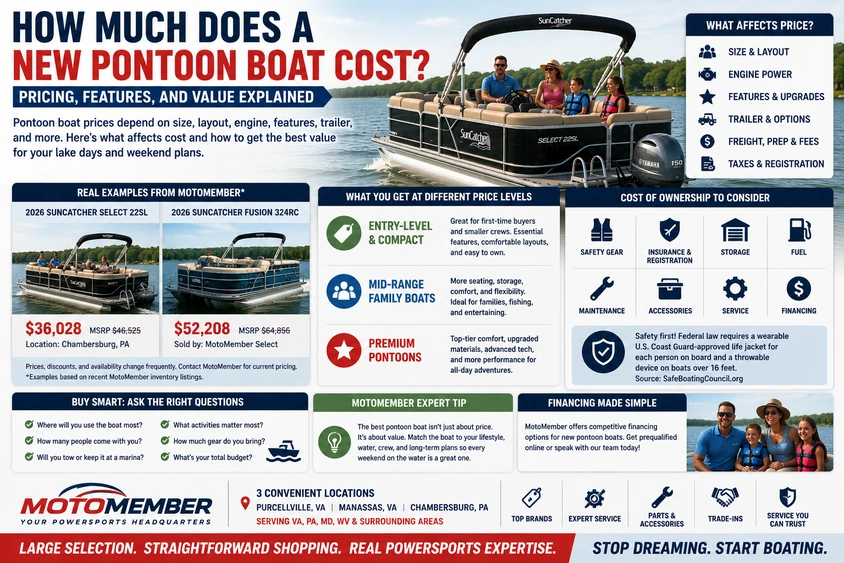
MotoMember recently listed a 2026 SunCatcher Select 22SL in Chambersburg with a listed price of $36,028, shown as reduced from $46,525 on the inventory page. That listing identifies the boat as new, a SunCatcher Select 22SL, and a pontoon located in Chambersburg.
MotoMember also recently listed a 2026 SunCatcher Fusion 324RC at $52,208, shown as reduced from $64,856 through MotoMember Select.
These examples are useful because they show how price can vary by series, size, features, and configuration. However, they should not be treated as fixed pricing for every buyer. Inventory, promotions, discounts, model availability, fees, taxes, and equipment can change.
What You Get at Different Pontoon Price Levels
Instead of shopping by price alone, think in terms of value. A lower-priced pontoon may be a perfect fit if it has the right layout. A higher-priced pontoon may be worth it if your family will actually use the extra comfort, performance, and features.
Entry-Level and Compact Pontoons
Compact pontoons are often attractive to first-time boat buyers, couples, smaller families, and shoppers with limited storage or towing needs.
They may offer a more approachable ownership experience while still giving you pontoon comfort, seating, and stability. SunCatcher’s official site shows Select models across multiple size groupings, including 16 and 18-foot options, as well as larger Select configurations.
A compact pontoon can be a smart buy if your boating plans are simple: relaxed cruising, casual fishing, smaller groups, and easier storage.
Mid-Range Family Pontoons
Many shoppers land in the middle because they want a strong balance of price, comfort, space, and features.
A mid-range pontoon may offer more seating, more deck space, better storage, a more flexible layout, and enough room for family weekends. This is often where buyers compare cruise layouts, fish-and-cruise models, rear lounges, and family-focused seating.
If you bring kids, guests, coolers, towels, life jackets, and water toys, the extra room can be worth it.
Premium Pontoons
Premium pontoons usually focus on upgraded comfort, advanced features, higher-end materials, larger layouts, stronger performance potential, and a more refined on-water experience.
SunCatcher’s official lineup includes model families such as Select, Fusion, Elite, and Amara. Its website describes the Select family as essential features and quality, Fusion as a blend of quality, comfort, and functionality, and Elite as sophistication with craftsmanship and high performance.
Premium models can make sense if you spend a lot of time on the water, entertain often, want more comfort, or plan to keep the boat for several seasons.
New Pontoon Boat Features That Affect Cost
Seating and Upholstery
Seating is one of the biggest reasons people buy pontoon boats. More seating, upgraded upholstery, rear lounges, high-back chairs, and premium materials can affect price.
When comparing boats, sit in every seat. A boat that looks good online should also feel comfortable in person.
Flooring
Marine flooring affects comfort, cleaning, appearance, and long-term enjoyment. Upgraded flooring may increase cost but can also make the boat easier to live with.
Families with kids, pets, fishing gear, and wet towels should pay attention to how easy the flooring is to clean.
Shade
A bimini top or shade system can make a major difference on hot summer days. Shade is especially important for families, kids, older passengers, and all-day boaters.
Ask how much coverage the shade provides and how easy it is to deploy.
Storage
Storage may not feel exciting when shopping, but it becomes one of the most important ownership features.
Life jackets, dock lines, anchor, fenders, towels, cooler, snacks, fishing gear, water toys, bags, cleaning supplies, and cover equipment all need a place to go. Better storage can make a boat feel larger and more comfortable.
Fishing Features
Fishing pontoons may include fishing seats, rod holders, livewells, open deck areas, and electronics. These features can affect pricing but may be worth it if you fish regularly.
If you only fish occasionally, a balanced cruise layout may be a better value than a heavily fishing-focused setup.
Electronics and Helm Features
Helm upgrades, audio systems, displays, charging points, steering systems, and gauges all contribute to the final price.
Do not pay for technology you will not use, but do not overlook features that make boating easier, safer, or more enjoyable.
Trailer
Some buyers need a trailer. Others keep the boat at a marina. Trailer needs can significantly affect the total purchase.
Before buying, ask whether the trailer is included, optional, or priced separately. Also discuss tow vehicle suitability, storage length, launch ramp comfort, and trailer maintenance.
Cost of Ownership Beyond the Purchase Price
The boat itself is only part of the total investment. A realistic pontoon budget should also include ownership costs.
Safety Gear
Every boat needs proper safety equipment. The National Safe Boating Council states that federal law requires a wearable U.S. Coast Guard-approved life jacket in good and serviceable condition and of the appropriate size for each person onboard. It also notes that boats greater than 16 feet must carry a U.S. Coast Guard-approved throwable device, except canoes and kayaks.
Budget for life jackets, throwable flotation device, fire extinguisher, dock lines, anchor, horn or whistle, navigation lights, and other required or recommended gear.
Insurance and Registration
Insurance and registration costs vary by state, boat, coverage, and owner. Ask your insurance provider and check official state boating resources before purchase.
Storage
Storage can be one of the biggest ongoing costs. Some buyers store at home. Others use marina slips, dry storage, covered storage, or seasonal storage.
Before buying, know where the boat will live.
Maintenance and Service
A new pontoon still needs maintenance. Plan for engine service, battery care, cleaning, cover care, trailer maintenance, winterization, and seasonal preparation.
Dealer support matters because ownership continues long after the sale.
Fuel
Fuel costs depend on engine, usage, passenger load, water conditions, and how often you boat. A family that cruises occasionally will have different fuel needs than a buyer who spends full weekends on the water.
Accessories
Many buyers add accessories after purchase. Common items include dock lines, fenders, anchors, life jackets, coolers, covers, cleaning supplies, electronics, tow ropes, inflatables, fishing gear, and storage organizers.
Financing a New Pontoon Boat
Financing can help many shoppers move from browsing to boating. MotoMember offers financing resources for new and used powersports vehicles and boats, including an online path to get prequalified or apply for financing. Financing options, approvals, and terms vary by customer and lender.
Before applying, think beyond the monthly payment. A comfortable boat budget should leave room for insurance, registration, safety gear, accessories, fuel, storage, maintenance, and seasonal service.
A lower payment may look attractive, but the best value is a boat you can enjoy comfortably after the sale.
Is a More Expensive Pontoon Boat Worth It?
Sometimes, yes. Sometimes, no.
A more expensive pontoon may be worth it if the upgrades directly improve how you use the boat. More seating, better storage, improved shade, stronger performance, premium comfort, fishing features, electronics, or a larger layout can all add real value for the right buyer.
However, paying for features you do not need may not be the best move. A compact or mid-range pontoon may be the better value if your boating plans are simple.
The goal is not to buy the most expensive boat. The goal is to buy the right boat.
New vs. Used Pontoon Boat Value
Many shoppers compare new and used pontoons before deciding.
Why Buy New?
A new pontoon gives you current model availability, fresh condition, and the ability to compare available layouts and features from day one. It also helps you avoid questions about previous storage habits, engine hours, maintenance history, seating wear, flooring condition, or trailer neglect.
New can be a strong choice if you plan to keep the boat for several seasons.
Why Consider Used?
A used pontoon may offer a lower upfront price depending on condition and availability. However, buyers should inspect condition carefully.
Look at engine history, service records, upholstery, flooring, electronics, pontoons, trailer, wiring, livewell function, storage history, and signs of neglect.
MotoMember can help shoppers compare new and used options when available.
How to Compare Pontoon Boat Value
Step 1: Define Your Use
Are you cruising, fishing, swimming, entertaining, tubing, or doing a little of everything?
Step 2: Know Your Passenger Count
Buy for your normal crew first. Then consider occasional guests.
Step 3: Plan Storage and Towing
Your tow vehicle, trailer setup, storage space, and launch routine can affect which boat makes sense.
Step 4: Compare Layouts in Person
Photos do not tell the whole story. Sit in the seats, open storage, walk the deck, and picture your family onboard.
Step 5: Ask for the Full Price Picture
Ask about the boat, trailer, fees, taxes, accessories, financing, service, and anything else that affects the out-the-door cost.
MotoMember Expert Tip
Do not shop pontoon boats by price alone.
Bring the MotoMember team your real boating plan: where you boat, how many people come with you, whether you tow or store at a marina, what vehicle you tow with, and whether your priorities are cruising, fishing, entertaining, swimming, or watersports.
A lower-priced pontoon may be the perfect value if it fits your use. A higher-priced model may be worth it if the added comfort, storage, performance, or features solve real problems for your family.
Why Shop New Pontoon Boats at MotoMember?
MotoMember helps shoppers across VA, PA, MD, WV, and nearby areas compare pontoon boats, financing, accessories, service, parts, and long-term ownership support.
That matters because the best pontoon value is not just the lowest number on a listing. It is the boat that fits your water, your crew, your storage plan, your towing needs, your budget, and your service expectations.
Start with the MotoMember homepage, browse current inventory, or review MotoMember’s financing resources before visiting.
Large selection. Straightforward shopping. Real powersports expertise.
Call to Action
Ready to find out how much a new pontoon boat costs for your lifestyle?
Visit MotoMember online or contact the team to check current SunCatcher pontoon availability, compare pricing, review features, explore financing options, and get practical dealership guidance before you buy.
Stop dreaming. Start boating.
Conclusion
So, how much does a new pontoon boat cost? It depends on size, layout, engine, features, trailer needs, taxes, fees, financing, and current availability.
The better question is: which pontoon gives you the best value for the way you actually boat?
For some shoppers, that may be a compact, easy-to-manage pontoon. For others, it may be a larger family model, fishing layout, or premium pontoon with more comfort and capability.
MotoMember can help shoppers in Virginia, Pennsylvania, Maryland, West Virginia, and surrounding areas compare real options and make a confident decision.
FAQ
How much does a new pontoon boat cost?
New pontoon boat cost depends on size, model, engine, trailer, layout, features, taxes, fees, and availability. MotoMember listings have shown new SunCatcher pontoons at different price points, including Select and Fusion models, but pricing can change. Always confirm live pricing with MotoMember.
What affects the price of a new pontoon boat?
Major cost factors include boat size, two-tube vs. tritoon-style design, engine choice, seating layout, fishing features, electronics, flooring, shade, trailer, freight, prep, taxes, fees, and accessories.
Is financing available for new pontoon boats at MotoMember?
Yes. MotoMember offers financing resources for new and used powersports vehicles and boats, including online prequalification and financing information. Approvals, terms, and options vary by customer and lender.
Is a more expensive pontoon boat worth it?
A more expensive pontoon may be worth it if the added features match your real use, such as more seating, storage, performance, fishing equipment, comfort, or premium materials. The best value is the boat that fits your crew, water, storage, and budget.
Should I buy a new or used pontoon boat?
Buy new if you want current model availability, fresh condition, and a clean ownership start. Consider used if budget is the top priority and you are comfortable reviewing condition, maintenance history, engine hours, trailer condition, and previous storage habits.