
Fishing Pontoon vs Traditional Fishing Boat

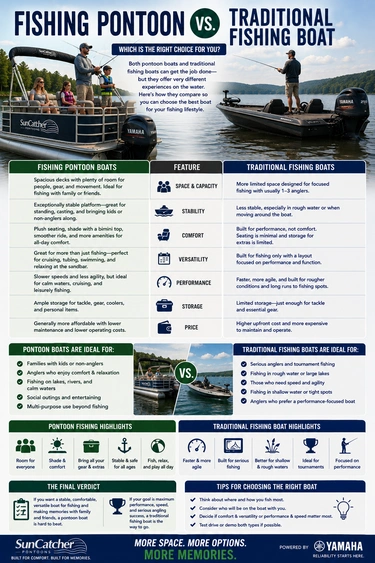
Fishing Pontoon vs Traditional Fishing Boat: Key Differences
Choosing between a fishing pontoon vs traditional fishing boat comes down to how you want to spend your time on the water.
A fishing pontoon is built around comfort, space, seating, stability, and family-friendly versatility. It can be a great choice for lake and reservoir anglers who want to fish, cruise, relax, bring guests, and enjoy a full day on the water without feeling cramped.
A traditional fishing boat is usually built around fishing performance first. Depending on the model, that may mean casting decks, rod storage, trolling motor control, easier maneuverability, shallow-water practicality, and a layout designed for anglers who move, cast, troll, anchor, and reposition throughout the day.
Neither boat type is automatically better. The right choice depends on your fishing style, passenger count, water type, tow vehicle, storage plan, budget, and long-term ownership goals.
For shoppers in Virginia, Pennsylvania, Maryland, West Virginia, and nearby areas, MotoMember can help compare fishing pontoons, aluminum fishing boats, jon boats, G3 models, SunCatcher pontoons, Yamaha-powered packages, trailers, accessories, financing, trade-ins, and service support. MotoMember lists new powersports and marine inventory in Purcellville, Manassas, and Chambersburg, and its lineup includes marine and powersports brands such as Yamaha, SunCatcher, G3, Sea-Doo, Can-Am, Polaris, Kawasaki, Slingshot, and more.
Quick Answer: Which Is Better?
Choose a fishing pontoon if you want more comfort, more seating, more deck space, easier family use, and a boat that can support fishing, cruising, relaxing, and entertaining.
Choose a traditional fishing boat if you want sharper fishing performance, better boat control, easier towing, more precise casting layouts, and stronger suitability for rivers, shallow water, or serious angling.
A simple way to compare:
| Priority | Better Fit |
|---|---|
| Family lake days | Fishing pontoon |
| Serious bass fishing | Traditional fishing boat |
| Crappie and panfish with guests | Fishing pontoon |
| River fishing | Traditional fishing boat |
| Towing and storage simplicity | Traditional fishing boat |
| Comfort and seating | Fishing pontoon |
| Precision trolling motor control | Traditional fishing boat |
| Social fishing trips | Fishing pontoon |
| Shallow creeks and tight ramps | Traditional fishing boat |
| Relaxed reservoir fishing | Fishing pontoon |
The better boat is the one that fits your next 20 trips, not just your dream trip.
What Is a Fishing Pontoon?
A fishing pontoon is a pontoon boat designed with fishing-friendly features. It usually combines a wide deck, comfortable seating, open movement, gates, storage, and family-friendly comfort with angler-focused features such as fishing seats, rod holders, livewell or baitwell access, and electronics space.
SunCatcher describes its pontoon lineup as built for cruising, fishing, entertaining, and family comfort with Yamaha power and layouts for different days on the water.
That combination is why fishing pontoons appeal to buyers who want more than a dedicated fishing platform. They want a boat that can fish in the morning, cruise at midday, anchor for lunch, relax in a cove, and still keep passengers comfortable.
Fishing Pontoon Strengths
Fishing pontoons are usually strongest in comfort, space, stability, seating, storage, and passenger enjoyment. They are especially useful for families, kids, grandparents, guests, and anglers who want room to spread out.
A pontoon layout can be excellent for crappie, panfish, catfish, casual bass fishing, social fishing, and relaxed lake or reservoir trips.
Fishing Pontoon Tradeoffs
Fishing pontoons are not always the best choice for technical angling. They may not feel as nimble around tight cover, shallow rivers, narrow creeks, or small ramps.
They can also require more storage space, more trailer awareness, and more room at the ramp than smaller traditional fishing boats.
What Is a Traditional Fishing Boat?
A traditional fishing boat is usually a purpose-built fishing platform. This can include aluminum fishing boats, jon boats, modified-V boats, deep-V boats, bass-style boats, and multi-species boats.
G3’s official lineup includes aluminum boat categories such as Gator Tough Jon, Sportsman, Angler V, Bay, and SunCatcher pontoons, giving freshwater buyers several styles to compare based on fishing use, family needs, and water type.
Traditional fishing boats tend to place fishing performance first. That may mean better casting decks, rod lockers, tackle storage, trolling motor use, livewell placement, and control around structure.
Traditional Fishing Boat Strengths
Traditional fishing boats are often stronger for serious fishing, river use, shallow-water access, precise boat control, solo launching, and towing simplicity.
They can be a great fit for bass anglers, river anglers, crappie anglers, catfish anglers, and multi-species anglers who want a fishing-first layout.
Traditional Fishing Boat Tradeoffs
A traditional fishing boat may not be as comfortable for families or guests. Seating can be more limited, shade may be less prominent, and passengers who are not fishing may feel like they are riding along rather than enjoying a social space.
If your boat needs to keep the whole family happy, a traditional fishing layout may feel too focused.
Layout Differences
Layout is one of the biggest differences between a fishing pontoon and a traditional fishing boat.
A fishing pontoon usually has a wide, open deck with seating around the perimeter. SunCatcher notes that pontoon layouts often provide space for guests and movement, with seating around the outside and open space through the middle.
A traditional fishing boat usually has a narrower, more fishing-focused layout. Depending on the model, it may include front and rear casting decks, rod lockers, tackle storage, pedestal seats, a console, livewell access, and trolling motor placement.
Pontoon Layout
A pontoon layout works well when passengers matter. People can sit, move, talk, snack, relax, and enjoy the day even if they are not fishing.
For families, this can be the deciding factor. A fishing pontoon gives the whole crew a reason to enjoy the boat.
Traditional Fishing Layout
A traditional fishing layout works well when fishing efficiency matters. Anglers can move from storage to casting deck to trolling motor to livewell without fighting lounge seating or extra furniture.
For serious anglers, that efficiency can matter all day.
Comfort and Passenger Space
Fishing pontoons usually win on comfort.
They tend to offer more seating, more room to move, more social space, and a more relaxed experience for people who are not actively fishing. That makes them excellent for families, kids, older passengers, and guests.
Traditional fishing boats can still be comfortable, especially larger multi-species or deep-V models. But they usually feel more focused on fishing than lounging.
If your passengers are serious anglers, that may be fine. If your passengers include kids, spouses, grandparents, or friends who want to relax, a pontoon may be a better fit.
Fishing Performance
Traditional fishing boats usually win on pure fishing performance.
They often provide better bow control, easier trolling motor operation, better casting angles, more specialized rod storage, and a layout designed around fishing movement. That is important for anglers who fish docks, grass, brush, standing timber, points, ledges, current seams, and shallow cover.
Fishing pontoons can still be very capable fishing platforms. They are especially good for anchored fishing, drifting, slow trolling, panfish, catfish, crappie, and relaxed multi-person fishing.
The difference is specialization. A traditional fishing boat is usually better when fishing is the mission. A pontoon is usually better when fishing is part of a larger day on the water.
Handling and Maneuverability
Traditional fishing boats are often easier to maneuver precisely.
A smaller aluminum fishing boat, jon boat, or modified-V boat can be easier to position around structure, control with a trolling motor, and manage in tight water. That matters for bass anglers, river anglers, and anyone who moves frequently between spots.
Fishing pontoons feel stable and spacious, but they are larger platforms. They may need more room to turn, dock, trailer, and reposition.
For broad lakes and reservoirs, that size may not be a problem. For narrow rivers or shallow ramps, it may become a major factor.
Lakes, Rivers, and Reservoirs
Your water should guide your decision.
Lakes
Fishing pontoons can be excellent on lakes because comfort, seating, and open deck space are valuable. They work well for crappie, panfish, catfish, casual bass fishing, and family fishing.
Traditional fishing boats also work well on lakes, especially when anglers want to cast, cover water, and fish structure efficiently.
Rivers
Traditional fishing boats usually have the edge on rivers. Jon boats and smaller aluminum fishing boats are often easier to launch, control, and use in shallow or changing water.
G3 describes its Gator Tough Jon boats as all-welded aluminum models built around fishing, hunting, and utility use, which is the type of practical direction many river anglers compare.
Reservoirs
Both can work on reservoirs.
A fishing pontoon may be better if your reservoir days include family, coolers, shade, seating, and relaxed fishing. A traditional deep-V or multi-species boat may be better if you fish bigger water seriously and want more control, storage, and fishing-focused performance.
Storage and Gear Management
Both boat types can offer storage, but they organize gear differently.
A fishing pontoon may provide storage for life jackets, bags, towels, coolers, snacks, and family gear. Fishing-friendly layouts may also include rod holders, fishing seats, livewell access, and space for tackle.
A traditional fishing boat may offer more angler-specific storage, such as rod lockers, tackle compartments, livewell placement, battery access, and casting deck storage.
The better choice depends on what you carry. If your gear is mostly rods, tackle, electronics, nets, and fishing tools, a traditional fishing boat may feel more efficient. If your gear includes family bags, towels, snacks, coolers, extra life jackets, and guest items, a pontoon may stay more organized.
Towing, Launching, and Storage
Traditional fishing boats are often easier to tow, launch, retrieve, and store, especially smaller aluminum boats and jon boats.
Fishing pontoons can require more storage room and more trailer planning. They can also need more space at the ramp and more attention when docking.
That does not mean pontoons are difficult for every buyer. Many owners tow and launch them confidently. But first-time buyers should think through driveway length, garage fit, storage facility space, tow vehicle capability, ramp access, and whether they will often launch alone.
MotoMember can help shoppers compare the full boat-and-trailer package, not just the boat itself. Current inventory availability, equipment, pricing, model year, and location can vary, so live inventory and direct team contact are important before planning around a specific unit.
Family Use
Fishing pontoons usually win for family use.
The reason is simple: they give non-anglers a better experience. Kids can sit comfortably. Guests can move more easily. Grandparents may appreciate the open layout. Families can bring coolers, towels, snacks, bags, and extra gear without feeling packed into a fishing-first cockpit.
A traditional fishing boat can still work for families, especially if the family is serious about fishing. But if some passengers mostly want to relax, a pontoon is often the more enjoyable option.
For many MotoMember shoppers, this is the deciding point. The best boat is often the one the whole household wants to use.
Serious Angler Use
Traditional fishing boats usually win for serious angler use.
Bass anglers often want casting decks, trolling motor control, electronics visibility, rod storage, tackle access, and fast repositioning. River anglers want manageable size and control. Multi-species anglers may want a balanced layout for casting, trolling, drifting, and live bait.
A pontoon can still work for serious anglers, especially crappie, panfish, catfish, and lake-based multi-species anglers. But for technical fishing, traditional boats usually provide a more efficient tool.
The question is not whether you are serious. The question is how you fish seriously.
New vs. Used Considerations
New and used options exist in both categories.
A new fishing pontoon or traditional fishing boat may make sense if you want a clean ownership history, current model choices, dealer guidance, and a package that can be planned around your needs from the start. MotoMember’s new inventory page includes marine vehicles along with broader powersports categories.
A used pontoon or traditional fishing boat may help manage upfront cost or include valuable accessories. MotoMember’s used inventory page lists pre-owned powersports and marine vehicles, including boats from major brands, and notes that used vehicles are inspected by expert technicians.
When comparing used boats, inspect the hull, pontoons or aluminum structure, motor, trailer, tires, wiring, batteries, livewell, flooring, seating, electronics, title paperwork, and service history.
Safety and Passenger Planning
Safety matters no matter which boat you choose.
BoatUS explains that recreational boats must carry Coast Guard-approved personal flotation devices in good and serviceable condition and properly sized for each intended user, and wearable PFDs must be readily accessible.
For pontoons, think about passenger movement, gates, seating, children, loose gear, and keeping walkways clear. For traditional fishing boats, think about casting decks, open hatches, rod clutter, batteries, and safe movement around tackle.
A comfortable boat still needs a smart safety plan. A fishing-first boat still needs passenger awareness.
Cost and Value Differences
Fishing pontoons often cost more than simple aluminum fishing boats because they include more deck space, seating, fencing, furniture, flooring, and comfort features. Traditional fishing boats can range widely, from simple jon boats to highly equipped multi-species boats.
The better value depends on use.
A fishing pontoon may be the better value if the whole family uses it often. A traditional fishing boat may be the better value if you fish frequently, launch alone, and care most about fishing performance.
Do not judge value only by price. Judge it by how often the boat gets used and how well it fits your real trips.
MotoMember Expert Tip
Do not compare a fishing pontoon and a traditional fishing boat while picturing them empty.
Picture the boat fully loaded. Add rods, tackle, cooler, life jackets, towels, bait, batteries, electronics, anchor, dock lines, snacks, passengers, and a fishing partner. Then walk through the day mentally.
Can you launch confidently? Can anglers fish comfortably? Can passengers sit safely? Can gear stay organized? Can the boat handle your favorite water? Can you tow and store it without stress?
If fishing performance matters most, a traditional fishing boat may be the better fit. If comfort and family use matter just as much, a fishing pontoon may be the smarter choice.
Call to Action
Your fishing boat headquarters starts at MotoMember.
Explore current MotoMember marine inventory, compare fishing pontoons and traditional fishing boats, ask about SunCatcher pontoons, G3 aluminum boats, Yamaha-powered packages, trailers, accessories, financing, trade-ins, and service support.
Current availability, pricing, model year, equipment, and promotions can vary, so check MotoMember inventory or contact the team before planning around a specific model or package.
Large selection. Straightforward shopping. Real powersports and marine expertise.
Stop dreaming. Start riding—and fishing—with MotoMember.
Conclusion
So, fishing pontoon vs traditional fishing boat: which is right for you?
Choose a fishing pontoon if you want comfort, seating, open deck space, family-friendly use, social fishing, relaxed lake days, and a boat that can support fishing, cruising, and entertaining.
Choose a traditional fishing boat if you want fishing performance, precision boat control, easier towing, river practicality, casting decks, rod storage, and a layout designed around serious angling.
Both can be excellent choices. The best decision depends on your water, your fishing style, your passengers, your tow vehicle, your storage plan, and how you want to use the boat season after season.
For shoppers in VA, PA, MD, WV, and nearby areas, MotoMember can help compare both options side by side so you choose with confidence.
FAQ
Is a fishing pontoon better than a traditional fishing boat?
A fishing pontoon is better if you value comfort, seating, family use, space, and relaxed lake or reservoir fishing. A traditional fishing boat is better if you prioritize fishing performance, boat control, casting decks, towing simplicity, and river use.
Can you fish seriously from a pontoon?
Yes, you can fish seriously from a pontoon, especially for crappie, panfish, catfish, casual bass, and multi-species lake fishing. However, highly technical bass anglers and river anglers may prefer a traditional fishing boat.
What is the main difference between a pontoon and a fishing boat?
The main difference is layout and purpose. A pontoon emphasizes deck space, seating, stability, and comfort. A traditional fishing boat emphasizes fishing performance, casting space, maneuverability, rod storage, and boat control.
Which is easier to tow: pontoon or traditional fishing boat?
Traditional fishing boats are often easier to tow and store, especially smaller aluminum boats and jon boats. Pontoons can require more trailer space, more storage room, and more planning at the ramp.
Can MotoMember help compare pontoons and fishing boats?
Yes. MotoMember can help shoppers compare fishing pontoons, traditional fishing boats, G3 aluminum boats, SunCatcher pontoons, Yamaha-powered packages, trailers, accessories, service, financing, and trade-ins across VA, PA, MD, WV, and nearby areas.