
Best Fishing Boat Features for Serious Anglers

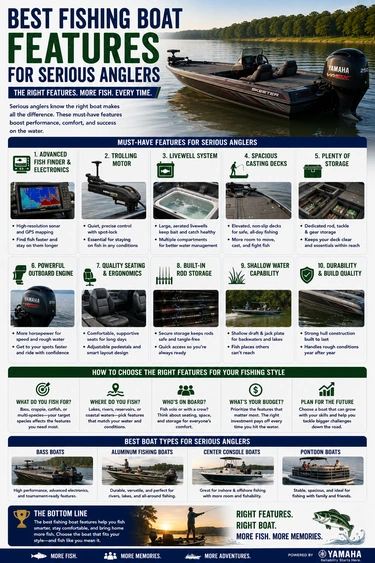
Best Fishing Boat Features for Serious Anglers
Serious anglers do not shop for fishing boats the same way casual weekend cruisers do. Comfort still matters, but the real questions are more specific: Can you fish the way you want? Can you carry your rods, tackle, bait, batteries, electronics, and passengers without fighting the layout? Can the boat handle the lakes, rivers, and reservoirs you fish most often?
The best fishing boat features are the ones that make your day easier from launch to cleanup. A good boat helps you stay organized, control your position, reach fishable water, protect your gear, land fish safely, and get back to the ramp with confidence.
For anglers shopping in Virginia, Pennsylvania, Maryland, West Virginia, and nearby areas, MotoMember can help compare fishing boats, pontoons, trailers, Yamaha-powered packages, accessories, financing, trade-ins, and service support. MotoMember lists new powersports and marine inventory across its Purcellville, Manassas, and Chambersburg locations, and its dealership resources include sales, service, parts, financing, and pre-loved inventory support.
Start With Fishability, Not Flash
A serious angler’s boat should be judged by how well it supports actual fishing. Shiny finishes, upgraded seating, and premium trim can be nice, but they do not matter much if the deck layout is awkward, rod storage is poor, or electronics are difficult to see while fishing.
Before choosing a model, think through your normal day on the water. You launch before sunrise, run to the first spot, deploy the trolling motor, pull rods, open tackle storage, check electronics, reposition several times, land fish, manage livewell use, and eventually load everything back on the trailer.
Every feature should make that process smoother.
The Best Feature Is the Right Layout
A fishing boat layout should match your primary technique. Bass anglers often want open casting decks, fast tackle access, and strong bow control. Crappie anglers may prioritize rod holders, seating comfort, livewell placement, and electronics visibility. Catfish anglers often want open deck space, anchor control, and easy cleanup. Multi-species anglers need a flexible cockpit that can handle casting, trolling, drifting, and family use.
Many shoppers start by asking, “What brand should I buy?” A better first question is, “Which layout helps me fish better?”
Casting Decks and Open Fishing Space
Casting space is one of the most important fishing boat features for anglers who cast all day. A well-designed casting deck gives you stable footing, room to move, and enough space to work around rods, tackle trays, a landing net, and a fishing partner.
For bass, pike, muskie, and shallow-water casting, bow deck space can make or break the experience. You need room to stand comfortably and make repeated casts without stepping over clutter.
Rear deck space also matters. If two anglers fish at once, the rear angler should not feel like an afterthought. A strong layout gives both anglers useful space without forcing one person into a cramped corner.
What to Check in Person
When you visit the showroom, stand where you would actually fish. Picture two rods on the deck, a tackle bag open, the trolling motor pedal in place, and a net nearby. If the layout feels tight while empty, it may feel worse once the boat is loaded.
Our team can help you compare deck layouts based on how you fish, how many anglers usually join you, and whether you need a specialized fishing platform or a more flexible family-friendly setup.
Rod Storage That Protects Your Gear
Serious anglers rarely bring one rod. They bring several rods rigged for different techniques, conditions, depths, and species. Poor rod storage leads to broken guides, tangled lines, scratched reels, and wasted time.
Look for rod storage that fits the length and number of rods you actually carry. Also consider whether rods can be stored rigged or if you will need to break them down between spots.
Dedicated rod compartments help keep the deck cleaner and reduce damage during travel. External rod holders can be useful for trolling, catfish, crappie, or bait fishing, but they should be positioned where they do not interfere with casting, seating, or walking paths.
G3’s fishing boat content notes that rod compartments and accessible bait storage are valuable features for fishing boats, while electronics and navigation systems may need to be planned around the boat’s ability to support them.
Smart Tackle and Gear Storage
Tackle organization is not just about convenience. It affects how efficiently you fish.
A boat with smart storage helps you switch techniques quickly. You can grab the right crankbait box, soft plastics, terminal tackle, tools, rain gear, or extra line without unloading half the boat.
Look for storage that stays dry, opens easily, and makes sense from the deck. Deep compartments can hold more gear, but shallow organized storage may be easier for fast access. Waterproof or water-resistant storage can help protect electronics, phones, licenses, wallets, and spare clothing.
Storage Questions Serious Anglers Should Ask
Ask how much tackle you carry on a normal day. Then ask where it would go. Do you need room for multiple tackle trays? Do you carry a cast net, minnow bucket, rain gear, extra batteries, a tool kit, marker buoys, or dock lines?
The best fishing boat features are not always glamorous. Sometimes the feature you appreciate most is a storage hatch that keeps your most-used gear exactly where your hand expects it to be.
Livewell Design and Bait Management
A serious fishing boat should support the way you handle fish and bait. Livewell location, size, access, aeration, drainage, and ease of cleaning all matter.
Tournament-minded anglers may care about fish care and quick access. Crappie and panfish anglers may need practical livewell placement for repeated use throughout the day. Bait anglers may want separate bait storage that is easy to reach without interrupting the fishing flow.
Before buying, open the livewell. Stand where you would stand while using it. Make sure the lid, location, and access point make sense.
A livewell that looks fine at the dock may feel awkward if it is blocked by seats, rods, passengers, or tackle once you are actually fishing.
Trolling Motor Compatibility and Boat Control
Boat control is one of the biggest differences between casual fishing and serious fishing. A good trolling motor setup helps you hold position, work shorelines, follow depth changes, control drift, and adjust quietly.
Look at where the trolling motor mounts, where the foot pedal or remote will be used, how batteries are stored, and whether the deck layout supports comfortable operation.
Battery access matters too. Trolling motor batteries need charging, inspection, and eventual replacement. A boat that makes battery access difficult can become frustrating over time.
Bow Control for Bass and Structure Fishing
Bass anglers, crappie anglers, and anyone who fishes docks, grass, timber, ledges, or rocky banks should think carefully about bow control. You need to operate the trolling motor while watching electronics, casting accurately, and staying balanced.
The right boat should feel natural from the bow. If you constantly fight the layout, you will fish less efficiently.
Electronics and Fishfinder Placement
Electronics have become a major part of serious freshwater fishing. Fishfinders, GPS, mapping, sonar, and other systems can help anglers understand depth, structure, temperature, bait movement, and navigation.
The key is not simply having electronics. It is having electronics positioned where you can actually use them.
A screen at the console helps while running. A bow-mounted display helps while casting, vertical fishing, or using the trolling motor. Multi-species anglers may want visibility from multiple positions.
G3’s fishing boat feature guidance highlights that GPS navigation, fish finders, and sonar systems are common marine electronics and that buyers should check whether the boat can support the technology they want.
Plan for Upgrades
Even if you do not install every electronic feature on day one, think about future upgrades. Ask about mounting locations, wiring access, battery capacity, charger placement, transducer options, and how cleanly additional accessories can be installed.
MotoMember’s service resources include accessory installation, battery service, routine maintenance, pickup and delivery, and seasonal prep, which can be helpful when anglers want to add or update equipment after purchase.
Hull Design for Your Water
Serious anglers should choose hull design based on water conditions, not just looks.
A jon boat or flat-bottom-style aluminum boat can be useful for shallow rivers, creeks, backwaters, and protected areas. G3 describes its Gator Tough jon boats as all-welded models built around durability, dependability, and value for hunting, fishing, and related uses.
Modified-V aluminum boats can work well for anglers who fish bass, crappie, catfish, and mixed freshwater environments. G3 describes its Sportsman Series as all-aluminum, all-welded fishing machines with versatile layouts and modified-V hulls.
Deep-V boats may be a better fit for larger lakes, reservoirs, and bigger water where comfort, protection, and confidence matter. G3 describes its Angler V Series as rugged deep-V models built with features for big fish and family use.
Match the Hull to the Mission
For rivers, prioritize control, manageable size, durability, and shallow-water practicality. For lakes, prioritize deck space, storage, trolling motor use, and versatility. For reservoirs, prioritize comfort, seating, electronics space, storage, and confidence in wind or boat traffic.
A serious angler should not buy a boat only for one perfect day. Buy for the conditions you face most often.
Seating That Works While Fishing
Seats should support fishing, not get in the way of it.
Bass anglers may want pedestal seats that support casting and bow control. Crappie anglers may prefer comfortable seating for slower presentations. Multi-species anglers may want adjustable seats that work for trolling, casting, cruising, and family trips.
Think about how often you stand versus sit. Think about whether passengers fish or simply ride along. Think about how seats affect access to storage, livewells, rod lockers, and the rear deck.
A comfortable seat in the wrong place can be a problem. A simpler seat in the right place may be better.
Console Layout and Visibility
The console is more than a steering position. It affects visibility, electronics use, wind protection, passenger movement, and overall comfort.
Side consoles can create more open deck space and may suit anglers who want a simple, fish-focused layout. Center consoles can offer standing control and open movement around both sides. Dual-console or windshield layouts may appeal to anglers who run bigger water or bring passengers who appreciate more protection.
Before choosing, sit at the helm. Check sight lines, switch access, storage reach, throttle comfort, electronics placement, and passenger movement.
For anglers comparing jon boat layouts, G3’s official lineup includes center-console and side-console Gator Tough jon packages in different lengths and configurations, so the right console choice depends on water, passenger count, and fishing style.
Flooring and Cleanup
Serious anglers are hard on boats. Mud, fish slime, bait, spilled drinks, wet shoes, sand, leaves, and tackle all end up on the floor.
Flooring should be durable, secure underfoot, and easy to clean. Carpet may feel comfortable, but some anglers prefer surfaces that rinse more easily. The right choice depends on whether you fish tournaments, take kids, use live bait, catfish at night, or launch from muddy riverbanks.
Also check drainage. Water should move where it is supposed to go. Compartments should not trap moisture, and cleanup should not become a major project after every trip.
Trailer Features Serious Anglers Should Not Ignore
A great fishing boat with a poor trailer setup can still create frustration. Serious anglers often launch early, retrieve late, and tow long distances to chase better water.
The trailer affects every trip. Look at bunks, rollers, winch position, tie-downs, lights, tires, spare tire, tongue jack, coupler, and overall fit. Make sure the trailer matches your tow vehicle and storage space.
If you plan to fish alone, trailer setup matters even more. A boat that loads and unloads easily can help you use it more often.
MotoMember’s inventory resources include marine vehicles and trailers, and the team can help shoppers compare boat-and-trailer fit, towing needs, and current availability.
Safety Features Belong on Every Serious Fishing Boat
Serious anglers sometimes push longer days, changing weather, early mornings, late evenings, cold water, and remote launch areas. That makes safety equipment essential.
The U.S. Coast Guard advises that a U.S. Coast Guard-approved life jacket or buoyancy aid should be worn when a vessel is underway, and wearable PFDs must be readily accessible.
A good fishing boat setup should make room for life jackets, throwable flotation when required, anchor, dock lines, fire extinguisher when required, navigation lights, sound-producing device, first-aid kit, communication device, and emergency tools.
Do not bury safety gear under tackle. The best safety gear is easy to reach when you need it.
Power, Batteries, and Charging Access
Serious fishing boats often rely on multiple electrical systems. You may have a cranking battery, trolling motor batteries, electronics, livewell pumps, navigation lights, bilge pump, chargers, and accessories.
Battery placement should be secure and serviceable. Charging access should be convenient. Wiring should be clean and protected. Future upgrades should be considered before the boat is packed full of gear.
Ask about how the boat is rigged, how batteries are accessed, and whether the current setup supports the way you fish. A boat with excellent fishing features can still disappoint if power management is not planned well.
Family-Friendly Features for Serious Anglers
Not every serious angler fishes alone. Many buyers want a boat that can support serious fishing on Saturday morning and family time on Sunday afternoon.
That is where seating, shade, boarding ease, storage, and comfort become important. A fishing pontoon can be a smart choice for anglers who want space, stability, and relaxed lake or reservoir fishing. G3’s official site lists SunCatcher pontoons among its lineup and describes them as pontoon models for relaxing on the water.
A pontoon may not be the right match for every technique, but it can be excellent for anglers who want to bring kids, guests, coolers, and extra gear while still enjoying practical fishing features.
MotoMember Expert Tip
Serious anglers should shop with a “loaded boat” mindset.
When you compare models, do not picture the boat empty. Picture five rods, two tackle bags, a net, rain gear, a cooler, life jackets, batteries, electronics, anchor, dock lines, tools, bait, and a fishing partner. Then ask whether the boat still feels organized.
Our team can help you compare casting space, storage, livewell placement, electronics readiness, trolling motor compatibility, trailer fit, accessories, financing, trade-ins, and service needs. Before choosing a model, bring details about your target species, favorite waters, tow vehicle, storage plan, normal passenger count, and must-have fishing gear.
Call to Action
Your fishing boat headquarters starts at MotoMember.
Explore current MotoMember new and pre-loved marine inventory, compare fishing boats and pontoons, ask about Yamaha-powered packages, and talk with the team about trailers, electronics, rod storage, trolling motor setup, livewell needs, accessories, financing, trade-ins, and service support.
Current availability can vary, so check MotoMember inventory or contact the team before planning around a specific model, equipment package, or promotion. MotoMember’s financing page notes support for new and used powersports vehicles and boats, and its contact resources list dealership locations in Purcellville, Manassas, and Chambersburg.
Large selection. Straightforward shopping. Real powersports and marine expertise.
Stop dreaming. Start riding—and fishing—with MotoMember.
Conclusion
The best fishing boat features for serious anglers are the features that help you fish more efficiently.
Casting decks, rod storage, tackle organization, livewell access, trolling motor compatibility, electronics placement, hull design, seating, trailer fit, battery access, safety storage, and service support all matter. The right combination depends on how you fish, where you fish, who rides with you, and how much gear you carry.
For anglers in VA, PA, MD, WV, and nearby areas, MotoMember can help turn a long feature list into a practical boat-shopping plan. Whether you are comparing jon boats, aluminum fishing boats, deep-V models, fishing pontoons, Yamaha power, trailers, or accessories, the goal is the same: choose a boat that supports your real fishing style every time you launch.
FAQ
What are the most important fishing boat features?
The most important fishing boat features are casting space, rod storage, tackle storage, livewell access, trolling motor compatibility, electronics placement, battery access, safe flooring, and a trailer that fits your tow and launch routine.
What fishing boat features matter most for bass anglers?
Bass anglers usually prioritize bow casting space, trolling motor control, rod storage, tackle access, electronics visibility, and a layout that allows quick movement around the deck.
Are fishing pontoons good for serious anglers?
Fishing pontoons can be good for serious anglers who value comfort, space, stability, and family-friendly lake or reservoir use. They may not be ideal for every technical casting style, but they can be excellent for relaxed multi-person fishing.
Should I choose a jon boat, modified-V boat, or deep-V boat?
Choose based on your water. Jon boats can make sense for shallow rivers and simple utility. Modified-V aluminum boats can work well for lakes and mixed freshwater fishing. Deep-V boats may be better for larger lakes, reservoirs, wind, and longer days on open water.
Can MotoMember help me compare fishing boat features?
Yes. MotoMember can help shoppers compare fishing boat layouts, pontoons, trailers, Yamaha-powered packages, accessories, electronics planning, trolling motor needs, service support, financing, and trade-ins across VA, PA, MD, WV, and nearby areas.