
Best Boat for Hunting Marshes, Creeks, and Backwaters

Best Boat for Hunting Marshes, Creeks, and Backwaters
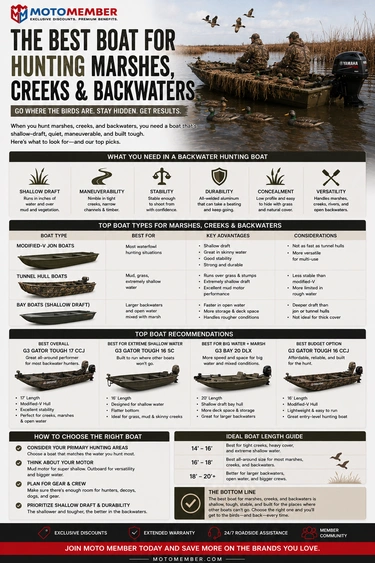
The best boat for hunting marshes, creeks, and backwaters is not always the biggest boat or the most expensive one. It is the boat that can safely reach your hunting spots, handle shallow water, carry your gear, hide well, and get you back to the ramp when the weather changes.
For waterfowl hunters, trappers, anglers, and outdoorsmen across Virginia, Pennsylvania, Maryland, and nearby areas, a boat is more than transportation. It is a mobile blind, gear hauler, dog platform, decoy carrier, and safety system all in one.
That is why choosing the right hunting boat takes more thought than simply asking, “What boat should I buy?” Before choosing a model, consider water depth, current, mud, vegetation, blind setup, number of hunters, dog space, launch access, trailer needs, and how you will use the boat outside hunting season.
MotoMember helps shoppers compare boats, trailers, marine accessories, powersports equipment, service needs, financing, and trade-ins. Current availability can vary, so check MotoMember inventory or contact the team before planning your setup.
What Makes a Good Marsh, Creek, and Backwater Hunting Boat?
A good hunting boat has to solve several problems at once. It needs to float shallow, remain stable, carry weight, maneuver in tight areas, and provide enough room to work safely.
Marshes, creeks, and backwaters often mean narrow channels, submerged stumps, muddy banks, shallow flats, grass beds, floating debris, and limited launch access. These conditions reward simple, durable boats with practical layouts.
Key Features to Look For
The right hunting boat should offer:
Shallow-water capability
Good stability for hunters and dogs
Open floor space
Durable construction
Easy blind integration
Manageable towing size
Reliable motor compatibility
Enough capacity for real hunting gear
Safe seating and movement
Storage for decoys, firearms, fuel, batteries, and emergency gear
Many shoppers focus only on hull length. That matters, but layout and load capacity matter just as much. A boat that is technically long enough may still feel cramped once you add hunters, waders, a retriever, decoys, anchors, blind bags, batteries, and a boat blind.
Jon Boats: The Classic Shallow-Water Hunting Choice
For many hunters, a jon boat is the first answer when comparing the best boat for hunting marshes, creeks, and backwaters. Jon boats are popular because they are simple, practical, easy to customize, and well suited for shallow water.
A flat-bottom jon boat can slide into skinny water where deeper-V hulls may struggle. The open layout also makes it easier to add a blind, organize decoys, and create space for a dog.
Why Jon Boats Work Well
Jon boats are often a strong fit for:
Protected marshes
Small creeks
Backwater sloughs
Farm ponds
River edges
Shallow ramps
Short hunting runs
DIY blind builds
Hunters who want a versatile boat for fishing and waterfowl hunting often like the simplicity of a jon boat. You can keep it basic or build it into a dedicated duck boat with flooring, grass rails, a blind frame, dog platform, interior lighting, and storage.
Where Jon Boats Have Limits
Jon boats are not ideal for every situation. Flat-bottom boats can ride rougher in chop, especially when crossing open water. Smaller jon boats can also become crowded quickly with multiple hunters and a large decoy spread.
If you regularly hunt exposed bays, wide rivers, or big reservoirs, you may need more hull, more freeboard, or a different design. The goal is not to buy the smallest boat that can technically float; it is to buy the safest boat for your real conditions.
Modified-V Jon Boats: A Smart Middle Ground
A modified-V jon boat offers some of the shallow-water utility of a flat-bottom boat with improved handling in light chop. The front of the hull is shaped to cut water better than a completely flat bow.
This style can be a smart choice for hunters who run creeks and backwaters but occasionally cross wider water to reach a blind or marsh edge.
Best Uses for Modified-V Boats
A modified-V jon boat may work well for:
Creeks with some current
River backwaters
Protected bays
Larger reservoirs
Mixed fishing and hunting use
Hunters who need a little more comfort on the ride in
The modified-V design can help reduce pounding compared with a flat-bottom hull, though it will not perform like a deep-V boat in rough water. It is a compromise, and for many hunters, that compromise makes sense.
Duck Boats and Purpose-Built Hunting Boats
Purpose-built duck boats are designed around waterfowl hunting from the start. These boats may include low-profile hulls, hunting-specific layouts, grassing rails, integrated storage, blind options, dog-friendly features, and rugged finishes.
A dedicated duck boat can be a great choice for hunters who spend a lot of time on the water during season and want a cleaner, more specialized setup.
When a Purpose-Built Duck Boat Makes Sense
Consider a purpose-built hunting boat if you:
Hunt frequently throughout the season
Run with multiple hunters
Carry a large decoy spread
Use a retriever
Need a reliable blind system
Want a boat designed around concealment
Prefer a ready-to-hunt setup over a DIY build
These boats can save setup time and reduce trial-and-error. However, they may be less flexible for summer fishing or family recreation depending on the layout.
Skiffs and Utility Boats for Backwater Hunters
Skiffs and utility boats can also work well in certain hunting environments. They may provide more hull depth, better load carrying, or more confidence in mixed water than a very shallow jon boat.
A skiff-style boat may be useful for hunters who split time between marsh edges, tidal creeks, protected coastal water, and fishing trips.
Strengths of Skiff-Style Boats
Skiffs can offer:
More room for gear
Better ride in light chop
Good platform stability
Useful year-round versatility
Space for hunting and fishing accessories
They may not run as shallow as some jon boats or mud boats, but they can be a practical option for hunters who need one boat for several jobs.
Layout Boats and Low-Profile Marsh Boats
Layout boats and low-profile marsh boats are designed for concealment. They sit low in the water and help hunters disappear in open marsh, shallow flats, or natural vegetation.
These boats are more specialized than jon boats. They may be excellent for a specific style of waterfowl hunting but less useful as general-purpose boats.
When Low-Profile Boats Work Best
Low-profile boats may be useful for:
Shallow marsh hunting
Open-water concealment
Sneak hunting
Single-hunter setups
Low-cover environments
They are not always the best choice for hauling several hunters, dogs, and large decoy spreads. Before buying one, think carefully about whether you need a specialized hunting tool or a more versatile boat.
Choosing the Right Motor
The best boat for marshes, creeks, and backwaters also needs the right motor. A great hull with the wrong motor can still struggle in shallow, weedy, or muddy areas.
Standard Outboard Motors
Traditional outboards are common, reliable, and versatile. They are a strong choice for hunters who run deeper creeks, rivers, reservoirs, protected bays, or mixed-use boats.
An outboard may be the best choice if you also plan to fish, cruise, scout, or use the boat outside hunting season. It can provide good speed and dependable performance when the water is deep enough.
Mud Motors
Mud motors are designed for shallow water, mud, vegetation, and rough marsh conditions. They can help hunters reach areas where a standard outboard would have trouble.
That does not mean every hunter needs one. Mud motors can affect weight, handling, noise, maintenance, and budget. Our team can help you compare whether a mud motor or traditional outboard fits your hunting area better.
Trolling Motors
A trolling motor can be helpful for quiet movement, final approaches, decoy pickup, and repositioning in shallow water. It can also help when scouting without disturbing an area.
Pay attention to battery weight and placement. A heavy battery in the wrong spot can affect balance, especially in a smaller boat.
Boat Size: How Big Should You Go?
The right size depends on how you hunt. A solo hunter in a protected creek may need a very different boat than a three-person crew hunting a tidal marsh with a dog and several dozen decoys.
Small Hunting Boats
Smaller boats are easier to hide, tow, launch, pole, and maneuver. They can be a good fit for tight creeks, small marshes, and solo hunts.
However, they have less room for gear and may feel cramped fast. They also require extra attention to weight distribution.
Mid-Size Hunting Boats
Mid-size jon boats and utility boats are often the sweet spot for many waterfowl hunters. They can carry more gear while still being manageable at smaller ramps.
This category often gives hunters room for a blind, dog, decoys, and storage without becoming too difficult to tow or hide.
Larger Hunting Boats
Larger boats can provide more space, more stability, and more carrying capacity. They may be better for bigger water, longer runs, and larger hunting parties.
The tradeoff is that they can be harder to hide, heavier to tow, harder to launch in remote areas, and more expensive to outfit. Large boats also need thoughtful blind design so they do not stand out in low marsh cover.
Stability Matters More Than Speed
Many hunters compare top speed first. For marshes, creeks, and backwaters, stability is often more important.
You need a boat that feels secure when hunters shift weight, a dog climbs aboard, decoys are being pulled, or someone reaches for gear. A boat that is fast but twitchy may not be the right choice for cold-weather hunting.
Think About Real Hunting Movement
Before choosing a boat, imagine what happens during a normal hunt:
Hunters step in wearing waders
A dog moves from side to side
Decoy bags shift
Someone reaches over the side
The blind opens
The boat turns in current
Gear gets wet and heavier
The wind picks up
That is the real test. A hunting boat should feel controlled and predictable under those conditions.
Blind Setup and Concealment
A hunting boat should hide as well as it runs. Marshes, creeks, and backwaters require different concealment strategies.
Marsh Hunting Blinds
In marshes, low-profile blinds with grassing options are often useful. The goal is to blend into reeds, cattails, marsh grass, and brush lines.
A tall, boxy blind may stand out if surrounding cover is low. Build the blind to match the landscape, not just the boat.
Creek and Backwater Blinds
In creeks and backwaters, hunters often hide along banks, timber edges, blowdowns, or brushy points. A slightly higher blind may work if it blends into natural cover.
Use natural vegetation where legal and appropriate. Regulations and property rules can vary, so verify what is allowed before cutting or collecting vegetation.
Removable vs. Permanent Blinds
A permanent blind is convenient for a dedicated hunting boat. A removable blind is better if the boat also gets used for fishing, family outings, or summer recreation.
Do not let the blind block steering, visibility, navigation lights, dog movement, or emergency access.
Storage and Layout
A clean layout makes a hunting boat safer and more enjoyable. Marsh and backwater hunting often happens in darkness, cold, rain, fog, or wind. You should not have to dig through loose gear to find essentials.
Build Zones Inside the Boat
Organize the boat into clear zones:
Driver area
Hunter seating area
Dog area
Decoy storage
Firearm-safe storage
Battery and fuel area
Emergency gear area
Dry storage
This keeps the boat easier to load, safer to move around in, and faster to pack up after a hunt.
Keep the Floor Clear
Loose decoy lines, shell boxes, blind bags, and ropes create trip hazards. Use bins, bags, straps, and clips to keep gear controlled.
A clear floor is especially important when hunting with a dog or when wearing heavy waders.
Safety for Cold-Weather Hunting Boats
Waterfowl hunters often operate in some of the most dangerous boating conditions of the year. Cold water, darkness, wind, ice, fog, and heavy clothing all increase risk.
Every boat setup should start with safety gear and smart decisions.
The U.S. Coast Guard has emphasized that boat operators are required to have a Coast Guard-approved wearable personal flotation device for every person aboard, and that many boating deaths involve drowning where victims were not wearing life jackets.
Virginia DWR states that there must be one wearable U.S. Coast Guard-approved life jacket for each person on the boat and that each life jacket should be in good condition and properly fitted.
Hunting Boat Safety Checklist
A practical hunting boat safety kit may include:
Proper life jackets for every person
Throwable flotation device when required
Sound-producing device
Navigation lights
Waterproof flashlight or headlamp
First aid kit
Fire extinguisher when required
Paddle or push pole
Anchor and rope
Bilge pump or hand pump
Spare drain plug
Tow rope
Basic tool kit
Phone in waterproof case
Dry bag with emergency clothing
Float plan shared with someone on land
Requirements can vary by boat size, motor type, location, and time of operation. Always check official state and federal resources before heading out.
Local and Regional Considerations for VA, PA, and MD Hunters
Hunters in Virginia, Pennsylvania, Maryland, West Virginia, and nearby areas may encounter a wide range of water: tidal creeks, inland marshes, farm ponds, wooded backwaters, rivers, reservoirs, and protected bays.
That variety is why one “best” boat does not fit everyone.
Virginia Hunters
Virginia hunters may deal with rivers, reservoirs, tidal areas, and marsh systems depending on where they hunt. A shallow jon boat may be excellent in protected backwaters, while a larger modified-V boat may make more sense for bigger water.
Virginia DWR provides official boating equipment requirements and hunting-related resources, making it a useful place to verify safety and regulatory details before the season.
Pennsylvania Hunters
Pennsylvania hunters often think about rivers, lakes, farm ponds, and backwater areas. Launch access and water depth can vary widely.
The Pennsylvania Game Commission publishes waterfowl hunting resources and hunting regulation information for hunters to review before going afield.
Maryland Hunters
Maryland has a deep waterfowl tradition, especially around the Chesapeake region. Depending on the area, hunters may need to consider tidal movement, wind exposure, distance from launch sites, and boat size carefully.
Maryland DNR provides waterfowl hunting resources and hunting license information for hunters in the state.
MotoMember Expert Tip
Before choosing a hunting boat, load-test the idea on paper.
Write down your normal hunting crew, dog weight, decoy count, blind type, motor choice, battery setup, fuel, anchors, emergency gear, and trailer needs. Then think through how that load will actually fit inside the boat.
Many shoppers start by asking, “What is the best boat for duck hunting?” A better showroom question is, “What boat still feels safe, organized, and usable when it is fully loaded on a cold morning?”
That question helps narrow the search quickly.
Best Boat Types by Hunting Style
There is no single winner for every hunter, but here is a practical way to compare options.
Best for Tight Creeks
A smaller jon boat or compact modified-V jon boat is often a strong choice for tight creeks. It should be easy to maneuver, easy to hide, and manageable at smaller launches.
Prioritize control, shallow draft, and a clean layout.
Best for Marsh Hunting
A flat-bottom jon boat, mud boat, or purpose-built duck boat can work well in marshes. The best choice depends on water depth, vegetation, mud, and how far you need to run.
Prioritize shallow-water performance, concealment, and stability.
Best for Backwaters
A mid-size jon boat or modified-V jon boat often works well in backwaters. These boats can handle mixed conditions while still offering practical room for gear.
Prioritize versatility, storage, and safe movement.
Best for Bigger Water Near Marshes
A larger modified-V boat, skiff, or utility boat may be a better choice when you need to cross wider water before reaching protected hunting areas.
Prioritize hull size, freeboard, motor reliability, and weather judgment.
Common Buying Mistakes to Avoid
The wrong boat can still look right in photos. Avoid these common mistakes before you buy.
Buying Too Small
A small boat may seem convenient until you load it for a real hunt. Decoys, dogs, waders, fuel, batteries, and blind frames quickly eat up space.
Ignoring the Trailer
The trailer is part of the setup. Make sure it fits the boat, ramp conditions, towing vehicle, and hunting schedule.
Choosing Speed Over Control
Fast is nice. Controlled, stable, and safe is better.
Overbuilding the Boat
Too many accessories can add weight and clutter. Add gear that improves safety, organization, concealment, or function.
Forgetting Service Support
A hunting boat takes abuse. Mud, cold starts, wet wiring, trailer wear, and seasonal storage all matter. Nearby service support can make ownership easier.
How MotoMember Can Help
MotoMember supports customers shopping for marine and powersports equipment across Virginia, Pennsylvania, Maryland, and surrounding areas. Whether you are comparing a jon boat, trailer, outboard, side-by-side for hunting property access, ATV, or accessories, the team can help you think through real use cases.
Our team can help you compare:
New and used inventory
Boat and trailer options
Motor needs
Accessory planning
Service support
Financing options
Trade-in opportunities
Multi-season use
Current availability can vary, so check MotoMember.com or contact the team for current inventory and guidance.
Large selection. Straightforward shopping. Real powersports expertise.
Call to Action
Ready to find the best boat for hunting marshes, creeks, and backwaters? Browse current MotoMember inventory, contact the team, or visit a MotoMember location to compare options in person.
For hunters across VA, PA, MD, WV, and nearby areas, MotoMember can help you choose a setup that fits your hunting style, towing needs, water conditions, and long-term ownership plans.
Stop dreaming. Start riding — and get your hunting boat ready before the season.
Conclusion
The best boat for hunting marshes, creeks, and backwaters depends on where you hunt and how you use the boat. A flat-bottom jon boat may be ideal for shallow protected marshes. A modified-V jon boat may be better for mixed creeks and backwaters. A purpose-built duck boat may be right for serious waterfowl hunters. A skiff or larger utility boat may make more sense for hunters who cross bigger water.
Focus on stability, layout, safety, shallow-water performance, concealment, and service support. Think about the boat fully loaded, not empty. Plan for dogs, decoys, blinds, batteries, fuel, and emergency gear.
The right boat should make hunting smoother, safer, and more enjoyable from launch to pickup.
FAQ
What is the best boat for marsh hunting?
A flat-bottom jon boat, mud boat, or purpose-built duck boat is often a strong choice for marsh hunting. The right option depends on water depth, mud, vegetation, distance from the ramp, number of hunters, and gear load.
Is a jon boat good for creeks and backwaters?
Yes. A jon boat can be excellent for creeks and backwaters because it is shallow-running, simple, easy to customize, and practical for hunting gear. For mixed water or light chop, a modified-V jon boat may be more comfortable.
Do I need a mud motor for backwater hunting?
Not always. A mud motor helps in shallow mud, vegetation, and marsh conditions, but a standard outboard may be better for deeper creeks, rivers, and year-round use. Match the motor to your actual hunting area.
What size hunting boat should I buy?
Choose a boat based on hunters, dog space, decoy count, blind setup, water conditions, and weight capacity. A boat that works for one hunter in a protected creek may not be enough for three hunters, a retriever, and a large decoy spread.
Can MotoMember help me compare hunting boat setups?
Yes. MotoMember can help shoppers compare boats, trailers, motors, accessories, service needs, financing, and trade-ins. Current availability can vary, so check inventory or contact the team for current options.