
Best ATVs and Side-by-Sides for Hunting

Best ATVs and Side-by-Sides for Hunting
Hunting season changes what you need from an off-road vehicle. A machine that is fun on a summer trail may not necessarily be the right choice when you are carrying hunting gear, navigating muddy access roads, crossing uneven property, working around camp, or heading out before sunrise in cold weather.
That is why choosing the best ATVs and side-by-sides for hunting is less about picking the biggest or most expensive machine and more about matching the vehicle to the property, terrain, passengers, cargo, transportation needs, and type of hunting you actually do.
For hunters across Virginia, Pennsylvania, Maryland, and nearby areas, MotoMember can help compare utility-focused ATVs and side-by-sides from brands such as Polaris, Can-Am, Yamaha, Kawasaki, and other manufacturers available through the dealership group. Current models and inventory change, so the goal of this guide is not to declare one specific machine the winner. Instead, it will help you understand what features matter most before you shop.
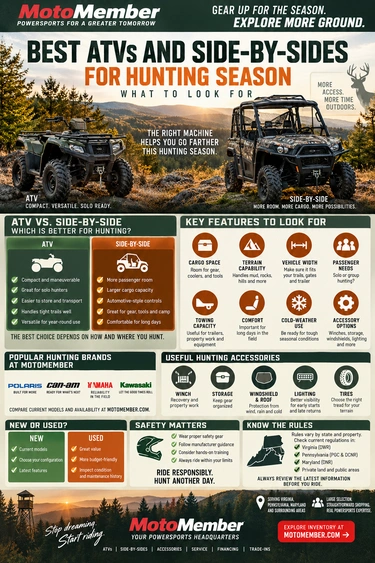
ATV vs. Side-by-Side for Hunting: Which Is Better?
Many hunters start by asking one question: Should I buy an ATV or a side-by-side for hunting?
Both can be excellent tools. The better choice depends on how you hunt and what you expect the machine to do.
Choose an ATV When Compact Size Matters
An ATV can make sense for hunters who usually travel alone and want a compact machine for moving through property, accessing trails, checking stands, carrying basic equipment, or handling chores during the rest of the year.
Because ATVs generally have a smaller footprint than side-by-sides, they may also appeal to buyers who are concerned about trailer space, garage storage, maneuverability, or fitting through tighter areas on private property.
ATVs require a more active riding position, however. If you expect to carry multiple hunters, substantial equipment, or bulky cargo regularly, a side-by-side may deserve stronger consideration.
Choose a Side-by-Side When Cargo and Passengers Matter
A utility-oriented side-by-side is often a natural fit for hunters who want more passenger room and dedicated cargo space.
Instead of straddling the machine and steering with handlebars, occupants sit in seats and use automotive-style controls. Depending on the particular model, side-by-sides may also offer configurations designed around cargo carrying, passenger seating, weather protection, storage, or utility work.
That can be useful when your hunting routine involves transporting another hunter, hauling equipment to camp, maintaining property, moving stands or tools, or simply spending long days traveling around acreage.
If you are still deciding, the MotoMember team can help you compare ATV and side-by-side options based on how you plan to ride rather than simply directing you toward a particular category.
Browse current MotoMember powersports inventory to see the types of ATVs and side-by-sides currently represented.
What to Look for in a Hunting ATV or Side-by-Side
The best hunting machine is one that handles the jobs you actually expect it to perform. Before choosing a model, consider these factors.
1. Cargo Space and Storage
Hunting rarely means traveling light.
Depending on the trip, you may be carrying packs, clothing, tools, coolers, recovery equipment, food plot supplies, trail cameras, stands, or other outdoor gear.
Think about where everything will go before buying.
With an ATV, that may mean evaluating front and rear rack space along with available storage accessories. With a side-by-side, hunters may prioritize a useful cargo bed and options for securely organizing smaller items.
Cargo capacity varies significantly by vehicle, so always check the manufacturer's current specifications for the exact model you are considering.
The bigger question is not simply, "How much can it hold?" It is, "Can I organize what I regularly carry without making the machine awkward or unsafe to operate?"
2. Terrain Capability
A hunting property in the Mid-Atlantic can present very different conditions during one season.
You may encounter rocky ground, wet leaves, mud, ruts, hills, fields, wooded trails, or frozen surfaces depending on where and when you hunt.
Before buying, think about your property's most difficult sections rather than its easiest ones.
Ask yourself:
- Are the access trails narrow or open?
- Are steep grades common?
- Does the property become muddy after rain?
- Are there rocks, roots, or deep ruts?
- Will you primarily use maintained farm roads?
- How much ground clearance do your normal routes require?
- How important is a compact turning footprint?
Do not assume that a machine marketed for off-road use is automatically ideal for every property. Vehicle dimensions, tires, suspension, drivetrain features, and ground clearance vary by model and configuration.
Our team can help you compare machines based on the terrain you describe.
3. Vehicle Width and Trail Access
Width deserves more attention than it often gets.
A larger side-by-side might provide exactly the comfort and cargo capacity you want, but that does not help if your regular access route is too narrow for it.
Hunters using established private-property trails should measure gates, bridges, storage entrances, trailer openings, and other tight areas before purchasing.
An ATV's compact footprint may be a major advantage in some wooded environments. On wider farm lanes or large properties, the additional space provided by a utility side-by-side may be more valuable.
Do your measurements before the showroom visit. It can eliminate entire categories of machines before you spend time comparing them.
4. Passenger Needs
Are you usually hunting alone, with one partner, or with several people?
That answer can quickly influence whether an ATV or side-by-side makes more sense.
Never treat cargo racks or beds as passenger seating. The ATV Safety Institute advises riders not to carry a passenger on a single-rider ATV and to carry no more than one passenger on an ATV specifically designed for two people.
If transporting hunting partners is part of your regular routine, look specifically at machines designed and equipped for the required number of occupants.
5. Towing and Hauling Requirements
Some hunting machines spend as much time working as they do transporting hunters.
Property owners may use an ATV or side-by-side for chores involving small trailers, tools, fencing supplies, maintenance equipment, or seasonal property work.
If towing is important to you, compare the manufacturer's published towing limits for the exact vehicle and configuration. Do not estimate based on engine size or the appearance of the machine.
You should also consider how a loaded vehicle will perform on the terrain where you actually use it. Hills, soft ground, and slippery conditions can change the practical demands placed on a machine.
6. Comfort for Long Hunting Days
Comfort may seem secondary until you are using the vehicle repeatedly in cold or rough conditions.
Consider the seating position, ease of entry and exit, steering effort, controls, visibility, and overall fit.
Side-by-sides can be particularly attractive to hunters who spend significant time moving around larger properties or who regularly carry passengers. Some buyers also prefer the ability to explore available roof, windshield, cab, or weather-protection accessories.
ATV shoppers should pay close attention to rider fit and control reach. A machine should feel manageable rather than simply impressive in the showroom.
7. Cold-Weather and Seasonal Use
Hunting season can bring wet mornings, falling temperatures, mud, frost, and shorter daylight hours.
That makes seasonal preparation important.
Before hunting season, inspect the battery, tires, fluids, brakes, controls, lighting, and other maintenance items listed by the vehicle manufacturer.
The ATV Safety Institute recommends a pre-ride inspection and uses the T-CLOC approach: tires and wheels, controls and cables, lights and electrics, oil and fuel, and chain/driveshaft and chassis.
Hunters who use the same machine throughout the year should also consider how their needs change after hunting season. A vehicle that can help with property maintenance, trail riding, hauling, or general recreation may offer more year-round usefulness.
Useful Hunting ATV and Side-by-Side Accessories
The right accessories can make a hunting machine substantially more practical, but it is easy to overbuild a vehicle before you know what you really need.
Start with the jobs you expect the machine to perform.
Winch
A winch can be useful for recovery and certain property tasks when used within its specifications and according to the manufacturer's instructions.
If you are considering one, ask whether the vehicle is already prepared for the installation and what additional mounting or electrical equipment is required.
Storage
Secure storage can help organize gloves, tools, straps, recovery equipment, and other small items.
ATV owners may consider rack-mounted storage solutions, while side-by-side owners can evaluate bed storage, under-seat storage where available, and vehicle-specific accessory options.
Windshield, Roof, or Cab Accessories
Hunters considering side-by-sides often ask about protection from wind, rain, and cold.
Available accessories vary considerably by model. If weather protection matters, consider it while choosing the vehicle—not after you have already purchased a machine that does not support the setup you want.
Lighting
Early mornings and late returns make visibility important.
Use manufacturer-approved or properly compatible lighting equipment, and make sure additional electrical accessories are appropriate for the vehicle's electrical system.
Tires
The tire setup should match the conditions where you actually ride.
A hunter dealing primarily with muddy property may have different priorities from someone traveling over firm farm lanes, rocky routes, or mixed terrain.
Before changing tires, check sizing, clearance, load considerations, and manufacturer guidance.
Utility Models vs. Sport Models for Hunting
A sport-focused machine can be exciting, but hunting buyers should ask whether performance-oriented features actually solve their day-to-day needs.
For most hunting-focused shoppers, utility should be high on the priority list.
That means considering factors such as:
- Usable cargo space
- Passenger requirements
- Low-speed control
- Storage
- Towing needs
- Vehicle dimensions
- Accessory support
- Comfort
- Ease of getting on and off the machine
- Year-round property usefulness
A crossover or recreation-oriented vehicle may still be right for someone who wants one machine for both hunting season and weekend trail riding.
The key is knowing your priority.
If 80% of your use involves property work and hunting, shop accordingly. If the machine will spend most weekends recreational riding and only occasionally support hunting, a different balance may make sense.
Hunting ATV and Side-by-Side Brands to Compare
MotoMember carries powersports brands that give hunters several different ATV and side-by-side categories to explore.
Depending on current inventory and location, shoppers may compare machines from manufacturers such as Polaris, Can-Am, Yamaha, and Kawasaki.
Instead of starting with a logo, start with your use case.
Polaris
Polaris offers ATV and side-by-side families oriented toward several different types of off-road use. Hunters comparing Polaris options can review MotoMember's Polaris ATV and side-by-side buying guide for additional shopping guidance.
Can-Am
Can-Am shoppers can compare ATV and side-by-side options depending on whether the machine will be used primarily for utility, recreation, property work, or a combination of activities.
Check current MotoMember inventory for exact models and configurations rather than assuming a specific unit will be available.
Yamaha
Yamaha produces both ATVs and side-by-sides, giving hunters options to consider across different riding and utility needs.
MotoMember's current inventory includes Yamaha powersports products, but availability varies by location and season.
Kawasaki
Kawasaki is another brand hunters may encounter while comparing utility-oriented side-by-sides and ATVs.
Again, the right choice depends on vehicle fit, cargo requirements, passengers, terrain, and the work you intend to perform.
You can compare current options on MotoMember's new powersports inventory page.
New vs. Used ATV or Side-by-Side for Hunting
A new machine is not automatically the right answer for every buyer, and neither is a used one.
New models can appeal to shoppers who want current equipment, a fresh vehicle condition, and the opportunity to choose among available configurations.
Used machines can be worth considering when budget or overall value is a higher priority.
When evaluating a pre-owned ATV or side-by-side, condition matters more than cosmetics alone.
Review maintenance history when available and inspect areas such as:
- Tires and wheels
- Steering and suspension
- Brakes
- Fluid condition
- Undercarriage
- Cargo areas and racks
- Electrical accessories
- Signs of corrosion or damage
- Controls and switches
A machine that has lived a hard off-road life can show wear in places that are not obvious from a few online photographs.
That is one reason seeing a vehicle in person can be valuable.
Measure Your Trailer and Storage Space Before Buying
One of the easiest buying mistakes to avoid happens before you ever visit the dealership.
Measure where the machine needs to go.
Know your trailer dimensions, ramp width, garage opening, shed dimensions, gate width, and any other physical limitations.
Also verify your tow vehicle and trailer ratings independently before transporting a powersports vehicle. Do not assume that because the machine physically fits on a trailer, the overall transportation setup is appropriate.
For hunters with limited storage or compact trailers, this step may significantly influence whether an ATV or side-by-side is the better purchase.
Safety Should Be Part of the Hunting Setup
Hunters should approach ATV and side-by-side safety with the same seriousness they apply to other equipment.
The ATV Safety Institute recommends protective gear including a DOT-compliant helmet, goggles, long sleeves, long pants, over-the-ankle boots, and gloves. It also encourages riders to take hands-on training.
For side-by-sides and other recreational off-highway vehicles, the Recreational Off-Highway Vehicle Association emphasizes seat belts, helmets and protective gear, keeping body parts inside the vehicle, using designated areas, and receiving appropriate training.
Hunters should also remember that riding conditions can change dramatically with weather, darkness, cargo, passengers, and unfamiliar property.
Slow down and operate within your own abilities and the vehicle manufacturer's guidance.
Know the Rules Where You Hunt
Do not assume ATV or side-by-side access rules are the same on private land, public hunting areas, trails, state forests, or wildlife management areas.
Rules also vary by state and property.
Virginia's Department of Wildlife Resources, for example, publishes ATV provisions within its hunting regulations, including restrictions affecting public property, passengers, protective equipment, and private-property permission.
Pennsylvania hunters should review current Pennsylvania Game Commission hunting regulations along with Department of Conservation and Natural Resources rules for the specific property they intend to use. Pennsylvania state forest regulations restrict motorized off-road vehicle operation to areas and periods specifically open for that use unless permission applies.
Maryland DNR likewise publishes designated ORV trail rules and registration requirements for state lands, including restrictions on where ORVs may be operated.
Regulations and access conditions can change, so check the responsible state agency and the specific property's current rules before riding.
Useful resources include the ATV Safety Institute and Recreational Off-Highway Vehicle Association.
MotoMember Expert Tip
Make a hunting-day equipment list before you shop.
Write down everything you realistically expect to carry: number of people, packs, tools, recovery equipment, coolers, stands, property-maintenance gear, and anything else that regularly comes with you.
Then bring your trailer measurements and describe your terrain to the dealership.
That information is far more useful than simply saying, "I need a hunting ATV."
Our team can help you compare whether a compact ATV, utility-focused side-by-side, or more versatile crossover-style machine makes the most sense for your property and riding plans.
For riders in VA, PA, MD, and nearby areas, local terrain and seasonal conditions can make these practical details especially important.
Questions to Ask Before Buying a Hunting ATV or Side-by-Side
Before choosing a machine, ask yourself and the dealership:
- Will I normally ride alone or carry passengers?
- How much gear do I need to transport?
- What is the narrowest point on my property?
- Will the machine fit my existing trailer?
- Do I need dedicated cargo-bed space?
- How often will I tow?
- What terrain do I encounter most often?
- What accessories do I genuinely need?
- How will I store the machine during winter?
- Where will I get routine maintenance and service?
- Will I use the vehicle outside hunting season?
These questions help turn a broad vehicle search into a much more useful comparison.
Call to Action
Hunting season is easier when your machine fits the way you actually use your land.
MotoMember helps powersports shoppers across Virginia, Pennsylvania, Maryland, and surrounding areas compare ATVs and side-by-sides from leading brands, along with financing resources, trade-in support, parts, accessories, and long-term service.
Explore MotoMember inventory or visit a MotoMember location to compare machines in person.
Bring your terrain questions, trailer measurements, passenger needs, and hunting-day equipment list. Our team can help you narrow the field.
Large selection. Straightforward shopping. Real powersports expertise.
Stop dreaming. Start riding.
Conclusion
The best ATVs and side-by-sides for hunting are not determined by one specification or one brand.
The right machine is the one that fits your property, terrain, passengers, cargo, storage space, trailer, comfort expectations, and year-round plans.
ATVs can be attractive to hunters who value compact dimensions and solo versatility. Side-by-sides may make more sense when passenger seating, dedicated cargo space, comfort, or utility work becomes a larger part of the equation.
Before choosing a model, think through how you will really use it. Check current manufacturer specifications, understand the rules for the property where you ride, and compare machines in person whenever possible.
Current availability can vary, so check MotoMember inventory or contact the team before visiting.
FAQ
Is an ATV or side-by-side better for deer hunting?
Either can work well. An ATV may make sense for a solo hunter who prioritizes compact dimensions and maneuverability. A side-by-side may be better suited to hunters who regularly carry passengers, substantial equipment, or cargo. The terrain and width of your access routes should also influence the decision.
What should I look for in a hunting side-by-side?
Start with usable cargo space, passenger capacity, vehicle dimensions, terrain capability, comfort, towing requirements, storage, and available accessories. Also measure gates, trails, trailers, and storage areas before choosing a model.
What should I look for in a hunting ATV?
Consider rider fit, maneuverability, rack and storage needs, terrain, tires, drivetrain features, towing requirements, and how easily the ATV can be transported and stored. Always compare the manufacturer's current specifications for the exact model.
Do I need a winch on a hunting ATV or side-by-side?
Not every hunter needs one, but a winch may be useful for recovery or property-related tasks. Consider where you ride and what jobs you perform before adding one. Any winch should be properly matched, installed, and operated according to the equipment and vehicle manufacturers' instructions.
Can MotoMember help me compare hunting ATVs and side-by-sides?
Yes. MotoMember serves powersports shoppers across Virginia, Pennsylvania, Maryland, and nearby areas with ATVs, side-by-sides, accessories, financing resources, trade-in support, parts, and service. The team can help you compare available machines based on terrain, passengers, cargo needs, transportation, comfort, and intended use.