
How to Set Up a Boat for Crappie Fishing

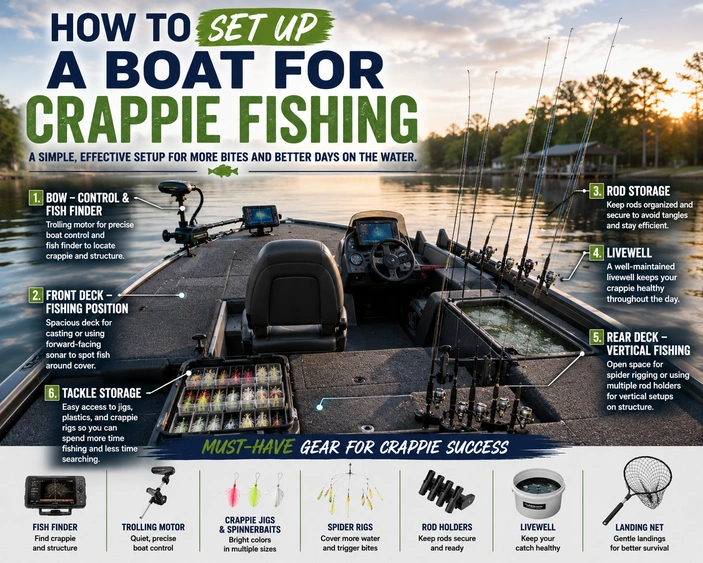
How to Set Up a Boat for Crappie Fishing
Crappie fishing rewards control, patience, clean organization, and the ability to stay on fish once you find them. That means your boat setup matters just as much as your rods, jigs, minnows, electronics, and fishing spots.
A good crappie fishing boat setup helps you move quietly, manage long rods, watch electronics clearly, keep tackle within reach, position over brush piles, troll at controlled speeds, and keep the deck safe when multiple anglers are fishing. A poor setup can make the boat feel cluttered, noisy, hard to control, and frustrating during the best part of the bite.
For anglers in Virginia, Pennsylvania, Maryland, West Virginia, and nearby areas, MotoMember helps shoppers compare fishing boats, G3 aluminum boats, jon boats, marine accessories, trailers, financing, trade-ins, and service support. MotoMember’s G3 boat guide notes that shoppers can compare jon boats, aluminum fishing boats, SunCatcher pontoons, trolling motor options, accessories, financing, trade-ins, and service support through the dealership team.
Start With the Way You Crappie Fish
Before adding accessories, think about your main crappie fishing style. A dock shooter, brush pile angler, spider-rigging fisherman, and long-line troller may all want different boat layouts.
Many shoppers start by asking, “What is the best crappie boat?” A better question is, “What setup helps me fish the way I fish most often?”
If you mostly fish brush piles, you may want strong electronics visibility, a quiet trolling motor, and precise boat positioning. If you spider rig, front seating and rod holder placement matter. If you long-line troll, you need open pathways, rod storage, speed control, and a layout that keeps lines separated.
Before choosing a boat or rigging plan, decide how often you fish:
- Brush piles
- Standing timber
- Docks
- Creek channels
- Shallow spring water
- Summer deeper water
- Long-line trolling patterns
- Spider-rigging setups
- Family fishing trips
Your setup should support your most common trips first.
Choose the Right Boat Layout
Crappie anglers often need a balance of open space, seating, rod management, electronics, and storage. The best layout is usually not the flashiest one. It is the one that makes slow, controlled fishing easier.
Jon Boats for Crappie Fishing
A jon boat can be a practical crappie platform because it is simple, open, and easy to customize. MotoMember’s jon boat setup guidance specifically notes that crappie anglers should prioritize trolling motor control, electronics visibility, long-rod storage, tackle trays, and seating.
A jon boat may work well if you fish smaller lakes, rivers, ponds, coves, or shallow water. It can also be easier to keep simple and uncluttered.
When setting up a jon boat for crappie, focus on:
- Stable front seating
- Trolling motor access
- Rod holder placement
- Battery location
- Simple tackle storage
- Clean wiring
- Safe deck space
Avoid overloading a smaller boat with too many accessories. Crappie gear adds up quickly.
Aluminum Fishing Boats
An aluminum fishing boat can offer more comfort, storage, and fishing-specific features than a basic jon boat. MotoMember’s G3 boat guide notes that G3 aluminum fishing boats may offer storage, seating, casting areas, livewell options, electronics-friendly layouts, and comfort for longer days.
This type of boat can be a strong direction for crappie anglers who fish bigger water, carry more gear, or want a more finished layout.
Look for:
- Open bow space
- Multiple seat bases
- Good livewell access
- Rod storage
- Electronics-friendly helm and bow areas
- Battery compartments
- Comfortable passenger seating
Deep-V and Multi-Species Layouts
Some crappie anglers prefer deep-V or multi-species boats because they handle bigger water and mixed conditions better than very flat layouts. G3’s official site lists Angler V models as rugged deep-V boats built for fishing and family use, while the Sportsman Series is described as all-aluminum fishing boats with modified-V hulls.
This type of layout may appeal to anglers who fish reservoirs, open lakes, windy conditions, or multi-species trips where crappie is one part of the plan.
The tradeoff is that a deeper boat may require more careful trolling motor shaft-length planning and more attention to front-deck setup.
Set Up the Front Deck for Crappie Fishing
The front deck is the command center for many crappie anglers.
This is where you may control the trolling motor, watch sonar, manage long rods, change jigs, grab the net, or adjust boat position over structure. A good front setup should feel calm and organized.
Front Seating
Crappie anglers often sit more than bass anglers. That makes seating position very important.
For spider rigging, two front seats may be useful if the boat supports them safely and comfortably. For solo brush pile fishing, one supportive front seat with a clear view of the electronics may be better.
Before choosing a layout, sit in the front fishing position and ask:
- Can I reach the trolling motor controls?
- Can I see the fish finder?
- Can I reach rods without twisting awkwardly?
- Can another angler sit nearby safely?
- Can I open storage lids?
- Is there room for a landing net?
A front deck that looks roomy empty can feel crowded once rods, holders, tackle, and electronics are installed.
Rod Holder Placement
Rod holders are a major part of many crappie setups. Placement depends on whether you spider rig, troll, drift, or fish vertically.
For spider rigging, rod holders are often placed forward where anglers can monitor several rod tips at once. For long-line trolling, holders may be spread to help separate lines. For brush pile fishing, fewer holders may be needed, with more emphasis on precise boat position.
Do not drill holes until you have tested the seating position, rod angles, electronics view, and movement around the deck. The best rod holder location is the one that works with your body position, not just the one that looks symmetrical.
Add the Right Trolling Motor Setup
A trolling motor is one of the most important tools on a crappie boat. It helps you move quietly, hold on structure, control drift, follow contours, and keep baits in the strike zone longer.
For many crappie anglers, a bow-mounted trolling motor is the preferred choice because it gives more precise control from the fishing position. Shaft length, thrust, voltage, battery capacity, and control style all matter.
Minn Kota’s motor selection guidance explains that shoppers should determine both power needs and shaft size, and its shaft-length chart is based on the distance from the mounting surface to the waterline.
For crappie fishing, consider:
- Bow mount vs. transom mount
- Shaft length
- Thrust
- Voltage system
- Battery space
- Foot pedal, hand control, or remote
- GPS anchoring features
- Low-speed control
- Compatibility with electronics
For brush pile fishing, GPS-style anchoring can be helpful when compatible with your setup. For trolling, fine speed control and battery capacity may matter more than high top-end power.
Plan the Battery and Charging System
Crappie fishing often means long hours at low speed. Your battery system needs to support that.
If you run a trolling motor, fish finder, livewell, lights, and accessories, battery planning becomes a key part of the build. A weak or poorly wired system can shorten your fishing time and create frustrating electronics issues.
A good setup should include:
- Batteries matched to the trolling motor voltage
- Secure battery trays
- Clean terminal connections
- Proper circuit protection
- Charger compatibility
- Easy access for inspection
- Weight distribution that keeps the boat balanced
Do not assume one battery can comfortably support every accessory all day. Talk with the MotoMember team or a qualified marine technician about your full electrical load before adding major electronics or trolling motor upgrades.
Set Up Fish Finders and Electronics
Electronics are especially useful for crappie fishing because crappie often relate to brush, timber, depth changes, bait, docks, channels, and seasonal structure.
A simple setup may include one fish finder at the helm. A more advanced crappie setup may include a bow display, console display, mapping, GPS waypoints, and a transducer mounted where it gives the clearest reading for your fishing style.
For crappie, electronics should help you:
- Find brush piles
- Mark waypoints
- Watch depth changes
- Locate bait
- Hold over structure
- Follow creek channels
- Return to productive spots
If you fish from the bow, make sure your front electronics are visible from your normal seated or standing position. If you troll from the stern or console, your display location may need to change.
Do not mount a screen where it blocks rod holders, storage lids, or safe movement.
Organize Long Rod Storage
Crappie anglers often carry longer rods than many other freshwater anglers. That makes rod storage a major setup issue.
Long rods can be awkward in smaller boats. They can also break easily if they are stepped on, bent under gear, or left loose across the deck.
Plan for:
- Rod length
- Number of rods
- Safe transport
- Storage while running
- Quick access while fishing
- Separation from tackle bags and passengers
If your boat has built-in rod storage, check the usable length before assuming your crappie rods will fit. If not, consider safe aftermarket storage options that do not create trip hazards.
Keep Tackle Easy to Reach
Crappie tackle can look simple, but most anglers carry a lot of small items. Jig heads, plastics, minnows, floats, hooks, weights, line, scent, tools, and spare gear can quickly clutter the boat.
Organize tackle by how you fish.
For example:
- One box for jig heads
- One box for favorite plastics
- One tray for floats and weights
- One small kit for tools
- One bag for backup colors
- One compartment for bait supplies
- One dry area for rain gear and extra clothing
Keep the most-used items near the fishing position. Store backup tackle where it will not block the deck.
Plan the Livewell and Fish Care Setup
If you keep crappie legally or fish events where live fish care matters, understand your livewell system before the trip.
Make sure you know how to:
- Fill the livewell
- Run the aerator
- Drain the livewell
- Use any recirculation settings
- Keep the lid clear
- Access fish safely
- Clean the system after use
Follow current fishing regulations for the state and waterway where you fish. Rules can change by location, season, and species, so check official state resources before keeping fish.
Make the Boat Comfortable for Long Days
Crappie fishing can mean sitting in one area for extended periods. Comfort matters.
Good seating, back support, shade planning, reachable storage, and a clutter-free floor can make long trips much more enjoyable. This is especially important if you fish with kids, older family members, or guests who are not used to long hours on the water.
Comfort upgrades may include:
- Supportive fishing seats
- Seat bases in useful locations
- Cup holders or small storage
- Dry storage for clothing
- Easy cooler access
- A clean walkway
- A simple anchor setup
- Weather-ready gear
The goal is not to turn the boat into a lounge. It is to make the boat easier to fish from for several hours at a time.
Prepare Safety Gear
A crappie boat should be set up for safety before accessories.
BoatUS explains that recreational boats must carry Coast Guard-approved personal flotation devices that are in good, serviceable condition and properly sized for intended users. It also notes that required equipment varies by boat length and use.
Depending on the boat and where you operate, safety gear may include:
- Wearable life jackets
- Throwable flotation device when required
- Fire extinguisher when required
- Sound-producing device
- Navigation lights
- First-aid kit
- Anchor and rope
- Paddle or backup propulsion
- Basic tool kit
- Phone or marine communication device
Keep safety gear accessible. Do not bury life jackets, ropes, or emergency tools under tackle trays and rod bags.
Match the Setup to Local Water
Crappie fishing across VA, PA, MD, WV, and nearby areas can mean different water types. Some anglers fish small electric-only lakes. Others fish rivers, reservoirs, tidal areas, or larger open water.
Local water affects the setup.
For small lakes, a simple jon boat with a quiet trolling motor and clean rod storage may be ideal. For reservoirs, electronics, mapping, livewell space, and battery capacity may become more important. For family trips, a more comfortable aluminum fishing boat or pontoon-style layout may make sense.
MotoMember’s Pennsylvania fishing boat guide notes that shoppers can compare fishing boats, jon boats, G3 options, trailers, motors, accessories, financing, trade-ins, and service support through the dealership.
Our team can help you compare how different layouts work for your home water, tow vehicle, storage situation, and fishing style.
Avoid Common Crappie Boat Setup Mistakes
A crappie setup should make the boat easier to fish, not harder.
Common mistakes include:
- Adding too many rod holders too quickly
- Mounting electronics where they are hard to see
- Choosing the wrong trolling motor shaft length
- Underplanning the battery system
- Blocking storage lids with seats or holders
- Creating trip hazards with loose rods
- Forgetting livewell access
- Overloading a smaller boat with gear
- Ignoring trailer and storage needs
- Not testing the layout before drilling holes
Before permanent installation, mock up the setup. Sit where you will fish. Place rods where they will sit. Pretend to grab tackle, steer, net a fish, and move around the boat. Small layout issues are easier to fix before hardware is installed.
MotoMember Expert Tip
Before setting up a boat for crappie fishing, start with three questions: Where will I sit, where will the rods point, and where will I look?
Those three details determine a lot. Your seat location affects trolling motor control. Rod angles affect holder placement. Electronics visibility affects where the display should go. Battery location affects balance. Storage access affects how clean the deck stays.
Many shoppers focus on the boat first and the crappie setup later. In the showroom, our team often helps buyers think through seating, trolling motor control, rod storage, livewell access, and electronics before choosing a model or accessory package.
Large selection. Straightforward shopping. Real powersports and marine expertise.
Crappie Fishing Boat Setup Checklist
Use this checklist when comparing boats or planning upgrades:
- Stable front fishing position
- Comfortable crappie seats
- Trolling motor matched to boat and water
- Correct shaft length
- Battery system planned before installation
- Fish finder visible from fishing position
- Transducer location planned carefully
- Rod holders positioned for your technique
- Long-rod storage
- Tackle trays organized by use
- Livewell access
- Clear walkways
- Accessible safety gear
- Trailer and tow vehicle compatibility
- Service and accessory support
A good crappie boat setup should feel calm, organized, and repeatable. When the bite turns on, you should be fishing instead of fighting clutter.
Call to Action
Ready to set up a boat for crappie fishing?
Contact MotoMember or browse current inventory to compare fishing boats, G3 aluminum boats, jon boats, trolling motor options, electronics-friendly layouts, marine accessories, trailers, financing, trade-ins, and service support. G3 Boats lists aluminum fishing boats, Angler V models, Sportsman models, and SunCatcher pontoons among its fishing and family-focused lineup.
Current availability, equipment, pricing, and model details can change, so check MotoMember inventory or contact the team before planning around one exact boat or accessory package.
Your crappie fishing boat setup starts at MotoMember.
Stop dreaming. Start fishing.
Conclusion
Setting up a boat for crappie fishing is about control, comfort, organization, and efficiency. The right layout helps you manage rods, watch electronics, stay on structure, move quietly, store tackle, and fish longer with less frustration.
Start with your fishing style. Then build around seating, trolling motor control, electronics visibility, rod storage, battery planning, livewell access, and safety gear. Avoid copying someone else’s setup without thinking about your own water, crew, storage, and tow vehicle.
For anglers across Virginia, Pennsylvania, Maryland, West Virginia, and surrounding areas, MotoMember can help compare fishing boats, G3 options, jon boats, accessories, financing, trade-ins, and service support before and after the sale.
A better crappie setup does not just make the boat look organized. It helps you fish with more confidence every time you launch.
FAQ
What is the best boat setup for crappie fishing?
The best setup depends on how you fish. Many crappie anglers benefit from front seating, a quiet trolling motor, visible electronics, good rod holders, long-rod storage, tackle organization, and livewell access.
Is a jon boat good for crappie fishing?
Yes, a jon boat can be a practical crappie fishing platform, especially on smaller lakes, rivers, ponds, coves, and shallow water. Keep the setup simple, balanced, and organized so the boat does not become cluttered.
Do I need rod holders for crappie fishing?
Rod holders are very useful for spider rigging, trolling, and multi-rod techniques. Placement matters. Test seating position, rod angles, electronics visibility, and deck movement before permanent installation.
What trolling motor setup works best for crappie fishing?
Many crappie anglers prefer a bow-mounted trolling motor with good low-speed control. The right shaft length, thrust, voltage, battery setup, and control style depend on your boat, water conditions, and fishing method.
Can MotoMember help me set up a crappie fishing boat?
Yes. MotoMember can help shoppers compare fishing boats, G3 aluminum boats, jon boats, trolling motor options, electronics-friendly layouts, accessories, financing, trade-ins, and service support. Current availability and equipment can vary, so contact the team for current guidance.