
Best PWCs for Families: Comfort & Safety Guide

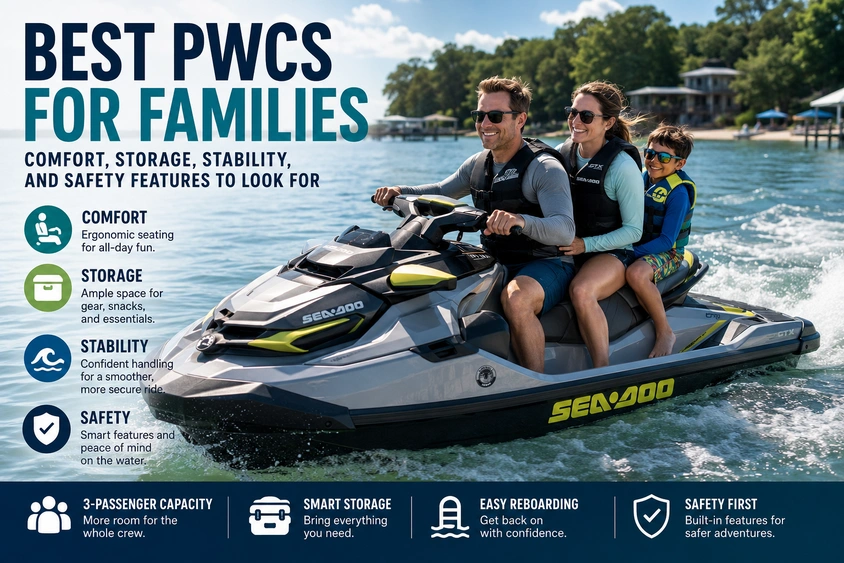
Best PWCs for Families: Comfort & Safety Guide
Shopping for the best PWCs for families is different from shopping for the fastest personal watercraft on the water. A family PWC needs to feel comfortable, predictable, stable, and easy to live with from the dock to the sandbar.
The right model should make everyone feel more confident: the driver, the passenger, the kids waiting for their turn, and the family member who always packs extra towels, snacks, sunscreen, and water bottles. That means comfort, storage, stability, reboarding ease, towing capability, and safety features matter just as much as horsepower.
At MotoMember, we help riders across Virginia, Pennsylvania, Maryland, and surrounding areas compare Sea-Doo, Yamaha WaveRunner, and Kawasaki Jet Ski models based on how they actually plan to ride. Whether your family wants relaxed lake cruising, towable fun, waterfront exploring, or a comfortable all-day ride, this guide will help you know what to look for before you buy.
Large selection. Straightforward shopping. Real powersports expertise.
What Makes a PWC Family-Friendly?
A family-friendly PWC is not just a personal watercraft with three seats. It is a machine designed to make shared time on the water easier, safer, and more enjoyable.
For most families, the best personal watercraft has a comfortable riding position, enough room for passengers, practical storage, predictable handling, and features that help new or occasional riders feel in control.
Many recreational and touring PWCs are built with these priorities in mind. Sea-Doo’s touring lineup, for example, emphasizes stability, comfort, and storage for longer rides, while Yamaha’s VX Series highlights practical storage and easy-access features. Kawasaki also offers three-passenger Jet Ski models with comfort-focused designs for longer days on the water.
Before focusing on one brand or model, think about how your family will use the PWC most often.
Will you cruise with two or three riders? Will you tow tubes? Will kids be climbing back on after swimming? Will you ride on lakes, rivers, bays, or larger open water? Your answers will point you toward the right size, hull design, seating layout, and storage setup.
Start With Stability
Stability should be one of the first features families consider. A stable PWC feels more planted at idle, during boarding, while carrying passengers, and when stopping near docks or swim areas.
Why Stability Matters for Families
Families often use PWCs differently than solo riders. You may have passengers shifting around, kids climbing on from the water, or a second adult helping with gear. A wider or more stable platform can make those moments feel less awkward.
Stability is especially important when:
You are loading passengers from a dock.
A rider is reboarding from the water.
You are cruising at slower speeds.
You are carrying a child passenger.
You are using the PWC as a base for swimming or tow-sports fun.
For family use, avoid choosing a model only because it is lightweight, aggressive, or performance-focused. Sport-oriented PWCs can be exciting, but many families are happier with recreational or touring models that prioritize balance and predictability.
Look for a Larger Riding Platform
A larger platform can make a PWC feel more secure when stopped or moving slowly. It also gives passengers more confidence when stepping on or off.
Sea-Doo notes that models like the GTX, GTX Limited, and Explorer Pro are built around larger, stable platforms for longer rides and extra storage. That type of design direction is often a better match for family cruising than a compact performance-first machine.
For Yamaha shoppers, the VX Series is a popular recreational category with family-friendly features such as large bow storage and a convenient reboarding step on select models.
Choose Comfortable Seating
Comfort is easy to overlook in the showroom, but it matters once you are 45 minutes into a ride. Families should pay attention to seat shape, passenger space, footwell room, handle placement, and overall riding posture.
Three-Passenger Seating Is Usually the Sweet Spot
For most families, a three-passenger PWC is the best place to start. It gives you more flexibility for riding with a spouse, child, friend, or spotter when towing.
A three-person capacity can also be important for tow sports. In many places, towing a tube or skier requires room for the operator, an observer, and the person being towed. Local regulations vary, so always check the laws for the waterway where you ride.
Even if you do not plan to ride with three people all the time, the extra seat length often makes the PWC more comfortable for two riders.
Pay Attention to Passenger Handles
Passenger handles are a small detail that make a big difference. A secure passenger feels more relaxed, especially during turns, acceleration, and choppy water.
Look for handles that are easy to grip and positioned naturally. This matters for younger riders and adults who are new to PWCs.
Consider Touring Seats for Longer Rides
If your family wants longer cruises, waterfront restaurant trips, or full afternoons on the water, consider models with more comfort-focused seating. Touring-style seats usually provide better support and a more relaxed posture than sport seats.
Your Sea-Doo Headquarters starts at MotoMember if you are comparing comfort-focused touring models, recreational cruisers, and family-ready PWC options in one place.
Storage Is a Big Deal for Family Riding
When families shop for PWCs, storage often becomes more important than expected. A solo rider might bring a phone and a bottle of water. A family brings towels, sunscreen, snacks, dock lines, dry clothes, goggles, waterproof bags, and safety gear.
Bow Storage
Bow storage is one of the most useful features on a family PWC. It gives you a larger compartment for bulkier items and keeps essentials out of the way while riding.
Yamaha highlights large bow storage in its VX lineup, describing it as useful for towels, personal items, and other essentials.
Sea-Doo also positions its touring models as long-ride machines with room for gear, lunch, and adventure supplies.
Glovebox and Dry Storage
A glovebox is ideal for smaller items you want close by, such as keys, sunglasses, wallet, phone, lip balm, or sunscreen. Some models offer watertight compartments, USB ports, phone storage, or accessory-ready spaces.
For families, dry storage helps reduce stress. You do not want to discover that a phone, key fob, or snack bag got soaked because everything was loose under the seat.
Swim Platform and Rear Storage Options
The rear deck area is important if your family swims from the PWC, uses towable tubes, or frequently boards from the water. Some models and accessory systems make it easier to add coolers, dry bags, fuel caddies, or storage boxes.
Before buying accessories, talk with the MotoMember team about compatibility. Not every storage add-on fits every model, and weight distribution matters on the water.
Reboarding Features Make Family Days Easier
A reboarding step can be one of the most family-friendly features on a PWC. After swimming, tubing, or falling off, riders need a simple way to climb back aboard.
Why a Reboarding Step Matters
Without a reboarding step, climbing back on can be difficult, especially for kids, shorter riders, or tired passengers. A fold-down reboarding step gives the rider a lower foothold and makes the process smoother.
Yamaha lists a convenient reboarding step as a feature on certain VX models, designed to fold away when not in use.
For family buyers, this is worth prioritizing. It can make the difference between a fun swim stop and a frustrating one.
Check the Rear Platform Layout
Beyond the step itself, look at the rear deck. Is there space to kneel? Are the grab points easy to reach? Does the seat shape make it easy to slide back into position?
These details matter when kids are getting back on repeatedly during a day at the lake.
Safety Features Families Should Look For
Safety starts with responsible operation, proper gear, and following local boating laws. Still, the right PWC features can help make riding easier and more controlled.
Braking and Reverse Systems
Modern PWCs often include systems that help with low-speed maneuvering, docking, reverse, and deceleration. These can be especially helpful for newer riders.
For example, Sea-Doo’s iBR system is designed to assist with braking and reverse control on equipped models. Yamaha’s RiDE system and Kawasaki’s Smart Reverse systems serve similar low-speed control purposes on select models, though exact availability depends on the model and year.
When shopping, ask which control systems are included on the specific unit you are considering. Do not assume every trim has the same features.
Speed Control and Learning Modes
Some PWCs offer speed-limiting, drive modes, or security settings. These features can be helpful for families with newer operators or shared use among adults with different experience levels.
A calmer riding mode can make the PWC feel less jumpy and easier to manage. That is useful when teaching responsible operation or riding in crowded areas.
Engine Cut-Off Switch
A safety lanyard or engine cut-off switch is essential. The operator should attach it properly every time. If the operator falls off, the system is designed to stop the engine.
Make this part of your family’s launch routine: life jackets on, lanyard attached, passengers seated, surroundings checked, then start the ride.
Mirrors and Tow-Sports Visibility
If you plan to tow tubes or wake toys, mirrors can help the operator maintain awareness. However, mirrors do not replace a proper observer where required.
For families interested in tow sports, choose a PWC with the right seating capacity, tow point setup, and visibility features.
Life Jackets and Required Safety Gear
Every rider needs the right safety gear. That begins with a properly fitted U.S. Coast Guard-approved life jacket.
The Pennsylvania Fish and Boat Commission states that boats must have a good, serviceable, U.S. Coast Guard-approved life jacket for each person, and that life jackets must be readily accessible and properly fit each person.
For PWC riders, the practical family rule is simple: everyone wears a properly fitted life jacket every ride.
Fit Matters for Kids
Do not buy a life jacket for a child to “grow into.” A loose jacket can ride up and fail to support the child correctly in the water.
Check the label for weight range, size, and U.S. Coast Guard approval. Fasten all straps and buckles before leaving the dock.
Know Local Rules
Life jacket laws vary by state and waterway. BoatUS notes that state requirements differ and that parents should still decide when a child should wear a life jacket even beyond the legal minimum.
MotoMember serves riders across VA, PA, MD, and surrounding areas, so it is especially important to check the specific rules where you ride.
Best Types of PWCs for Families
Instead of asking, “What is the fastest PWC?” families should ask, “What type of PWC fits how we ride?”
Here are the main categories to compare.
Recreational PWCs
Recreational PWCs are often the best fit for first-time family buyers. They usually offer a strong balance of price, comfort, stability, fuel efficiency, and everyday usability.
Models in this category are great for lake cruising, short trips, casual exploring, and occasional tow sports. Yamaha’s VX Series and Sea-Doo’s GTI lineup are examples many families compare when shopping for a versatile recreational PWC.
MotoMember’s new watercraft inventory includes Yamaha, Sea-Doo, and Kawasaki options across multiple locations, giving shoppers a practical way to compare brands and sizes in person.
Touring PWCs
Touring PWCs are designed for longer rides and extra comfort. They often have larger platforms, premium seating, more storage, and smoother long-distance manners.
If your family wants to cruise for hours, explore bigger water, or carry more gear, a touring PWC may be worth the upgrade.
Sea-Doo’s touring category highlights stability, comfort, and convenience for two to three riders, making it a useful category for families who want a more relaxed ride.
Performance PWCs
Performance PWCs are exciting, but they are not always the best first choice for families. Higher horsepower, sharper acceleration, and sportier handling can be more than some families need.
That does not mean performance models are wrong. They can be a good fit for experienced riders who still want passenger capacity and comfort. But if the main goal is family cruising, stability and control should come first.
Fishing or Adventure PWCs
Fishing and adventure-focused PWCs can appeal to families who want versatility. They may offer extra storage, accessory mounting options, coolers, navigation equipment, or extended cruising features.
These can be excellent for families that fish, explore, picnic, or spend long days away from the dock. Just make sure the added accessories do not get in the way of your main family riding needs.
Sea-Doo vs. Yamaha vs. Kawasaki for Families
Each major PWC brand has strong family options. The best choice depends on your budget, riding style, comfort preferences, and available inventory.
Sea-Doo Family PWCs
Sea-Doo offers a wide range of recreational, touring, fishing, and performance models. Families often compare Sea-Doo because of its stable platform designs, storage solutions, accessory systems, and comfort-focused trims.
MotoMember has a dedicated Sea-Doo page where shoppers can explore the lineup and view inventory.
If your family wants a blend of easy ownership, storage, and comfort, start with recreational and touring Sea-Doo models before moving into more aggressive performance trims.
Yamaha WaveRunner Family PWCs
Yamaha WaveRunners are popular with families looking for practical features, clean layouts, and recreational versatility. The VX Series is a common family-shopping category because it emphasizes everyday usability, storage, and comfort-oriented features.
MotoMember also offers Yamaha Watercraft inventory for riders comparing WaveRunner options.
If your family wants a straightforward, confidence-inspiring PWC for cruising, swimming, and towable fun, Yamaha’s recreational lineup is worth a close look.
Kawasaki Jet Ski Family PWCs
Kawasaki Jet Ski models are known for strong performance and bold styling, but the lineup also includes three-passenger models built for comfort and longer days on the water.
Kawasaki describes the Jet Ski STX 160 as a three-passenger personal watercraft with comfort and convenience features for all-day adventures.
Families who want a sporty feel without giving up passenger capacity should compare Kawasaki’s three-passenger recreational and touring-style options.
Buying Tips for Family PWC Shoppers
A PWC can look great online, but the right decision often happens when you sit on the machine, compare storage, and picture your real day on the water.
Sit on the PWC as a Family
Have the main driver and passengers sit on the PWC in the showroom. Check seat spacing, handle reach, footwell room, and comfort.
Ask yourself:
Can everyone sit naturally?
Does the passenger feel secure?
Is the seat comfortable enough for longer rides?
Can kids reach handles safely?
Does the driver feel in control?
A few minutes in the showroom can reveal a lot.
Match the PWC to Your Water
Lake riders may prioritize easy cruising, tow sports, and sandbar stops. River riders may care more about maneuverability and predictable handling. Bay and larger-water riders may want more size, comfort, and storage.
Be honest about where you ride most often. The “best” PWC for calm inland lakes may not be the best choice for longer rides in choppier water.
Think About Trailering and Storage
Family ownership also includes everything off the water. Consider trailer size, garage space, towing vehicle capacity, winter storage, and maintenance access.
A slightly larger PWC may feel better on the water, but make sure it also works with your towing and storage setup.
Compare New vs. Used
A new PWC gives you access to current features, warranty coverage, and the latest model options. A used PWC may help lower the entry cost, depending on condition, hours, service history, and availability.
For family buyers, condition and reliability matter. Ask about service records, prior use, maintenance needs, and any included accessories.
Ask About Accessories Before You Buy
Popular family PWC accessories may include:
Dock lines
Fenders
Waterproof bags
Coolers
Tow ropes
Tube attachments
Covers
Safety kits
Extra life jackets
Audio systems
Storage accessories
Buying the right accessories from the start helps your first day on the water go smoother.
Why Shop Family PWCs at MotoMember?
MotoMember is built for powersports shoppers who want selection, guidance, and a straightforward buying experience. With locations serving Virginia, Pennsylvania, Maryland, and surrounding areas, MotoMember gives families access to major brands, helpful product knowledge, and a large in-stock watercraft selection.
MotoMember’s new watercraft inventory includes Yamaha, Sea-Doo, and Kawasaki models across multiple locations, including Purcellville, Manassas, and Chambersburg.
That matters when you are comparing family PWCs. You can look at seat comfort, storage, boarding areas, controls, accessories, and overall size before making a decision.
Stop dreaming. Start riding.
Call to Action
Ready to find the best PWC for your family? Visit MotoMember to explore available watercraft, compare family-friendly models, and connect with a knowledgeable team that can help you choose the right Sea-Doo, Yamaha WaveRunner, or Kawasaki Jet Ski for your riding style.
Browse new watercraft inventory, explore Sea-Doo models, or check out Yamaha Watercraft today.
Your next family adventure starts at MotoMember.
Conclusion
The best PWCs for families are comfortable, stable, practical, and easy to enjoy. Look beyond horsepower and focus on the features that make real family days better: three-passenger seating, a stable hull, useful storage, a reboarding step, intuitive controls, safety systems, and the right accessories.
Sea-Doo, Yamaha, and Kawasaki all offer strong options for family riders. The right choice depends on how your family wants to ride, where you plan to use it, and which features make everyone feel confident on the water.
Large selection. Straightforward shopping. Real powersports expertise. That is what makes MotoMember a trusted destination for family PWC shoppers across VA, PA, MD, and beyond.
FAQ
What is the best type of PWC for families?
Most families should start by comparing three-passenger recreational or touring PWCs. These models typically offer the best mix of comfort, stability, storage, and everyday usability.
Is a three-passenger PWC better for families?
Yes, in most cases. A three-passenger PWC gives families more room, better flexibility, and the capacity needed for many tow-sports situations where an operator and observer may be required.
What safety features should I look for in a family PWC?
Look for braking and reverse assist systems, speed control or riding modes, a safety lanyard, good mirrors, secure passenger handles, and a stable platform. Always pair those features with properly fitted U.S. Coast Guard-approved life jackets.
How much storage does a family PWC need?
More than you think. Families should look for large bow storage, a glovebox, dry storage, and accessory options for towels, snacks, sunscreen, dock lines, and safety gear.
Are PWCs safe for kids?
PWCs can be safe for family use when operated responsibly, with proper supervision, age-appropriate passengers, correct life jackets, and compliance with local boating laws. Kids should always wear a properly fitted life jacket and ride with a responsible adult operator.