SunCatcher Pontoon U-Shape Design Advantages

SunCatcher Pontoon U-Shape Design Advantages
A pontoon boat looks simple from the dock: a wide deck, comfortable seating, an outboard, and flotation underneath. But once you start comparing brands, the foundation under the floor becomes one of the most important parts of the buying decision.
That is especially true with SunCatcher pontoons. SunCatcher, a Yamaha Boat Company brand associated with G3 Boats, uses a distinctive U-shaped pontoon log design instead of relying only on the traditional round-log approach many shoppers picture when they think of pontoons. The result is a construction philosophy built around rigidity, surface contact, flotation support, and real-world performance. SunCatcher’s current lineup includes model families such as Amara, Elite, Fusion, and Select.
For shoppers in VA, PA, MD, WV, and nearby areas, MotoMember can help compare SunCatcher layouts, Yamaha-powered packages, trailers, accessories, financing, trade-ins, and service needs. Current inventory and equipment can change, so the best next step is to compare available SunCatcher pontoons with the MotoMember team before choosing a specific model.
What Is SunCatcher’s U-Shaped Pontoon Design?
Most pontoon buyers focus first on seating, horsepower, colors, audio, and price. Those are important, but the structure under the deck determines how solid the boat feels, how efficiently it rides, and how confidently it supports passengers and gear.
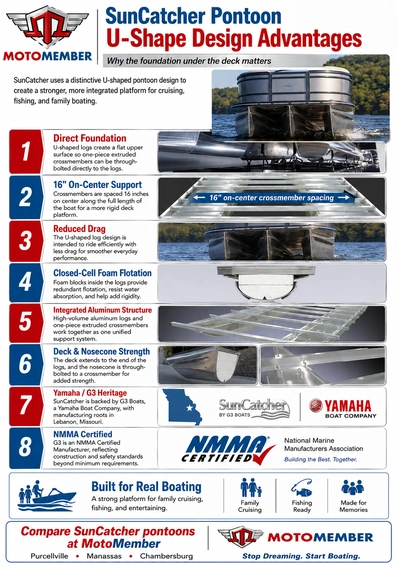
SunCatcher’s construction page explains that its pontoon foundation starts with high-volume U-shaped flotation logs. Instead of using a round tube with brackets welded on top to create a flat mounting area, SunCatcher through-bolts one-piece extruded crossmembers directly to the top of the U-shaped logs.
That matters because a U-shaped log creates a broad, flat upper surface for the crossmembers. In practical terms, the pontoon log and the deck support structure can be tied together more directly.
For a boat buyer, that translates into a simple question: does the pontoon feel like one connected structure, or does it feel like a deck sitting on top of floats? SunCatcher’s U-log design is intended to create a stronger, more integrated foundation.
Advantage 1: A More Direct Foundation Under the Deck
The biggest advantage of the SunCatcher U-shaped pontoon design is how the crossmembers connect to the logs.
SunCatcher says the preferred way to build a superior pontoon foundation is to through-bolt one-piece extruded crossmembers directly to the top of the U-shaped flotation logs. The company also notes that this method is more labor-intensive than simpler construction approaches.
Why Crossmembers Matter
Crossmembers are the structural supports that run across the boat under the deck. They help tie the deck, logs, furniture, console, passengers, fuel system, and gear into one foundation.
On a pontoon, flex is the enemy. Too much flex can make the boat feel less solid, especially when crossing wakes, loading passengers, docking, or cruising with gear onboard.
SunCatcher’s approach is built to reduce that flex by connecting the deck support structure directly to the flotation logs. This is not just a “spec sheet” detail. It is the kind of construction difference shoppers should ask about when comparing pontoons side by side.
Advantage 2: 16-Inch-On-Center Crossmember Spacing
SunCatcher states that its crossmembers are attached 16 inches on center for the full length of the boat and that this approach is used across all SunCatcher models. That is important because tighter, consistent support spacing can help create a more rigid platform from bow to stern.
Why Full-Length Support Helps
A pontoon deck carries more than people. It supports furniture bases, storage areas, batteries, fuel, coolers, fishing gear, tables, towers or arches on select models, boarding traffic, and the constant vibration of use on the water.
When shoppers compare pontoons, many look at the floor plan from above. MotoMember recommends also thinking about what is happening underneath.
Full-length crossmember support helps create a more consistent foundation. That can matter for families who carry several passengers, anglers who move around the deck, and boaters who trailer often.
Advantage 3: U-Shaped Logs Can Reduce Drag
SunCatcher’s official construction material says U-shaped logs sit higher in the water with less drag on the side of the pontoon, which the company connects to better fuel efficiency and performance.
That does not mean every SunCatcher model will perform the same way. Performance depends on boat length, two-log or three-log configuration, engine choice, load, propeller, water conditions, fuel, trim, and how the boat is operated.
But the design logic is clear. If the log shape helps the pontoon ride efficiently, the boat can feel more responsive and composed for everyday cruising.
What This Means for Real Boaters
For local boaters running inland lakes, rivers, coves, and calm recreational waterways, efficiency is not just about saving fuel. It affects the feel of the boat.
A pontoon that gets on plane confidently, holds speed smoothly, and feels planted with passengers onboard can make the day more enjoyable. That is especially true when the boat is used for family cruising, tubing where properly equipped, fishing, swimming, and entertaining.
Advantage 4: Closed-Cell Foam Flotation Blocks
SunCatcher adds closed-cell foam flotation blocks inside the logs. The company describes this as redundant flotation, meaning the foam provides backup flotation support even in the unlikely event of a log puncture. SunCatcher also states that the lightweight foam blocks do not absorb water and add rigidity to the log.
This is one of the most important details shoppers often miss.
Why Redundant Flotation Matters
Traditional air-filled pontoon logs depend on sealed air chambers for buoyancy. SunCatcher’s foam-supported approach adds another layer to the flotation conversation.
For buyers, the takeaway is not that you should ignore safe operation or maintenance. You still need to inspect your boat, operate responsibly, and follow the owner’s manual. The takeaway is that SunCatcher designs its logs with additional flotation support inside the structure.
That can be reassuring for families, anglers, and first-time boaters who want a pontoon built with safety-minded engineering.
Advantage 5: Less Reliance on Spot-Welded Bracket Solutions
SunCatcher compares its U-log construction to pontoon designs that use spot-welded “M”-shaped brackets to create a mounting platform on top of round logs. According to SunCatcher, those brackets compensate for the lack of flat surface area on a round pontoon log, while the U-shaped log gives the crossmembers a direct mounting surface.
This is a deeper construction point, but it matters.
A round tube is strong in many ways, but it does not naturally give builders a broad flat surface on top. To attach a deck-support structure, builders may need additional brackets or mounting systems.
SunCatcher’s U-shaped log creates the flat upper surface as part of the log design. That is why the company emphasizes through-bolting crossmembers directly to the logs rather than building up an artificial platform.
Advantage 6: Aluminum Construction Where Design Matters Most
Pontoon buyers often ask, “What quality of aluminum does SunCatcher use?”
The most accurate answer is this: SunCatcher’s current official construction materials emphasize the engineering of the aluminum structure more than a universal public alloy or gauge number for every model. The official construction page specifically highlights high-volume U-shaped flotation logs, one-piece extruded crossmembers, through-bolted construction, and full-length under-deck performance shields.
That distinction matters because not all “aluminum pontoons” are built the same. Aluminum is widely valued in transportation and marine-style applications because it offers a useful combination of light weight, corrosion resistance, versatility, and strength-to-weight benefits.
Why MotoMember Recommends Confirming Model-Specific Specs
It is easy to overpromise when talking about aluminum. Many manufacturers use different materials, gauges, reinforcements, and construction details depending on model, year, package, and performance level.
Rather than guessing at an alloy or gauge that may not apply to every SunCatcher pontoon, MotoMember recommends confirming the exact model’s current specifications, construction details, and package equipment before purchase.
Our team can help you compare the build details that matter most: log configuration, motor package, trailer fit, flooring, seating, electronics, storage, warranty process, and service support.
Advantage 7: Decking and Nosecone Integration
SunCatcher says its decks extend to the end of the pontoon log, and the tip of the nosecone is through-bolted to a crossmember. The company says this adds strength to the foundation and helps maximize deck space.
SunCatcher also lists 3/4-inch top-quality 6-ply marine-grade treated plywood for pontoon decking, with a limited lifetime guarantee direct from the manufacturer. Full-length under-deck performance shields are listed as standard and are described as supporting fuel efficiency, speed, and durability.
Why This Matters on the Water
A pontoon’s deck is where your boating life happens. It supports passengers, furniture, coolers, fishing gear, towels, pets, kids, snacks, batteries, audio components, and repeated boarding from the dock or water.
The stronger and more supported that deck foundation is, the better the pontoon can feel over time. When comparing pontoons, ask how the deck is supported, how the nosecones tie into the frame, and whether the structure feels consistent from bow to stern.
Advantage 8: Yamaha and G3 Manufacturing Experience
SunCatcher is tied closely to G3 Boats and Yamaha. G3’s history traces back to 1992 as “Generation III Boats,” founded by a third-generation boat builder in Lebanon, Missouri. Yamaha Motor Corporation acquired the company in 1997, and G3 became a Yamaha Boat Company.
Yamaha’s careers page for G3 Boats describes a 48-acre campus in Lebanon, Missouri, with 235,000 square feet of manufacturing space where more than 100 boat models are produced. It also describes G3 as building aluminum fishing boats and pontoons with a team of craftspeople, many with decades of boat-building experience.
Why Build Location Matters
Boat buyers often care where a product is built because manufacturing consistency, parts support, warranty process, and dealer communication all matter after the sale.
A pontoon is not a disposable purchase. It needs seasonal care, proper storage, service support, and a dealer who can help answer questions after delivery.
For shoppers in VA, PA, MD, and nearby areas, that is where MotoMember adds value. We can help you compare the boat itself and the ownership plan that comes with it.
Advantage 9: NMMA Certification and Construction Standards
SunCatcher’s website identifies G3 as an NMMA Certified Manufacturer. The page explains that G3 voluntarily goes beyond minimum U.S. Coast Guard standards to meet more comprehensive safety and construction standards set by the American Boat and Yacht Council.
The same page notes that NMMA certification involves inspection and construction practices for major safety systems and components, including items such as fuel systems, grab handles, re-boarding ladders, and other equipment.
Why Certification Should Matter to Shoppers
Certification does not replace your responsibility to operate safely, follow capacity labels, maintain the boat, and use the right safety gear. But it does give shoppers another way to evaluate a manufacturer’s process.
When you are comparing pontoon brands, ask about certification, warranty, dealer support, and service access. Those factors can matter as much as upholstery color or audio upgrades.
Advantage 10: A Better Platform for Family, Fishing, and Cruising Layouts
SunCatcher’s U-shaped pontoon design is not only about engineering. It supports the real reason people buy pontoons: usable space.
A strong, rigid foundation makes sense for a boat designed around people moving, sitting, fishing, swimming, relaxing, and entertaining. SunCatcher’s model families give shoppers different ways to prioritize comfort, value, performance, fishing function, or premium amenities.
Family Cruising
For families, a pontoon should feel stable, open, and comfortable. A strong foundation helps support the furniture, deck traffic, coolers, towels, kids, and guests that come with a full lake day.
Fishing
For anglers, stability and deck space matter. Fishing pontoons benefit from room to cast, move around, store rods, manage tackle, and relax between bites.
Entertaining
For social boaters, the foundation supports the features everyone sees: lounges, tables, sound systems, shade, swim ladders, and open walkways.
The U-shaped log design may be underneath the boat, but it supports everything passengers enjoy above it.
MotoMember Expert Tip
When comparing SunCatcher pontoons, do not shop only by length or horsepower.
Start with your normal boating day. How many people usually come with you? Will you fish, cruise, swim, tow, entertain, or trailer to different lakes? Do you need a compact pontoon that is easy to manage, or a larger layout with more seating and storage?
Then ask the MotoMember team to walk you through the foundation: two-log vs. three-log setup, U-shaped log construction, crossmember support, deck layout, trailer fit, Yamaha outboard package, warranty process, and service needs.
The right pontoon is not just the one that looks good in the showroom. It is the one that fits how you actually boat.
Why Buy a SunCatcher Pontoon from MotoMember?
MotoMember helps shoppers compare SunCatcher pontoons with practical dealership guidance. Our team can help you understand available layouts, current inventory, Yamaha outboard packages, trailer options, financing, trade-ins, accessories, and long-term ownership support.
MotoMember serves customers across Virginia, Pennsylvania, Maryland, West Virginia, and surrounding areas, with dealership locations including Purcellville, Manassas, and Chambersburg. MotoMember carries brands including SunCatcher, Yamaha, Can-Am, Sea-Doo, Polaris, Slingshot, Kawasaki, and others.
Large selection. Straightforward shopping. Real powersports and marine expertise.
Call to Action
Ready to compare SunCatcher pontoons with U-shaped log construction?
Contact MotoMember or visit the showroom to compare current SunCatcher pontoon inventory, Yamaha-powered packages, trailer options, financing, and trade-in opportunities. Availability, pricing, model year, and equipment can change, so check current inventory or speak with the MotoMember team before visiting.
Stop dreaming. Start boating.
Conclusion
The biggest advantage of the SunCatcher U-shaped pontoon design is not one single feature. It is the way multiple construction decisions work together.
High-volume U-shaped logs create a direct foundation for through-bolted one-piece extruded crossmembers. Full-length 16-inch-on-center support helps create rigidity. Closed-cell foam blocks add redundant flotation. Decking, nosecone integration, and under-deck performance shields all contribute to the overall structure. SunCatcher also benefits from G3’s Yamaha-backed boat-building heritage and NMMA certification.
For buyers in VA, PA, MD, WV, and nearby areas, MotoMember can help turn those construction details into a confident buying decision.
FAQ
What is the main advantage of SunCatcher’s U-shaped pontoon design?
The main advantage is the foundation. SunCatcher’s U-shaped logs provide a flat upper surface that allows one-piece extruded crossmembers to be through-bolted directly to the flotation logs, helping create a rigid deck support system.
Are SunCatcher pontoons made with aluminum?
Yes. SunCatcher pontoons use aluminum structural components such as flotation logs and one-piece extruded crossmembers. The current official construction page emphasizes the U-shaped aluminum log design, through-bolted construction, crossmember spacing, foam flotation, decking, and under-deck performance shields rather than publishing one universal alloy or gauge for every model.
Where are SunCatcher pontoons built?
SunCatcher is connected to G3 Boats, a Yamaha Boat Company. G3’s history is tied to Lebanon, Missouri, and Yamaha’s careers page describes G3’s 48-acre Lebanon campus with 235,000 square feet of manufacturing space where more than 100 boat models are produced.
What does closed-cell foam flotation do in a SunCatcher pontoon?
SunCatcher says the foam blocks inside the logs provide redundant flotation, meaning backup flotation support in the unlikely event of a log puncture. The company also states the blocks do not absorb water and add rigidity to the log.
Can MotoMember help compare SunCatcher pontoon models?
Yes. MotoMember can help compare SunCatcher layouts, current availability, Yamaha outboard packages, trailers, accessories, financing, trade-ins, and service needs for shoppers in VA, PA, MD, WV, and surrounding areas. Current inventory can vary, so contact MotoMember before making a final decision.