Pontoon vs. Tritoon: Which Boat Is Better?

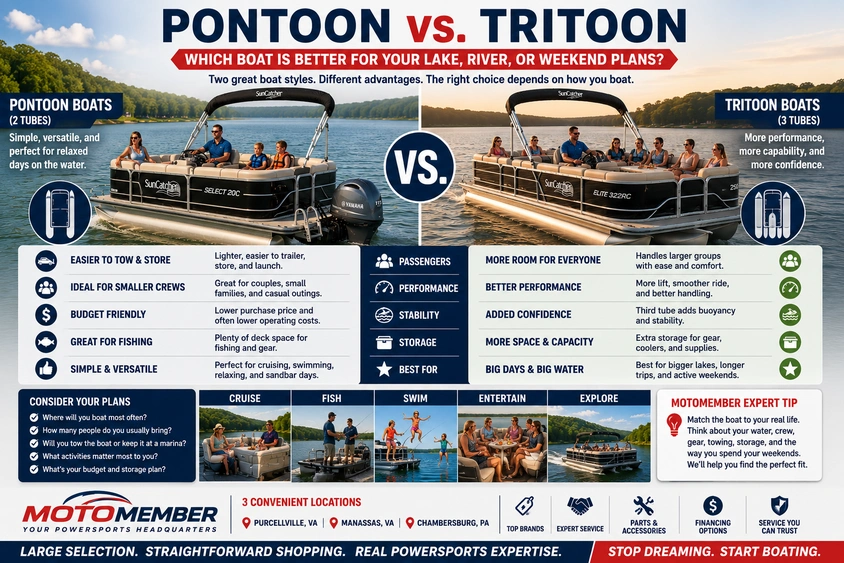
Pontoon vs. Tritoon: Which Boat Is Better for Your Lake, River, or Weekend Plans?
When shoppers compare pontoon vs. tritoon boats, they are usually trying to answer one practical question: which setup will feel better for the way they actually use the water?
A traditional pontoon boat uses two pontoons, often called tubes, beneath the deck. A tritoon uses three. That third tube can change how the boat feels, handles, carries weight, and performs depending on the model, engine pairing, passengers, gear, and water conditions.
For families, anglers, lake homeowners, weekend cruisers, and first-time boat buyers, both styles can make sense. The right answer depends on where you boat, how many people you bring, whether you tow, what activities matter most, and how much performance you want.
MotoMember helps shoppers across Virginia, Pennsylvania, Maryland, West Virginia, and nearby areas compare pontoon boats, available SunCatcher models, accessories, financing options, service support, and ownership needs. MotoMember is a full-service dealership group with locations listed in Purcellville, Virginia; Manassas, Virginia; and Chambersburg, Pennsylvania, and it represents brands including SunCatcher, Yamaha, G3, Sea-Doo, Can-Am, Polaris, Kawasaki, Slingshot, and others.
What Is a Pontoon Boat?
A pontoon boat is built on two flotation tubes beneath a wide deck. This design creates a stable, comfortable platform that works well for cruising, fishing, entertaining, swimming, and relaxing days on the water.
Traditional pontoons are popular because they are approachable and versatile. Many families like them because they feel roomy and social. Anglers like the open deck space. First-time buyers often appreciate the comfortable seating and relaxed boating experience.
SunCatcher’s official site lists current pontoon model families including Select, Fusion, Elite, and Amara, with Select models shown in multiple size ranges from compact layouts through larger configurations.
What Is a Tritoon Boat?
A tritoon boat is a pontoon-style boat with three tubes instead of two. That center tube can provide added buoyancy and can help support higher performance setups, larger passenger loads, and more confident handling depending on the design.
Many shoppers consider a tritoon when they want a smoother-feeling ride, more capability with passengers and gear, or better performance for bigger lakes and active weekends.
A tritoon is not automatically “better” for every buyer. It may be more boat than some families need. But for the right shopper, the third tube can make a meaningful difference.
Pontoon vs. Tritoon: The Simple Difference
The simplest difference is the number of tubes.
A pontoon has two tubes.
A tritoon has three tubes.
That one design change can affect comfort, performance, handling, weight capacity, engine options, towing needs, storage planning, and budget.
The best way to compare them is not by asking which one is better overall. It is better to ask which one is better for your lake, river, passengers, activities, tow vehicle, storage plan, and budget.
Choose a Pontoon If You Want Simplicity and Comfort
A two-tube pontoon can be an excellent choice for relaxed boating. If your ideal weekend includes cruising, anchoring, fishing, swimming, and enjoying time with family, a traditional pontoon may fit very well.
Best Uses for a Pontoon Boat
A pontoon may be the right fit if you mostly boat on calmer lakes, bring a moderate number of passengers, prefer relaxed cruising, want a more straightforward ownership experience, and do not need maximum performance.
For many families, a pontoon offers exactly what they want: room to sit, room for gear, shade, storage, and a comfortable way to enjoy the water.
Why Families Like Pontoons
Families often choose pontoons because they make boating feel easy. There is space for kids, grandparents, coolers, towels, life jackets, snacks, bags, fishing rods, and water toys.
A pontoon also keeps people connected. Instead of everyone facing different directions or crowding into small seating areas, passengers can relax and talk comfortably.
Why Anglers Like Pontoons
Fishing pontoon boats can provide open deck space, fishing seats, rod storage, livewell options, and comfortable seating for long days. MotoMember inventory pages have included fishing-focused SunCatcher models such as the Select 18F and Select 20F, though availability, model year, pricing, and equipment can change. Shoppers should confirm current details directly with MotoMember before visiting.
Choose a Tritoon If You Want More Performance and Capability
A tritoon can be a better choice for shoppers who want more from their boat. The third tube can support more confident handling, heavier loads, and stronger performance depending on the model and setup.
Best Uses for a Tritoon Boat
A tritoon may be right if you regularly bring larger groups, cruise on bigger or busier water, want more power, care about handling, plan longer weekend outings, or want a more premium feel.
If you often load the boat with passengers, coolers, water toys, fishing gear, and supplies, a tritoon may feel more planted and capable.
Why Families Consider Tritoons
A family that brings guests often may appreciate the added capability of a tritoon. More people usually means more gear, more movement, more storage needs, and more demand on the boat.
A tritoon can be especially appealing for families who want one boat for cruising, entertaining, swimming, and occasional watersports.
Why Weekend Boaters Consider Tritoons
If your weekends are long and active, the boat has to do more. You may leave the dock in the morning, cruise to a cove, swim, eat lunch, pull a tube, visit friends, and return later in the day.
That kind of use may point toward a tritoon if you want more comfort, performance, and confidence with a loaded boat.
Pontoon vs. Tritoon for Lakes
Lake use is one of the biggest factors in this decision.
Smaller Lakes
On smaller, calmer lakes, a two-tube pontoon may be all you need. If your boating is mostly relaxed cruising, fishing, swimming, and short trips, a pontoon can be comfortable and practical.
A smaller or mid-size pontoon may also be easier to trailer, launch, store, and manage.
Larger Lakes
On larger lakes, a tritoon may be worth considering. Bigger water, more traffic, longer cruises, changing conditions, and heavier passenger loads can make added capability more valuable.
That does not mean every large-lake buyer needs a tritoon. But it does mean the conversation should include where you boat, how far you cruise, how many people you bring, and whether you want more performance.
Pontoon vs. Tritoon for Rivers
River boating adds another layer to the decision. Current, debris, changing depths, traffic, ramps, and local conditions can all affect what setup makes sense.
A pontoon may work well for relaxed river cruising in appropriate conditions. A tritoon may appeal to shoppers who want more handling confidence, more passenger capability, or a more performance-oriented setup.
Before choosing, talk with the MotoMember team about the rivers you plan to use, your launch points, your passenger count, and your comfort level. Also review official state and local boating rules for the waters you plan to visit.
Pontoon vs. Tritoon for Family Weekends
For family weekends, the decision often comes down to space, comfort, and how much gear you bring.
A pontoon can be perfect for smaller families, relaxed cruising, fishing, swimming, and moderate passenger loads.
A tritoon may be better for larger families, frequent guests, more gear, longer days, busier water, and buyers who want stronger performance.
Think about your real Saturday. How many people come? How many coolers? How many bags? Are kids swimming? Are adults lounging? Is someone fishing? Are you cruising long distances? That real-world picture matters more than the name on the boat.
Pontoon vs. Tritoon for Fishing
Both pontoons and tritoons can work for fishing, depending on layout.
A fishing pontoon can offer seats, rod holders, livewell space, open deck areas, and comfortable seating. For casual anglers and families, a two-tube fishing pontoon may be a great fit.
A tritoon may make sense for anglers who bring more passengers, carry more gear, fish bigger water, or want additional performance and capability. However, layout still matters most. A tritoon without the right fishing setup may not serve anglers as well as a fishing-focused pontoon.
Before choosing, compare rod storage, livewell access, deck space, electronics, shade, seating, and how easily people can move while fishing.
Pontoon vs. Tritoon for Watersports
If tubing or casual watersports are part of your plan, a tritoon is often worth discussing. Depending on the model and engine pairing, a tritoon may support stronger performance and more confident handling under load.
That said, not every buyer needs a watersports-focused setup. If you only want relaxed cruising and occasional swimming, a traditional pontoon may be more than enough.
Do not choose based only on horsepower or online photos. Talk with MotoMember about passenger load, water conditions, engine pairing, and intended use before deciding.
Pontoon vs. Tritoon for Entertaining
Entertaining usually favors space, seating, storage, and stability.
A full-size pontoon can be excellent for entertaining if your water is calm and your passenger load is reasonable. It gives people room to relax, eat, talk, and enjoy the day.
A tritoon may be better if you entertain with larger groups, carry more gear, cruise longer distances, or want a more premium ride feel.
For entertaining, walk through the boat in person. Sit in the seats. Open the storage. Imagine coolers, towels, guests, bags, and food onboard. The layout should feel usable, not just attractive.
Pontoon vs. Tritoon for First-Time Boat Buyers
First-time buyers often assume they should start with a basic pontoon. That may be true, but not always.
A traditional pontoon can be a smart first boat because it is comfortable, approachable, and well suited for relaxed use.
A tritoon may also be a smart first boat if your family needs more room, you plan to boat on larger water, you have a proper tow and storage plan, or you want to buy a boat you can grow into.
The key is confidence. Choose the boat that fits your ability, storage, towing plan, water, and passenger needs.
Trailering and Storage Differences
Towing and storage can strongly affect the pontoon vs. tritoon decision.
A tritoon may be heavier or require more planning depending on the model, trailer, engine, and equipment. That can affect tow vehicle needs, trailer setup, storage length, launch ramp comfort, and seasonal storage.
A two-tube pontoon may feel easier to tow and store, especially for smaller models.
Before buying, tell the MotoMember team what you drive, where you will store the boat, how often you will tow, and which ramps or marinas you plan to use. Those details can quickly narrow the right choice.
Budget Differences
A tritoon may cost more than a comparable two-tube pontoon, depending on model, features, engine, trailer, and equipment. It may also influence fuel use, storage costs, insurance, maintenance, and accessory planning.
That does not mean a tritoon is the wrong choice. It simply means shoppers should compare total ownership cost, not just the purchase price.
MotoMember offers financing resources for new and used powersports vehicles and boats, including an online application path. Financing approvals, options, and terms vary by customer and lender.
Safety Matters With Either Choice
Whether you choose a pontoon or tritoon, safety gear should be part of the buying conversation.
The National Safe Boating Council states that federal law requires a wearable U.S. Coast Guard-approved life jacket in good and serviceable condition and of the appropriate size for each person onboard. It also states that boats greater than 16 feet must carry a U.S. Coast Guard-approved throwable device, except canoes and kayaks.
The U.S. Coast Guard notes that children under 13 must wear a USCG-approved life jacket while a vessel is underway, with limited exceptions, and that state laws may vary.
Before your first trip, ask about life jackets, throwable flotation devices, fire extinguishers, dock lines, anchor, horn or whistle, navigation lights, first-aid kit, and state-specific requirements.
MotoMember Expert Tip
Do not decide between a pontoon and tritoon based on the third tube alone.
Start with your real use. Tell the MotoMember team where you boat, how many people normally come with you, whether you tow or store at a marina, what vehicle you tow with, and whether you care most about cruising, fishing, entertaining, swimming, or watersports.
A two-tube pontoon may be the better value and fit for relaxed lake use. A tritoon may be worth the upgrade if you want more capability, larger-group comfort, or stronger performance. The right answer depends on your weekends.
Questions to Ask Before You Buy
Where will I use the boat most often?
Small lake, large lake, river, marina, and mixed-use boating can point toward different setups.
How many people usually come with me?
Buy for your normal passenger count first, then consider occasional guests.
Will I tow or keep the boat at a marina?
Towing, launch ramp comfort, storage length, and tow vehicle capability all matter.
Do I want relaxed cruising or more performance?
A pontoon may be ideal for easy cruising. A tritoon may be better if performance and handling are higher priorities.
How much gear do I bring?
Coolers, towels, fishing gear, water toys, life jackets, bags, and accessories can quickly change how a boat feels.
What is my total ownership budget?
Plan for the boat, trailer, safety gear, insurance, registration, fuel, storage, service, accessories, and seasonal maintenance.
Why Shop Pontoon and Tritoon Boats at MotoMember?
MotoMember helps powersports and marine shoppers across VA, PA, MD, WV, and nearby areas compare boats, accessories, financing, trade-ins, service, parts, and ownership support.
That matters because a pontoon or tritoon should fit more than your wishlist. It should fit your water, your crew, your storage, your tow vehicle, your budget, and your long-term service needs.
Start with the MotoMember homepage, browse current inventory, or review MotoMember’s financing resources before visiting.
Large selection. Straightforward shopping. Real powersports expertise.
Call to Action
Ready to compare pontoon vs. tritoon boats?
Visit MotoMember online or contact the team to check current SunCatcher pontoon availability, compare two-tube and three-tube options when available, ask about layouts, towing, storage, financing, accessories, and service support.
Your lake, river, or weekend plans deserve the right boat.
Stop dreaming. Start boating.
Conclusion
Pontoon and tritoon boats both offer comfort, space, and on-water fun. A traditional pontoon may be the right choice for relaxed cruising, fishing, swimming, smaller crews, and simpler ownership.
A tritoon may be better for larger groups, bigger water, stronger performance, longer outings, and buyers who want added capability.
The best boat is not the one with the most tubes. It is the one that fits how you actually spend time on the water.
For shoppers in Virginia, Pennsylvania, Maryland, West Virginia, and surrounding areas, MotoMember can help you compare your options and choose with confidence.
FAQ
Is a tritoon better than a pontoon?
A tritoon may be better if you want more performance, added capability, and more confidence with larger passenger loads or bigger water. A traditional pontoon may be better for relaxed cruising, fishing, smaller crews, and simpler ownership.
What is the main difference between a pontoon and a tritoon?
A pontoon has two tubes beneath the deck. A tritoon has three. The third tube can affect buoyancy, handling, performance, and capacity depending on the model and setup.
Is a pontoon or tritoon better for families?
Both can be good for families. A pontoon may work well for smaller families and relaxed lake days. A tritoon may be better for larger families, guests, longer outings, and more active weekends.
Is a tritoon worth it for lake use?
A tritoon can be worth it if you boat on larger or busier lakes, carry more passengers and gear, or want more performance. For smaller calmer lakes, a traditional pontoon may be enough.
Can I finance a pontoon or tritoon at MotoMember?
MotoMember offers financing resources for new and used powersports vehicles and boats. Financing approvals, terms, and options vary, so contact MotoMember for current details.