
How Much Does a PWC Cost? Buyer’s Pricing Guide

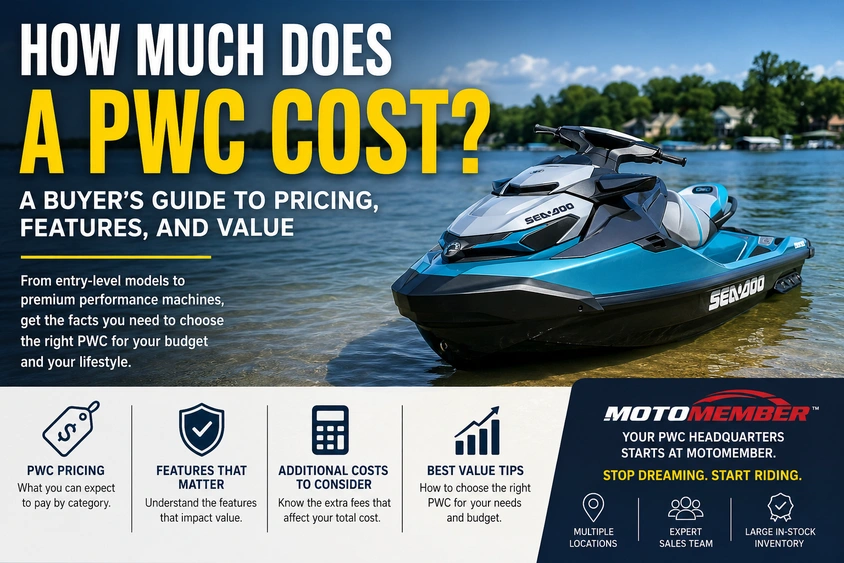
How Much Does a PWC Cost? Buyer’s Pricing Guide
Buying a personal watercraft is exciting, but the first question most shoppers ask is simple: how much does a PWC cost?
The honest answer is that PWC pricing depends on the brand, model, engine, features, accessories, freight, setup, trailer needs, financing, and how you plan to ride. A basic recreational model can be a smart entry point, while a touring, fishing, or performance watercraft can cost significantly more because it brings more power, technology, comfort, and capability.
For many buyers, the right PWC is not automatically the cheapest one. It is the one that gives you the best mix of price, reliability, comfort, storage, performance, and long-term enjoyment.
At MotoMember, shoppers can compare new watercraft across multiple locations serving Virginia, Pennsylvania, Maryland, and surrounding areas. With a large in-stock inventory, helpful sales support, and a straightforward shopping experience, MotoMember makes it easier to understand the real cost of owning a PWC before you buy.
What Is the Average PWC Cost?
Most new personal watercraft shoppers should expect a broad pricing range from roughly the high-$8,000s to the low-$20,000s before taxes, registration, destination, prep, trailer, accessories, and optional protection products.
For example, Yamaha’s 2026 WaveRunner lineup includes entry-focused models starting around $8,499, while Sea-Doo lists 2026 models such as the GTI starting at $12,099 and premium models such as the GTX Limited starting at $22,549.
Performance models can also move quickly into the $20,000 range. Sea-Doo lists the 2026 RXP-X starting at $20,099, while MotoMember lists the 2026 Sea-Doo RXT-X starting at $21,899 and the 2026 Yamaha GP SVHO starting at $19,199.
That price spread exists because “PWC” covers several different types of machines. A casual lake cruiser, a family-friendly three-seater, a fishing-ready model, and a supercharged performance watercraft are all built for different riders.
PWC Cost by Category
Entry-Level and Rec-Lite PWCs
Entry-level models are usually the most affordable way to get on the water. These are ideal for new riders, casual weekend use, lake houses, rental-style simplicity, and buyers who want fun without paying for every premium feature.
Yamaha’s JetBlaster models start around $8,499 for 2026, giving buyers a lower-cost entry into the WaveRunner lineup.
Expect this category to focus on value, lighter weight, simple operation, and approachable performance. You may not get the largest storage capacity, highest horsepower, biggest display, or most advanced touring seat, but you do get the core experience: fast starts, easy handling, and plenty of fun.
This is a strong choice if you are buying your first PWC or adding a second machine for friends and family.
Recreation PWCs
Recreation PWCs are the sweet spot for many buyers. They usually offer more comfort, more stability, better seating, stronger engine options, and more room for gear than entry-level models.
Sea-Doo’s 2026 GTI starts at $12,099 at MotoMember, and the GTI SE starts at $13,299 on Sea-Doo’s official model page.
This class is popular because it works for many riding styles. You can cruise, explore, tow a tube where allowed, carry a passenger, and spend longer days on the water without feeling like you bought more machine than you need.
If you are shopping for the best all-around PWC cost-to-value ratio, recreation models deserve a close look.
Luxury and Touring PWCs
Luxury and touring PWCs are built for riders who care about comfort, range, storage, technology, and a smoother day on the water. These models often include larger platforms, premium seating, improved ergonomics, audio options, larger fuel capacity, and more advanced controls.
Sea-Doo’s 2026 GTX starts at $15,949, while the GTX Limited starts at $22,549. The Explorer Pro, designed for longer-distance adventure riding, starts at $20,149.
At MotoMember, shoppers can also find models like the 2026 Sea-Doo Explorer Pro starting at $20,149 and the 2026 Yamaha VX Limited HO starting at $16,699.
This category makes sense if you want a more refined ride or plan to spend long hours on the water. The higher upfront PWC cost may be worth it if comfort, storage, and premium features keep you riding more often.
Performance PWCs
Performance PWCs are built for riders who want acceleration, handling, horsepower, and aggressive styling. These models often include supercharged engines, upgraded hull designs, sport seating, premium displays, launch control-style systems, or race-inspired ergonomics.
Sea-Doo’s 2026 RXP-X starts at $20,099, and Kawasaki’s 2026 Jet Ski Ultra 310X is listed with an MSRP of $19,199.
Performance models are exciting, but they are not always the best fit for every buyer. They can cost more to insure, burn more fuel, and may require more careful maintenance depending on engine configuration and riding style.
Choose this category if you already know you want high output and sharp handling. For casual family fun, a recreation or touring model may deliver better everyday value.
Fishing and Adventure PWCs
Fishing and adventure-focused PWCs have become more popular because they give riders a compact alternative to a boat. These models may include accessory mounting points, coolers, extended platforms, navigation-ready layouts, additional storage, and improved stability.
Sea-Doo’s Explorer Pro starts at $20,149 for 2026, reflecting its long-distance and adventure-oriented setup.
This type of PWC is best for riders who know exactly how they will use it. If you plan to fish, explore bigger waterways, carry gear, or ride longer distances, the added cost may be justified.
What Affects the Cost of a PWC?
Brand and Model Line
Brand matters because every manufacturer organizes its lineup differently. Yamaha WaveRunner, Sea-Doo, and Kawasaki Jet Ski models each offer different hulls, engines, seating layouts, technology, accessories, and price points.
MotoMember shoppers can explore new inventory, Yamaha Watercraft, and Sea-Doo models to compare options in one place.
Your best move is to compare models by how you ride, not just by badge. A lower-priced model from one brand may meet your needs better than a more expensive model from another.
Engine Size and Performance
Engine output is one of the biggest drivers of PWC cost. More horsepower usually means a higher price, stronger acceleration, and a more thrilling ride.
However, more power is not always better. Newer riders may prefer predictable handling and lower operating costs. Families may care more about stability, seating, storage, and fuel efficiency than top speed.
For most buyers, the best engine is the one that matches your real riding style.
Seating Capacity and Hull Size
Many shoppers want a three-person PWC because it offers more flexibility. Larger hulls can feel more stable, handle chop better, and provide more room for passengers and gear.
Smaller machines can be more playful, easier to store, and more affordable. They may be perfect for quick rides and solo fun.
Think about who will ride with you most often. If you usually ride with a passenger, do not shop like a solo rider.
Technology and Convenience Features
Modern PWCs can include braking and reverse systems, Bluetooth audio, color displays, GPS-related features, phone storage, cruise modes, trim systems, drive modes, USB charging, boarding ladders, and accessory-ready platforms.
These features improve the riding experience, but they also affect price. A base model may cost less, while a premium trim can add comfort and convenience that you will appreciate every time you ride.
The key is separating “nice to have” from “must have.”
Storage and Accessory Compatibility
Storage matters more than many first-time buyers expect. Towels, ropes, dry bags, drinks, safety gear, anchors, dock lines, and personal items all need space.
Some PWCs are also designed to work with coolers, fishing accessories, audio systems, LinQ-style accessories, storage boxes, and extended rear platforms. These upgrades can make the machine more useful, but they add to your total investment.
Ask yourself what you will carry on a normal day. That answer can help you avoid buying too little PWC.
New vs. Used PWC Cost
Buying a New PWC
A new PWC usually costs more upfront, but it gives you the latest model-year features, clean ownership history, manufacturer warranty coverage, and the ability to choose the model, color, and trim you want.
New models also make comparison shopping easier because you can evaluate current MSRP, current incentives, current financing options, and available inventory.
At MotoMember, new watercraft inventory may include current Sea-Doo and Yamaha models across locations such as Purcellville, Manassas, and Chambersburg. Availability changes, so it is always smart to check current listings or contact the team.
Buying a Used PWC
A used PWC can lower the purchase price, but condition matters. Hours, maintenance records, hull condition, corrosion, previous storage habits, trailer condition, and signs of improper winterization can all affect value.
A cheaper used PWC is not automatically a better deal. Repairs, worn components, missing accessories, old batteries, and neglected maintenance can erase the savings quickly.
If you are considering pre-owned, work with a dealership that can help you understand the condition and value of the unit.
Additional Costs to Budget For
Trailer
Some PWC prices do not include a trailer. That matters because a trailer can be a necessary part of ownership unless you keep your machine at a marina, lift, dock, or waterfront property.
Trailer cost depends on whether you need a single or double trailer, material, capacity, and features. Always ask whether the advertised PWC price includes a trailer.
Freight, Prep, Taxes, and Registration
Manufacturer pricing often excludes transportation, preparation, tax, title, registration, and dealer fees. Sea-Doo’s official pricing pages note that transportation and preparation are not included in listed starting prices.
This is why the advertised MSRP is not always the final out-the-door number. Ask for a complete quote so you understand the full purchase cost before comparing models.
Insurance
Insurance cost varies by state, rider experience, coverage level, horsepower, storage location, and the value of the machine. A higher-performance PWC may cost more to insure than a lower-powered recreation model.
Even where insurance is not required in the same way as an automobile, coverage can protect you from theft, damage, liability, and unexpected loss.
Gear and Safety Equipment
Every PWC owner should budget for safety gear. That includes properly fitted life jackets, a whistle or sound-signaling device, dock lines, fenders, waterproof storage, anchor options, tow ropes if applicable, and riding apparel.
Depending on where you ride, you may also need state-specific registration decals, boater education credentials, or additional required equipment. Check your local boating agency for current rules before hitting the water.
Maintenance
PWCs need routine care. Budget for oil changes, spark plugs, battery care, pump inspection, flushing, cleaning, winterization, storage, and wear items.
Maintenance cost depends on how often you ride, whether you ride in freshwater or saltwater, and whether your model has higher-performance components.
Skipping maintenance is one of the fastest ways to turn a fun purchase into an expensive problem.
How to Choose the Best PWC for the Money
Match the PWC to Your Riding Style
Start with how you plan to ride. Are you cruising with family, towing tubes, riding solo, fishing, exploring, or chasing performance?
A family buyer may value stability, seating, boarding ease, and storage. A performance rider may care more about acceleration and handling. A fishing buyer may want accessory mounting and deck space.
The best value is the model that fits your real use, not the one with the most features on paper.
Compare Total Ownership Cost
Do not compare only MSRP. Compare the full ownership picture.
Look at purchase price, fees, trailer, insurance, fuel use, maintenance, accessories, storage, and resale value. A slightly more expensive model may be the better long-term buy if it gives you the features you will otherwise add later.
Large selection. Straightforward shopping. Real powersports expertise. That is where a dealership like MotoMember can help you compare more than just a sticker price.
Think About Resale Value
Brand reputation, condition, maintenance records, hours, and popularity all influence resale value. A well-kept PWC from a desirable model line can hold value better than a neglected machine that looked cheaper upfront.
Buy with the next owner in mind. Keep records, rinse and clean the machine, store it properly, and follow maintenance intervals.
Sit on Different Models
Comfort is personal. Seat shape, handlebar position, footwell room, boarding access, and passenger space can feel different from model to model.
Before choosing based only on price, sit on a few machines. Bring the primary rider and frequent passenger when possible.
A model that feels right in the showroom is more likely to feel right on the water.
Is Financing a PWC Worth It?
Financing can make sense if you want to preserve cash, buy the right model now, or take advantage of available promotions. Monthly payments depend on price, down payment, credit approval, term, rate, taxes, fees, and any accessories or protection products included.
The important part is not just getting a low payment. It is making sure the total cost fits your budget.
Ask MotoMember about current financing options, trade-in opportunities, and available models. A helpful sales team can walk you through options without making the process complicated.
PWC Cost Examples at MotoMember
Current inventory can change, but MotoMember listings show how pricing can vary by model and category.
A 2026 Sea-Doo GTI starts at $12,099, making it a strong recreation-class example. A 2026 Yamaha VX Limited starts at $15,199, while a 2026 Yamaha VX Limited HO starts at $16,699.
For performance-minded riders, MotoMember lists the 2026 Yamaha GP SVHO starting at $19,199 and the 2026 Sea-Doo RXT-X starting at $21,899.
For premium touring, the 2026 Sea-Doo GTX Limited starts at $22,549 at MotoMember.
These examples show why it helps to shop by category. There is a meaningful difference between an affordable recreation model and a premium performance or touring machine.
When Is the Best Time to Buy a PWC?
The best time to buy depends on your priorities. Spring and early summer usually bring excitement, selection, and the chance to ride immediately. Late summer and fall may bring different opportunities as dealers manage seasonal inventory.
If you want the best choice of colors and trims, shop early. If you are flexible and focused on price, ask about available incentives, non-current models, or remaining inventory.
Because watercraft availability changes quickly, the best strategy is to stay connected with a dealership that has multiple locations and access to a wide inventory.
Call to Action
Ready to compare PWC cost, features, and value in person?
Visit MotoMember to explore current watercraft inventory, compare Yamaha WaveRunner and Sea-Doo models, and get help from a team that understands how real riders shop.
Your PWC headquarters starts at MotoMember. Stop dreaming. Start riding.
Conclusion
So, how much does a PWC cost? In today’s market, many new models fall somewhere between roughly $8,500 and $23,000 before taxes, fees, trailer, accessories, and other ownership costs.
Entry-level models are great for affordable fun. Recreation models deliver excellent all-around value. Touring and luxury PWCs add comfort and technology. Performance models bring serious power. Fishing and adventure models give riders more ways to use the water.
The right choice comes down to your budget, riding style, passenger needs, storage expectations, and long-term ownership plans. MotoMember makes that process easier with multiple locations, a large selection, and straightforward guidance from real powersports experts.
FAQ
How much does a new PWC cost?
Most new PWCs range from about the high-$8,000s to the low-$20,000s before taxes, fees, trailer, accessories, and setup costs. Entry-level models cost less, while luxury, fishing, and performance models cost more.
Does a PWC price include a trailer?
Not always. Some advertised prices do not include a trailer, freight, prep, taxes, title, or registration. Always ask for an out-the-door quote so you can compare the full cost accurately.
Is a Sea-Doo or Yamaha WaveRunner more affordable?
Both brands offer models across several price ranges. Sea-Doo has recreation models like the GTI, while Yamaha offers lower-priced options like the JetBlaster and mid-range VX models. The better value depends on how you ride and which features matter most.
What is the best PWC for first-time buyers?
Many first-time buyers do well with a recreation-class model because it balances stability, comfort, manageable power, and price. Entry-level models can also be a smart choice for casual solo riding.
Should I buy a new or used PWC?
Buy new if you want warranty coverage, current features, and a clean ownership history. Consider used if you want a lower purchase price and are comfortable evaluating condition, maintenance history, hours, and possible repair needs.