
G3 Jon Boat Trolling Motor Setup Guide

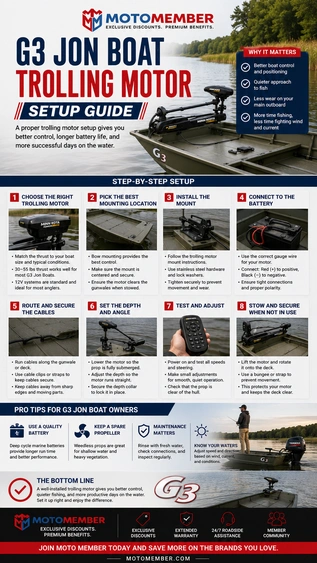
Trolling Motor Setup Guide for G3 Jon Boats
A smart trolling motor setup for G3 jon boats can completely change how your boat fishes.
The outboard gets you to the area. The trolling motor helps you work the bank, hold near brush, slow-roll a flat, control drift, stay on a crappie school, position above catfish structure, or quietly move through shallow water without constantly firing up the main motor.
G3 makes trolling motor planning easier because many Gator Tough Package Jon models list factory trolling motor and electronics options. The 18 SC and 20 SC, for example, list Minn Kota trolling motor options such as RT SM70 52, Maxxum 70 52, Ultrex 80 52 DSC, and Ultrex 80 52 MDI, along with Humminbird console and bow electronics options.
For shoppers in Virginia, Pennsylvania, Maryland, West Virginia, and nearby areas, MotoMember can help compare G3 models, Yamaha power, trolling motor options, batteries, chargers, electronics, trailers, accessories, financing, trade-ins, and service support before you finalize a fishing setup.
Start With How You Fish
Before choosing a trolling motor, decide how you fish most often.
Bass anglers usually want quick steering response, strong bow control, and the ability to work shorelines, grass edges, docks, laydowns, and shallow cover. Crappie anglers may care more about slow-speed control, boat positioning, and electronics visibility. Catfish anglers may use the trolling motor for controlled drifting, anchor positioning, or small adjustments around structure. River anglers need enough control to fight wind, current, and changing water levels.
The right trolling motor setup is not just about thrust. It is about boat size, water type, current, wind, batteries, mounting location, shaft length, wiring, electronics, and how much gear you carry.
Bow Mount vs Transom Mount
Most serious fishing setups use a bow-mounted trolling motor.
A bow-mounted motor pulls the boat instead of pushing it, which usually gives better control while casting, jigging, trolling, or holding position. It also puts control closer to the angler fishing from the front deck.
A transom-mounted trolling motor can still work for simple jon boat setups, especially smaller Loose Jon boats, pond fishing, electric-only waters, or lightweight utility use. It is usually simpler and less expensive to set up, but it may not give the same fishing control as a bow mount.
For many G3 Package Jon shoppers, a bow mount is the better long-term choice. G3’s 20 CC page specifically notes that the bow has a wide casting deck with room for an optional trolling motor, which is exactly the kind of setup bass and crappie anglers often want.
Choose the Right Thrust
Trolling motor thrust is measured in pounds.
Minn Kota’s official thrust guidance says the general rule is at least 2 pounds of thrust for every 100 pounds of fully loaded boat weight, including fuel, gear, and people. Minn Kota also notes that wind and current are major factors, so anglers who regularly fish tougher conditions should consider extra thrust.
That means you should not size the trolling motor based only on dry boat weight. Use the real-world loaded weight:
Boat.
Outboard.
Fuel.
Batteries.
Trolling motor.
Electronics.
Cooler.
Tackle.
Rods.
Anchor.
Passengers.
Hunting or utility gear if applicable.
A trolling motor that feels fine on a calm pond may feel underpowered in wind, current, or a fully loaded 18- or 20-foot jon boat.
Understand Voltage: 12V, 24V, and 36V
Voltage affects how many batteries the trolling motor needs.
Minn Kota says trolling motors require one battery for every 12 volts in the system. A 12V system uses one battery, a 24V system uses two batteries, and a 36V system uses three batteries.
For many smaller jon boat setups, 12V may be enough. For many 17- to 20-foot G3 Package Jon fishing setups, a 24V system is often worth discussing because it can provide stronger control and better endurance. A 36V system may be more than many jon boat owners need, but it can make sense for heavier boats, strong current, long fishing days, or advanced fishing setups.
Do not choose voltage only by boat length. Choose it by loaded weight, fishing conditions, battery space, and how long you expect to use the trolling motor during a normal day.
Pick the Right Shaft Length
Shaft length matters because the trolling motor prop needs to stay properly submerged.
Minn Kota’s motor selection guide says the propeller tip should be submerged at least 12 inches below the waterline to avoid churning or surface agitation, and it also emphasizes that proper shaft length is important so the motor section stays submerged.
A shaft that is too short can pop out of the water in chop, wakes, or when weight shifts. A shaft that is too long may be awkward in very shallow water or on smaller boats.
For G3 jon boats, shaft length should be matched to the exact model, bow height, typical load, and water conditions. A 17-foot side-console setup, an 18-foot center-console setup, and a 20-foot Jet Jon may not all need the same trolling motor.
Battery Placement and Weight Balance
Battery placement is one of the most overlooked parts of a trolling motor setup.
A 24V system adds two deep-cycle batteries. A 36V system adds three. That weight affects how the boat sits, planes, drafts, and handles. It can also change how the boat feels when passengers move around.
Minn Kota recommends using separate deep-cycle marine batteries for the trolling motor rather than relying on the crank battery used to start the gasoline outboard. Minn Kota also recommends storing and maintaining batteries at full charge, noting that failure to recharge lead-acid batteries within 12–24 hours is a leading cause of premature battery failure.
On a G3 jon boat, battery placement should be planned with the entire layout in mind. Think about livewell water weight, fuel, tackle, cooler, electronics, passengers, and anchor gear. A clean battery setup should be secure, serviceable, and easy to charge.
Wiring, Breakers, and Safe Installation
A trolling motor draws serious electrical current, so wiring matters.
Minn Kota highly recommends using a circuit breaker or fuse when installing a trolling motor and points owners to conductor gauge and circuit breaker sizing guidance. Minn Kota also warns not to connect the positive and negative terminals of the same battery together because that can create an immediate short and fire danger.
This is not the place for guesswork. Use marine-grade wiring, proper connectors, correct wire gauge, approved circuit protection, secure battery mounting, and clean routing away from sharp edges, heat, moving parts, and standing water.
MotoMember can help shoppers think through dealer-supported installation and service instead of turning a high-value fishing setup into a messy wiring project.
Foot Control, Hand Control, or Remote Control?
Control style affects how the boat fishes.
A foot-control trolling motor is popular with bass anglers because it allows hands-free steering while casting. It can be excellent for working banks, docks, grass, and visible cover.
A hand-control motor can be simple and reliable, especially for smaller boats, casual fishing, or transom-mount setups.
A remote-control or GPS-enabled trolling motor can be useful for anglers who want advanced boat positioning, route control, or spot-holding features, depending on the model. This can be especially helpful for crappie anglers, catfish anglers, and anyone who wants to hold near structure without constantly adjusting the motor manually.
Before choosing, picture where you stand or sit while fishing. A great trolling motor should match your body position, not force you to fish awkwardly.
G3 Model Examples for Trolling Motor Setups
G3 17 SC
The G3 17 SC is a manageable side-console jon boat that can work well for anglers who want a practical fishing platform without jumping into a larger package. G3’s 2026 17 SC page lists a Minn Kota 55 Edge option, along with Yamaha engine choices and standard features such as Yamaha controls, an aerated livewell, 800 GPH bilge pump, and built-in 19-gallon fuel system.
This type of setup can make sense for bass, crappie, panfish, and small-lake anglers who want simple boat control and easier ownership.
G3 18 SC
The G3 18 SC is one of the strongest all-around Gator Tough choices for anglers who want side-console space and strong trolling motor options. G3 lists Minn Kota options including RT SM70 52, Maxxum 70 52, Ultrex 80 52 DSC, and Ultrex 80 52 MDI, plus Humminbird console and bow electronics options.
This makes the 18 SC a smart fit for crappie anglers, bass anglers, and multi-species anglers who want a clean, open layout with serious bow-control potential.
G3 20 SC
The G3 20 SC is a strong choice if you want more room for rods, tackle, passengers, batteries, electronics, and a more advanced trolling motor setup. G3 lists the same Minn Kota options found on the 18 SC, including 70- and 80-pound-class choices, along with Humminbird bow and console electronics options.
This is a strong direction for spider-rigging crappie, catfishing, long days on larger protected water, or anglers who routinely carry more gear.
G3 18 CC
The G3 18 CC gives center-console anglers a practical fishing layout. G3 highlights the 18 CC’s Yamaha throttle, switch panel, cupholder, optional electronics space, battery storage under the console, and upright rod holders.
For trolling motor setup, the 18 CC makes sense if you want center-console control, rod organization, electronics planning, and a fishing layout that still keeps the bow useful.
G3 20 CC
The G3 20 CC is the larger center-console option for anglers who want more room. G3 says the bow has a wide deck for casting and an optional trolling motor, and the center console provides visibility, steering, electronics space, and accessible controls.
This is a strong platform for anglers who want a more serious bow-mount trolling motor and electronics setup.
G3 18 CCJ
The G3 18 CCJ is the shallow-water Jet Jon option for anglers who fish rivers, skinny water, and places where access matters. G3 says the 18 CCJ can add an optional trolling motor for precise, quiet control while fishing.
For river anglers, this matters. The jet setup helps with access, while the trolling motor helps with fishing control once you get there.
Trolling Motor Setup by Fishing Style
Bass Fishing
Bass anglers should prioritize bow control, foot pedal location, clean casting space, and electronics visibility.
A bow-mounted trolling motor with strong thrust can help work shorelines, grass, docks, laydowns, rock, and shallow cover. Make sure the foot pedal does not create a tripping point and that rods can be staged without catching on the trolling motor mount.
Crappie Fishing
Crappie anglers should prioritize slow-speed control, electronics, rod-holder placement, and battery endurance.
If you spider-rig or long-line troll, you may use the trolling motor for long stretches. That makes thrust, voltage, battery capacity, and charging convenience especially important.
Catfishing
Catfish anglers may not run a trolling motor constantly, but it still matters.
It can help position the boat before anchoring, control drift, hold near structure, or make quiet adjustments at night. Catfish anglers should keep anchor lines, rod holders, and trolling motor controls from interfering with each other.
River Fishing
River anglers should think carefully about thrust, current, battery endurance, and shaft length.
A trolling motor that works fine on a lake may struggle in current. If you fish shallow, rocky rivers, pair trolling motor planning with the correct hull and propulsion choice, such as a G3 Jet Jon or Tunnel Jon when conditions call for it.
Match Electronics to the Trolling Motor
Modern fishing setups often combine the trolling motor with bow electronics.
G3’s 18 SC and 20 SC pages list Humminbird electronics options for both console and bow mounting, including PiranhaMAX, Helix, and Xplore choices depending on model and configuration.
That matters because bow electronics are most useful when you can see them while operating the trolling motor. Console electronics are useful for running, navigation, depth, and marking areas. Some anglers need both.
Before mounting screens, think about glare, cable routing, transducer placement, screen visibility, and whether the unit will be used while standing, sitting, casting, trolling, or running.
Charging Setup and Storage
A trolling motor setup is only as good as the charging routine behind it.
Make sure batteries are easy to reach, easy to inspect, and easy to charge. An onboard charger can make ownership much easier, especially with 24V or 36V systems. Plan where the charging plug will be accessed at home and how the charger will stay protected.
Also think about winter storage. Batteries should not be ignored after the last trip of the season. A clean charging and maintenance routine helps prevent frustrating early-season problems.
MotoMember can help shoppers think through battery chargers, service, seasonal prep, and storage planning as part of the full G3 ownership picture.
Common Trolling Motor Setup Mistakes
The most common mistake is buying too little thrust.
The second is choosing a shaft that is too short. The third is underestimating battery space. The fourth is wiring the system poorly. The fifth is mounting accessories before understanding how the boat actually fishes.
Avoid drilling permanent holes until the layout is clear. Use the boat, notice where you stand, where rods pile up, where the net lands, where the cooler sits, and where passengers naturally move.
A clean setup usually comes from a little patience.
MotoMember Expert Tip
Set up the trolling motor around your worst normal fishing day, not your calmest one.
Think about afternoon wind, river current, a full livewell, extra tackle, two passengers, a cooler, and batteries. If the trolling motor can handle that day, it will feel easy on calmer trips.
Many shoppers ask, “What trolling motor fits this G3?” The better question is: What trolling motor fits my loaded boat, my water, my fishing style, and my battery space?
Our team can help you compare G3 jon boat models, Minn Kota options, electronics, wiring, chargers, and layout choices before you commit.
Regional Advice for VA, PA, MD, WV, and Nearby Areas
For anglers in Virginia, Pennsylvania, Maryland, West Virginia, and nearby areas, trolling motor needs vary by water.
Pond and small-lake anglers may be fine with a simpler system. Crappie anglers on reservoirs may want more battery endurance and better electronics integration. River smallmouth anglers may need more thrust for current. Catfish anglers may need a system that supports anchoring, drifting, and night-fishing positioning.
MotoMember is a full-service dealership group with locations in Purcellville and Manassas, Virginia, and Chambersburg, Pennsylvania, and its site lists powersports and marine categories along with finance application access. Current availability can vary by season, location, model year, motor package, electronics, trolling motor options, trailer setup, and accessories, so check MotoMember inventory or contact the team before planning around one exact configuration.
Safety Considerations
A trolling motor adds batteries, wiring, weight, and another system to manage, so safety planning matters.
The U.S. Coast Guard says recreational vessels must have a Coast Guard-approved wearable PFD for each person onboard. Pennsylvania’s Fish and Boat Commission states that all boats must carry a serviceable USCG-approved life jacket for each person, and boats 16 feet and over must also have an immediately available USCG-approved throwable device onboard. Virginia DWR states that operators of motorboats with a 10 hp or greater engine need to take a boating safety course.
Before launching, inspect life jackets, confirm navigation lights, check battery charge, secure batteries, inspect wiring, verify the trolling motor deploys and stows correctly, and keep safety gear reachable instead of buried under tackle or coolers.
Call to Action
Your G3 Gator Tough Headquarters starts at MotoMember.
Explore current G3 availability, compare trolling motor-ready jon boat layouts, and talk with the MotoMember team about Yamaha power, Minn Kota options, Humminbird electronics, battery placement, onboard chargers, wiring, trailers, accessories, financing, trade-ins, service, towing, and storage.
Large selection. Straightforward shopping. Real powersports and marine expertise.
Stop dreaming. Start riding—and boating—with MotoMember.
Conclusion
A good G3 jon boat trolling motor setup starts with the way you fish.
Choose the right mount location, thrust, voltage, shaft length, batteries, wiring, charger, control style, and electronics layout before adding permanent accessories. A bass angler, crappie angler, catfish angler, and river angler may all need different setups, even if they own similar G3 boats.
For many G3 Package Jon shoppers, models like the 18 SC, 20 SC, 18 CC, 20 CC, and 18 CCJ offer strong trolling motor setup paths. A Loose Jon may be better for a custom build. A Tunnel or Jet Jon may be better if shallow-water access is the main priority.
For shoppers in VA, PA, MD, WV, and nearby areas, MotoMember can help build a trolling motor setup that fits your boat, water, gear, trailer, storage space, and fishing season.
FAQ
What size trolling motor do I need for a G3 jon boat?
Start with fully loaded boat weight, not dry weight. Minn Kota recommends at least 2 pounds of thrust for every 100 pounds of fully loaded boat weight, including fuel, gear, and people, with extra thrust worth considering for wind or current.
Is a 12V or 24V trolling motor better for a G3 jon boat?
A 12V system may work for smaller, lighter, calmer-water setups. A 24V system is often better for larger 17- to 20-foot fishing setups, longer days, wind, and current. Minn Kota says you need one battery for every 12 volts in the trolling system.
Where should I mount a trolling motor on a G3 jon boat?
Most serious fishing setups use a bow-mounted trolling motor because it gives better control while casting, jigging, trolling, or positioning. A transom mount can work for smaller Loose Jon or simple pond setups.
Do I need a circuit breaker for a trolling motor?
Yes, proper circuit protection is strongly recommended. Minn Kota highly recommends a circuit breaker or fuse when installing a trolling motor and points owners to conductor gauge and circuit breaker sizing guidance.
Can MotoMember help set up a G3 jon boat trolling motor?
Yes. Contact MotoMember to compare current G3 availability, trolling motor options, electronics, battery placement, chargers, accessories, service, and financing. Availability and option packages can vary by model year, location, and incoming inventory.