First Time Boat Buyer Guide

First Time Boat Buyer Guide
Buying your first boat is exciting, but it can also feel like a lot to figure out at once. You are not just choosing a model. You are thinking about where you will use it, how many people you want to bring, how you will tow it, where you will store it, what gear you need, and how ownership will fit into your weekends.
That is where a good dealership conversation matters. At MotoMember, our team helps first-time boat buyers compare options based on real use: family cruising, fishing, watersports, lake days, river runs, sandbar trips, and relaxing days on the water. For shoppers in Virginia, Pennsylvania, Maryland, and nearby areas, the right boat often comes down to matching the model to local waterways, storage options, towing setup, and long-term service support.
This guide walks through what to know before buying your first boat, what questions to ask, and how to shop confidently.
Start With How You Actually Want to Use the Boat
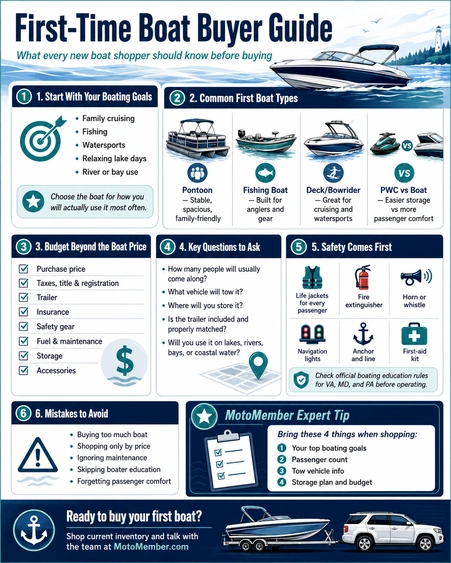
Many first-time boat buyers begin by asking, “What boat should I buy?” A better first question is, “What do I want my boat to do most often?”
A fishing-focused buyer may need casting space, rod storage, electronics, and livewell features. A family buyer may care more about seating, shade, swim platforms, storage, and easy boarding. A watersports buyer may look for power, tow points, ballast or wake-focused features, and room for gear.
Before choosing a boat, consider:
- How many people will usually be onboard?
- Will you fish, cruise, tube, ski, wakeboard, or mostly relax?
- Will you use the boat on lakes, rivers, bays, or coastal water?
- Do you need a trailer?
- Will you store it at home, at a marina, or in seasonal storage?
- What vehicle will tow it?
- Who else in your household will operate it?
A boat that is perfect for quiet fishing mornings may not be ideal for entertaining eight people. A big family boat may feel like more than you need if most trips are solo fishing runs. The goal is not to buy the biggest boat you can afford. The goal is to buy the boat you will actually enjoy using.
Common First Boat Types
Pontoon Boats
Pontoon boats are popular with first-time buyers because they are stable, comfortable, and easy to enjoy with family and friends. They are great for cruising, swimming, relaxing, entertaining, and casual fishing.
A pontoon may be a smart fit if your ideal day includes comfortable seating, shade, coolers, music, and easy movement around the deck. Many shoppers also like pontoons because they feel less intimidating than narrow, performance-focused boats.
MotoMember shoppers interested in family-friendly boating can start at MotoMember.com to view current boat inventory and ask about available brands and models.
Fishing Boats
Fishing boats are built around function. Depending on the model, they may include casting decks, trolling motor options, livewells, fish finders, rod storage, and layouts designed for anglers.
First-time buyers should think about where they fish most. Smaller lakes, rivers, and protected waters may call for a different setup than larger open water. Seating, storage, stability, and electronics matter, but so does how easily you can launch, retrieve, and trailer the boat.
Deck Boats
Deck boats blend some of the open seating feel of a pontoon with a more traditional hull design. They can work well for families that want cruising, swimming, and watersports capability.
They are often considered by buyers who want more performance than a basic pontoon but more seating and social space than a smaller runabout.
Runabouts and Bowriders
Runabouts and bowriders are versatile recreational boats. They are common choices for cruising, tubing, skiing, and general family use.
If you want a boat that feels sporty, has forward seating, and can cover a range of activities, this category is worth comparing. Pay close attention to storage, passenger capacity, engine size, and how easy the boat feels to operate around docks and ramps.
Personal Watercraft vs Boat
Some shoppers compare a first boat against a personal watercraft. A PWC can be easier to store, easier to tow, and more affordable than many boats, but it does not offer the same passenger space, shade, storage, or family comfort.
MotoMember sells and supports a wide range of powersports and marine products, including personal watercraft and boats. Our team can help you decide whether your first watercraft should be a boat, PWC, or both.
New vs Used Boats
Buying a New Boat
A new boat gives you the latest model-year features, a fresh ownership history, and the ability to choose the layout and equipment that best matches your plans. New boats may also offer manufacturer warranty coverage, though exact warranty details vary by brand and model.
New may be right for you if you want fewer unknowns, current technology, and dealership support from day one.
Buying a Used Boat
A used boat may offer a lower entry price or help you move into a larger model for your budget. The tradeoff is that condition matters more. You will want to understand maintenance history, engine hours, storage history, trailer condition, upholstery condition, electronics, and whether the boat has been inspected.
Used can be a smart choice, but first-time buyers should avoid shopping on price alone. A low-cost boat that needs major repairs, trailer work, or outdated safety equipment can become expensive quickly.
Set a Realistic Boat Budget
Your boat budget should include more than the selling price. First-time buyers should plan for the full ownership picture.
Common costs include:
- Boat purchase price
- Taxes, title, and registration
- Trailer, if not included
- Insurance
- Safety gear
- Dock lines, bumpers, anchor, and basic equipment
- Fuel
- Maintenance
- Winterization or seasonal service
- Storage
- Accessories
- Tow vehicle needs
- Financing costs, if applicable
A good dealership conversation helps you avoid surprises. MotoMember can help shoppers compare options, discuss financing, value a trade, and understand what accessories or services may be useful for their first season.
Understand Boat Size and Capacity
Bigger is not always better for a first-time boat buyer. A larger boat may provide more seating, comfort, and open-water confidence, but it may also require more towing capacity, more storage space, more fuel, and more confidence at the ramp.
Smaller boats can be easier to trailer, launch, dock, clean, and store. However, they may feel crowded if you frequently bring family and friends.
Look at passenger capacity, storage space, seating layout, freeboard, hull design, and how the boat feels from the helm. Sit in the captain’s seat. Walk through the boat. Imagine coolers, towels, life jackets, fishing gear, kids, pets, and passengers moving around.
Do Not Overlook the Trailer
For trailerable boats, the trailer is a major part of ownership. First-time buyers often focus on the boat and forget that launching, retrieving, towing, parking, and storing the trailer are part of every trip.
Before buying, ask:
- Is the trailer included?
- Is it properly matched to the boat?
- What is the combined boat and trailer weight?
- Can your vehicle tow it safely?
- Does your vehicle need a hitch, wiring, brake controller, or towing upgrades?
- Where will you store the trailer?
- Are the tires, lights, bunks, rollers, winch, and brakes in good condition?
For many first-time boaters, confidence at the ramp is just as important as confidence on the water. Practice helps. So does buying a setup that is realistic for your vehicle, driveway, and local ramps.
Safety Gear Comes First
Every boat owner needs proper safety equipment. The U.S. Coast Guard’s federal recreational boating guidance explains that required equipment varies by vessel type and size, but key items often include wearable life jackets, sound-producing devices, navigation lights, fire extinguishers where required, visual distress signals where required, and ventilation or backfire flame control equipment for certain boats.
BoatUS also notes that recreational boats must carry U.S. Coast Guard-approved personal flotation devices in good, serviceable condition and in the proper size for intended users. Wearable PFDs must be readily accessible, and throwable devices must be immediately available when required.
At a minimum, first-time boat buyers should plan for:
- Properly sized life jackets for every passenger
- Throwable flotation device, where required
- Fire extinguisher, where required
- Sound device such as whistle or horn
- Navigation lights
- Anchor and line
- Dock lines and fenders
- First-aid kit
- Basic tool kit
- Bilge pump or bailer, depending on boat type
- Emergency communication plan
- Engine cut-off switch use when applicable
Safety equipment is not the place to cut corners. Make sure everything fits, works, and is easy to reach.
Know Your State Boating Education Rules
Boating education requirements vary by state, age, vessel type, and horsepower. Because many MotoMember customers boat across VA, PA, MD, and surrounding areas, it is important to check the official rules for where you operate.
In Virginia, the Department of Wildlife Resources says all PWC operators age 14 and older and all operators of motorboats with a 10 hp or greater engine, regardless of age, need to take a boating safety course.
In Maryland, the Department of Natural Resources states that anyone born on or after July 1, 1972, must possess a certificate of boating safety education to operate any motorized vessel.
In Pennsylvania, the Fish and Boat Commission offers approved boating safety education courses, and successful students receive a Boating Safety Education Certificate that is good for a lifetime.
These rules can change, and there may be additional age, horsepower, rental, or PWC-specific requirements. Check official state resources before operating.
Think About Where You Will Store the Boat
Storage affects the type of boat you should buy. A boat that fits your family but does not fit your driveway, garage, marina slip, or storage budget can create frustration.
Common storage options include:
- Home driveway storage
- Garage storage
- Outdoor storage lot
- Covered storage
- Marina slip
- Dry stack storage
- Seasonal winter storage
Each option has tradeoffs. Home storage may be convenient, but you need space and may have neighborhood or HOA rules. Marina storage can make boating easier because the boat is already near the water, but it adds cost. Covered storage can help protect the boat from sun and weather.
For VA, PA, and MD boaters, seasonal storage and winterization are especially important because freezing temperatures can damage engines, water systems, and components if the boat is not properly prepared.
Service Support Matters
A first boat is much easier to own when you have a dealership that can help after the sale. Service support matters for oil changes, impellers, batteries, winterization, spring commissioning, trailer service, electronics, accessories, and general troubleshooting.
Before choosing a boat, ask:
- Who will service it?
- How close is the service department?
- What maintenance does the engine require?
- What should be done before winter storage?
- What should be checked before the first spring launch?
- Are parts and accessories available?
- Can the dealership help with upgrades later?
MotoMember supports customers before, during, and after purchase with inventory guidance, financing, trade-ins, accessories, and service support. That long-term relationship is especially valuable for first-time buyers.
Financing Your First Boat
Boat financing can help make ownership more manageable, but it is important to shop with a monthly payment and total ownership cost in mind. Your payment is only one part of the budget.
Before financing, think about down payment, loan term, interest rate, insurance, storage, fuel, service, and accessories. A lower payment over a longer term may look attractive, but the total cost matters.
MotoMember can help qualified buyers explore financing options and compare choices without making the process feel overwhelming. You can start at MotoMember.com to contact the team, ask about current inventory, and discuss next steps.
Accessories Worth Considering
First-time buyers often discover that the right accessories make boating easier and more enjoyable. Some accessories are safety-related. Others are comfort, convenience, or activity-specific.
Useful accessories may include:
- Life jackets for adults and children
- Dock lines and fenders
- Anchor and anchor line
- Boat cover
- Battery charger or maintainer
- Cooler
- Tow rope and tube
- Fish finder or chartplotter
- Extra storage bags
- Cleaning supplies
- Trailer lock
- Spare trailer tire
- Waterproof phone storage
- VHF radio for appropriate waterways
Do not buy every accessory at once unless you know you need it. Start with safety and basic operation, then build your setup around how you actually use the boat.
New Boat Walkthrough: What to Ask at Delivery
Your delivery walkthrough is one of the most important parts of buying your first boat. Take your time and ask questions.
Ask the dealership to review:
- Starting and stopping procedures
- Fueling
- Battery switch operation
- Bilge pump operation
- Navigation lights
- Helm controls
- Trim operation
- Engine break-in guidance, if applicable
- Trailer hookup and launch basics
- Required safety gear
- Recommended maintenance schedule
- Cleaning and storage tips
- Warranty basics, if applicable
- Winterization needs
Take notes and photos. Ask what to check before each outing. A confident first launch starts with understanding the boat before you get to the ramp.
First-Time Boat Buyer Mistakes to Avoid
Buying Too Much Boat
A boat that is too large, too heavy, or too complex can make ownership stressful. Choose something you can confidently tow, launch, dock, clean, and store.
Ignoring Passenger Comfort
Look beyond the captain’s seat. Think about where passengers will sit, how they will board, where they will store bags, and how much shade they will have.
Forgetting About Maintenance
Every boat needs care. Budget for service, cleaning, batteries, fuel system care, trailer checks, and seasonal maintenance.
Skipping Boater Education
Even experienced drivers need to learn navigation rules, markers, docking, ramp etiquette, weather awareness, and emergency procedures. Boater education is a smart investment even when not required.
Shopping Only by Price
The cheapest boat is not always the best value. Condition, dealer support, trailer quality, engine history, included accessories, and fit for your use matter.
MotoMember Expert Tip
Before you visit the showroom, write down your top three boating goals. For example: “family cruising,” “fishing with two people,” and “tubing with kids.” Then bring a realistic passenger count, tow vehicle information, storage plan, and budget range.
Our team can help you compare boats based on real use instead of guesswork. Many first-time buyers change their mind once they step inside different layouts, compare seating, and talk through towing, storage, service, and accessories.
Call to Action
Ready to buy your first boat? Visit MotoMember to view current inventory, ask about available boats, explore financing, value your trade, and speak with a team that understands first-time ownership.
Large selection. Straightforward shopping. Real powersports expertise. Stop dreaming. Start boating.
Conclusion
Your first boat should make your life more fun, not more complicated. The right choice starts with how you plan to use it, where you plan to run it, who you plan to bring, and how you will tow, store, maintain, and enjoy it.
For shoppers in Virginia, Pennsylvania, Maryland, and nearby areas, MotoMember can help you compare boats, personal watercraft, trailers, accessories, financing, and service support in one place. Current availability can vary, so check MotoMember inventory or contact the team before planning around a specific model, color, or package.
FAQ
What is the best first boat to buy?
The best first boat depends on how you will use it. Pontoons are popular for family cruising and relaxing. Fishing boats are better for anglers. Bowriders and deck boats are versatile choices for cruising and watersports.
How much should a first-time boat buyer budget?
Budget for more than the boat price. Include taxes, registration, trailer needs, insurance, safety gear, storage, fuel, service, winterization, and accessories.
Do I need a boating license?
Boating education requirements vary by state, age, horsepower, and vessel type. Virginia, Maryland, and Pennsylvania each have their own rules, so check official state resources before operating.
Is it better to buy a new or used boat first?
New boats offer a fresh ownership history and current features. Used boats may lower the entry price but require closer attention to condition, service history, trailer condition, and inspection.
What should I bring when shopping for my first boat?
Bring your intended use, passenger count, budget range, tow vehicle information, storage plan, and questions about service, safety gear, financing, and accessories.