
Best Fishing Boat Layouts for Families & Anglers

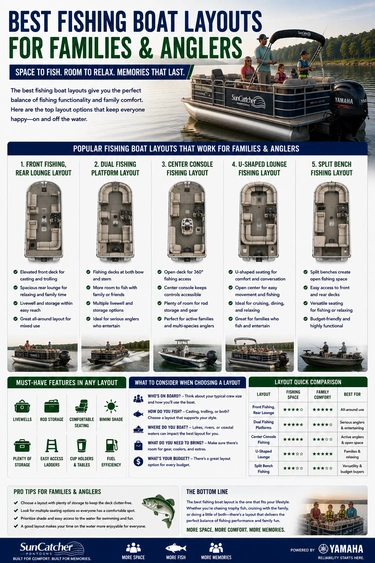
Best Fishing Boat Layouts for Families and Anglers
The best fishing boat layout is not always the one with the most seats, the biggest deck, or the most storage. It is the layout that fits how your family and fishing crew actually use the boat.
A serious bass angler may want open casting decks, rod storage, fast tackle access, trolling motor control, and electronics visibility. A family may care more about comfortable seating, shade, safe movement, easy boarding, coolers, snacks, and room for guests who may not fish all day. Many buyers need both.
That is why layout matters so much. The right boat should support fishing in the morning, family time in the afternoon, and easy cleanup when the day is done.
For shoppers in Virginia, Pennsylvania, Maryland, West Virginia, and nearby areas, MotoMember can help compare aluminum fishing boats, jon boats, fishing pontoons, SunCatcher models, Yamaha-powered packages, trailers, accessories, financing, trade-ins, and service support. MotoMember lists marine inventory along with motorcycles, ATVs, side-by-sides, personal watercraft, trailers, and other powersports categories, and its dealership locations include Purcellville, Manassas, and Chambersburg.
Quick Answer: What Fishing Boat Layout Is Best?
For serious anglers, the best fishing boat layout usually prioritizes casting room, rod storage, tackle storage, livewell access, trolling motor control, electronics placement, and open movement around the deck.
For families, the best layout usually prioritizes seating, shade, storage, stable movement, boarding ease, passenger comfort, and space for coolers, bags, towels, and safety gear.
For buyers who need both, a multi-purpose aluminum fishing boat or fishing pontoon can be the best fit. G3’s official lineup includes aluminum fishing boat categories such as Gator Tough Jon, Sportsman, Angler V, and SunCatcher pontoons, while SunCatcher describes its pontoon lineup around cruising, fishing, entertaining, family comfort, Yamaha power, and multiple layouts.
A good way to think about it:
| Primary Use | Layout to Consider |
|---|---|
| Bass fishing | Front casting deck with rod and tackle storage |
| Crappie and panfish | Comfortable seats, rod holders, electronics visibility |
| Catfish | Open deck space, rod holders, easy-clean surfaces |
| River fishing | Simple jon boat or modified-V aluminum layout |
| Family lake days | Fishing pontoon or multi-purpose fishing layout |
| Mixed fishing and cruising | Aluminum multi-species boat or fishing pontoon |
The better layout is the one that makes your next 20 trips easier, not just the one that looks best in photos.
Start With How the Boat Will Be Used
Many shoppers start by asking, “How many people can this boat hold?” That matters, but it should not be the first question.
Start with the normal day on the water. Who launches the boat? Who rides most often? Are passengers serious anglers, kids, grandparents, or guests? Do you fish from one spot or move constantly? Do you cast, troll, anchor, drift, or mostly relax?
A boat that works perfectly for two serious anglers may feel uncomfortable for a family. A pontoon that feels perfect for relaxing may not be ideal for tight river turns or precision casting around docks.
Before choosing a model, picture the boat loaded with rods, tackle, life jackets, batteries, a cooler, dock lines, anchor, snacks, towels, rain gear, and passengers. A layout that still feels organized when loaded is usually the better long-term choice.
Front Casting Deck Layouts
A front casting deck is one of the most important layout features for anglers who fish actively. Bass anglers, pike anglers, muskie anglers, and many multi-species anglers spend long hours standing, casting, controlling the trolling motor, and watching electronics from the bow.
A good front deck gives you stable footing and enough room to cast without stepping around clutter. It should also make it easy to reach rods, tackle, the trolling motor pedal or remote, and bow-mounted electronics.
G3 describes its Sportsman Series as all-aluminum fishing boats with modified-V hulls and versatile layouts for bass, crappie, catfish, and other freshwater species. That kind of layout direction can make sense for anglers who want a fishing-first aluminum boat without moving into a large pontoon platform.
Best For
Front casting deck layouts are best for anglers who cast often, fish shorelines, work structure, and use a trolling motor to control position.
They are especially useful for bass fishing, but they can also support crappie, perch, pike, and other freshwater techniques when the rest of the layout fits the trip.
Family Considerations
A large casting deck is great for anglers, but families should think about seating and movement. A deck that is perfect for standing anglers may not be the most comfortable place for small children or non-fishing passengers.
If your family rides often, ask whether the boat offers enough seating, safe movement, and storage away from the casting areas.
Rear Fishing Deck Layouts
A rear fishing deck gives the second angler a real place to fish. This matters more than many buyers realize.
In some boats, the bow angler gets the best space while the rear angler is squeezed around seats, batteries, livewell lids, or motor controls. That may be fine for quick trips, but it can become frustrating when two people fish together often.
A useful rear layout gives the second angler a stable place to cast, access to storage, and room to land fish without blocking the motor, console, or passenger area.
Best For
Rear fishing deck layouts work well for two-angler bass fishing, crappie fishing, panfish, casting along banks, and fishing with a partner who wants to be just as active as the person in the bow.
Family Considerations
Families should check whether the rear deck can still function as passenger space. Some layouts convert between fishing and seating better than others.
If kids will be on board, make sure the rear fishing area does not create too many open hatches, loose rods, or trip hazards.
Side Console Layouts
Side console layouts are common in many aluminum fishing boats. The steering console sits along one side, leaving useful space for passengers, storage, and movement.
For anglers, a side console can provide a good balance between fishability and comfort. It gives the driver a dedicated helm while keeping the boat more open than some dual-console layouts.
Side console designs can work well for lake anglers, bass anglers, crappie anglers, and buyers who want a practical fishing boat that still feels comfortable for short family trips.
Best For
Side console layouts are a strong choice for buyers who want fishing utility, simple operation, better helm comfort than tiller control, and a layout that still leaves room to move.
They can also be easier for many first-time boat owners to understand because the helm feels familiar.
Family Considerations
Side console boats may not offer the same passenger protection or lounge seating as pontoons, but they can be a good compromise for families that still want a fishing-first boat.
Ask where passengers will sit, where coolers will go, and whether the console blocks movement when rods and tackle are on board.
Center Console Layouts
Center console layouts place the helm near the middle of the boat, usually allowing movement around both sides. This can be helpful for anglers who want better visibility, balanced movement, and fishability from several positions.
Center consoles can make sense for river fishing, bay-style freshwater use, catfish, striper-style fishing, or anglers who move around the boat frequently. They can also be helpful when landing fish because anglers may be able to walk around the console instead of crossing over seats or storage.
MotoMember has published buyer guidance comparing center console and side console jon boats, and G3’s official lineup includes Gator Tough Jon packages in center-console and side-console configurations.
Best For
Center console layouts are best for anglers who want open movement, practical control, good visibility, and a layout that supports fishing from multiple sides of the boat.
They can be especially useful for catfish, river fishing, open-water bait fishing, and anglers who do not want the helm tucked tightly against one side.
Family Considerations
Center consoles can be practical, but they are not always the softest family layout. Seating may be more upright and utility-focused than lounge-focused.
If family comfort is a major priority, compare the seating carefully before deciding.
Dual Console and Walk-Through Layouts
Dual console and walk-through layouts are often considered by buyers who fish larger lakes or reservoirs and want more protection for passengers. These layouts can provide a more comfortable ride for the driver and front passenger, especially when wind, spray, or cooler weather are part of the day.
For serious anglers, the tradeoff is deck space. A second console or windshield can reduce open movement or change how rods, tackle, and nets are handled.
Still, a dual-console layout can be excellent for families who fish seriously but also want a more comfortable ride between spots.
Best For
Dual console and walk-through layouts can make sense for reservoir anglers, multi-species anglers, walleye-style fishing, trolling, family trips, and buyers who spend longer days on bigger water.
Family Considerations
This is one of the better fishing-boat layouts for families who still want a traditional aluminum fishing boat instead of a pontoon. It gives passengers a more defined ride position and can feel more comfortable during longer runs.
Jon Boat Layouts
Jon boat layouts are usually simple, practical, and easy to understand. They can be excellent for rivers, creeks, small lakes, shallow water, and utility-focused fishing.
G3 describes its Gator Tough Jon Series as all-welded aluminum jon boats built around durability, dependability, and value for hunting, fishing, and related uses. That practical design direction is why jon boats remain popular with anglers who want function without unnecessary complexity.
Jon boats may have bench seating, open floors, tiller controls, side consoles, center consoles, or fishing-specific packages depending on the model.
Best For
Jon boat layouts are best for river anglers, shallow-water anglers, hunters, utility users, and buyers who want a straightforward aluminum boat that is easy to tow, launch, and clean.
Family Considerations
Jon boats can work for simple family fishing, but they are usually not the most comfortable choice for guests who want lounge seating, shade, and lots of storage.
If the family will ride often, compare a jon boat against a fishing pontoon or multi-purpose aluminum layout before buying.
Fishing Pontoon Layouts
Fishing pontoon layouts are designed for anglers who want comfort and space without giving up fishing features. They may include fishing seats, rod holders, livewell features, storage, open deck space, gates, shade options, and passenger-friendly seating.
SunCatcher describes its pontoons as built for cruising, fishing, entertaining, and family comfort with Yamaha power and layouts for different days on the water. MotoMember has also published guidance around fishing pontoons and SunCatcher inventory, while noting that availability, pricing, model year, and equipment can change.
For many families, a fishing pontoon is the easiest layout to enjoy because not everyone has to fish the same way. One person can cast from a fishing seat while others relax, snack, talk, or enjoy the ride.
Best For
Fishing pontoon layouts are best for families, casual anglers, grandparents, kids, social fishing trips, lake days, reservoir fishing, and buyers who want one boat for fishing and relaxing.
Family Considerations
This is where pontoons shine. The extra seating, deck space, and relaxed layout can make boating more enjoyable for passengers who are not serious anglers.
The tradeoff is size and precision. Pontoons can require more storage space and ramp awareness, and they may not feel as nimble as a dedicated aluminum fishing boat around tight cover or narrow river sections.
Seating Layouts: Fishing Seats vs Lounge Seating
Seating is one of the biggest differences between a family-first layout and an angler-first layout.
Fishing seats are usually positioned to help anglers cast, watch rods, operate electronics, or control the boat. Lounge seating is designed for comfort, conversation, and relaxed time on the water.
The right layout may need both.
A serious crappie angler may want supportive seats near rod holders and electronics. A family may want bench seating or lounge-style seating so passengers have a comfortable place to sit while the angler fishes.
What to Check
Sit in every seat before buying. Ask whether the seat makes sense while fishing, while cruising, and while waiting at anchor.
Then ask what happens when the boat is loaded. Can people still move around? Are rods underfoot? Does the cooler block a walkway? Are life jackets easy to reach?
A layout that looks clean when empty may feel crowded once the family arrives.
Storage Layouts for Families and Anglers
Storage is where good layouts separate themselves.
Anglers need rod storage, tackle storage, livewell access, battery compartments, anchor storage, tool storage, and room for nets. Families need space for towels, snacks, bags, jackets, sunscreen, extra clothes, kids’ items, and safety gear.
A layout that lacks storage can turn every trip into a clutter problem.
Angler Storage
Serious anglers should look for rod compartments, tackle trays, livewell access, electronics space, and battery access. Storage should be easy to reach from the places where you actually fish.
Family Storage
Families should look for storage that keeps walking areas clear. Bags, towels, coolers, and life jackets should not end up scattered across the deck.
BoatUS explains that recreational boats must carry Coast Guard-approved personal flotation devices in good condition and sized for the intended users, with wearable PFDs readily accessible and throwable devices immediately available when required. That means safety gear storage should be planned into the layout, not buried under tackle or luggage.
Livewell and Bait Layouts
Livewell placement matters for both fishing efficiency and passenger comfort.
An angler should be able to access the livewell without stepping over rods, moving passengers, or blocking the helm. Bait storage should be practical for the way you fish, whether that means minnows, worms, cut bait, or simply keeping fish healthy until release or harvest.
For families, livewell lids and bait areas should not create trip hazards. Kids and guests may not notice open hatches, wet floors, or loose bait containers.
Before choosing a layout, open every hatch and picture the boat in motion. The best livewell location is the one you can use safely and naturally.
Electronics Layouts
Fishing electronics only help if they are visible and usable from the right positions.
A console screen helps while running. A bow screen helps while casting or using the trolling motor. A cockpit screen may help anglers who troll, drift, or fish seated. Families may also appreciate clean wiring and protected mounting locations that do not create snag points or clutter.
If you plan to upgrade electronics later, ask about mounting space, transducer options, battery capacity, charger access, and wiring routes.
MotoMember’s service page lists accessory installation, battery service, routine maintenance and inspections, pickup and delivery, wash/detail, and seasonal prep among its service offerings. That kind of support can matter when you want to add electronics, improve storage, update batteries, or prepare the boat for another season.
Trolling Motor and Boat Control Layouts
For many anglers, trolling motor placement is a layout decision, not just an accessory choice.
The bow should give you enough room to stand comfortably, use the pedal or remote, watch electronics, and cast without losing balance. Battery storage should be accessible for charging and service. Wiring should be protected and planned.
A family-focused boat may not need the same trolling motor setup as a serious bass boat, but boat control still matters if you fish docks, coves, points, brush, or shorelines.
Ask how the trolling motor will be used during a normal day. Then make sure the layout supports that routine.
Boarding and Movement Layouts
Family-friendly layouts should make boarding and movement easy. Gates, steps, grab points, open walking paths, and stable surfaces can make a major difference for kids, older passengers, and guests.
Pontoon layouts often do well here because the deck is wide and passenger movement is more natural. Aluminum fishing boats can also work well if the seating and storage are arranged thoughtfully.
The U.S. Coast Guard advises boaters to wear a USCG-approved life jacket or buoyancy aid when the vessel is underway because a life jacket only helps when it is worn. For families, the layout should make it easy to keep life jackets accessible, sized properly, and used consistently.
Layouts for Lakes, Rivers, and Reservoirs
Different water favors different layouts.
For lakes, buyers often compare aluminum fishing boats, fishing pontoons, and multi-purpose layouts. The right choice depends on how much of the day is fishing, cruising, or relaxing.
For rivers, simple aluminum and jon boat layouts often make more sense because current, shallow sections, tight ramps, and debris can make oversized boats harder to manage.
For reservoirs, families and anglers may want more comfort, storage, electronics space, seating, and confidence for longer days. A deeper aluminum fishing layout or fishing pontoon may make sense depending on whether fishing performance or passenger comfort comes first.
For shoppers in VA, PA, MD, WV, and nearby areas, local use can vary from small lakes and private ponds to larger reservoirs and river systems. Our team can help you compare layouts based on where you actually launch.
New vs. Used Layout Considerations
New and used fishing boats can both be smart choices, but layout inspection matters either way.
MotoMember’s new inventory page includes marine vehicles, outboard motors, and trailers among broader powersports categories, while MotoMember’s used inventory page lists pre-owned powersports and marine vehicles and notes that used vehicles are inspected by expert technicians.
When comparing used boats, check whether the layout still works after wear, modifications, or removed accessories. Look at flooring, seats, storage lids, livewell operation, wiring, electronics mounts, batteries, trailer fit, and whether previous owners changed the setup in ways that help or hurt your use.
A used boat with the right layout can be a great match. A used boat with the wrong layout can be frustrating even if the price seems attractive.
MotoMember Expert Tip
Shop the layout as if the boat is already loaded.
Picture your normal crew, not your dream crew. Picture your real gear, not an empty showroom boat. Add rods, tackle, a net, cooler, towels, life jackets, batteries, anchor, dock lines, snacks, rain gear, electronics, and passengers.
Then walk through the boat mentally from launch to fishing to docking to cleanup. Can people move safely? Can anglers reach what they need? Can kids sit comfortably? Can safety gear stay accessible? Can the boat still be easy to tow, launch, and store?
Our team can help you compare aluminum fishing boats, jon boats, fishing pontoons, SunCatcher layouts, Yamaha-powered packages, trailers, accessories, financing, trade-ins, and service support with your real use in mind.
Call to Action
Your fishing boat headquarters starts at MotoMember.
Explore current MotoMember marine inventory, compare family-friendly fishing boat layouts, ask about aluminum boats and SunCatcher fishing pontoons, and talk with the team about Yamaha power, trailers, accessories, service, financing, and trade-ins.
Current availability can vary, so check MotoMember inventory or contact the team before planning around a specific model, layout, equipment package, price, or promotion.
Large selection. Straightforward shopping. Real powersports and marine expertise.
Stop dreaming. Start riding—and fishing—with MotoMember.
Conclusion
The best fishing boat layouts for families and anglers balance two things: how well the boat fishes and how well the boat carries people.
Anglers should prioritize casting space, rod storage, tackle access, livewell placement, trolling motor control, electronics visibility, and open movement. Families should prioritize seating, shade, boarding ease, safety gear access, storage, comfort, and space for guests who may not fish all day.
A front casting deck may be perfect for bass anglers. A center console may make sense for open movement. A jon boat may be ideal for rivers. A dual-console aluminum boat may suit bigger water. A fishing pontoon may be the best choice for families who want comfort and fishability in one package.
For shoppers in VA, PA, MD, WV, and nearby areas, MotoMember can help compare layouts side by side so you choose a boat that fits your water, your fishing style, your family, and your ownership plan.
FAQ
What fishing boat layout is best for families?
A fishing pontoon or multi-purpose aluminum fishing boat is often best for families because seating, storage, open movement, and passenger comfort matter. The right choice depends on where you fish, how many people ride, and how serious the fishing side of the day will be.
What fishing boat layout is best for serious anglers?
Serious anglers often prefer layouts with front and rear casting decks, rod storage, tackle compartments, livewell access, trolling motor control, and electronics visibility. Aluminum fishing boats are often strong choices for fishing-first buyers.
Are pontoon layouts good for fishing?
Yes, fishing pontoon layouts can be very good for lake and reservoir fishing, especially when comfort, seating, stability, and family use matter. They may not be the most precise choice for tight rivers or technical bass fishing, but they can be excellent for relaxed multi-person fishing.
Is a center console or side console better for fishing?
A center console can offer better movement around both sides of the boat, while a side console may keep the layout simpler and more open in some aluminum fishing boats. The better choice depends on your water, passenger count, fishing style, and comfort preferences.
Can MotoMember help compare fishing boat layouts?
Yes. MotoMember can help shoppers compare aluminum fishing boats, jon boats, fishing pontoons, SunCatcher models, Yamaha-powered packages, trailers, accessories, financing, trade-ins, and service support across VA, PA, MD, WV, and nearby areas.