
Why Wide Deck Space Matters in Jon Boats

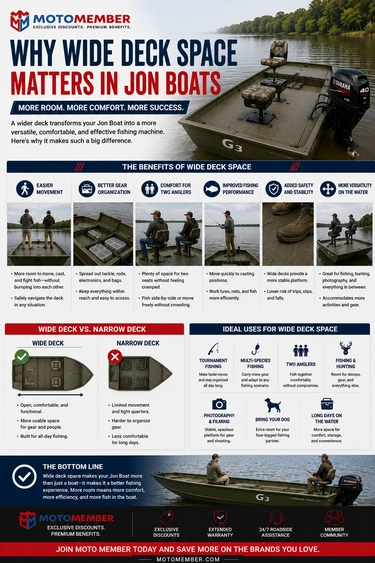
Why Wide Deck Space Matters in a Fishing Jon Boat
Wide deck space can make the difference between a fishing jon boat that feels easy to use and one that feels crowded after the first cooler, tackle bag, battery, net, and rod bundle come onboard.
A jon boat is already known for practical, open utility. Discover Boating describes jon boats as aluminum fishing boats with flat or nearly flat bottoms, simple layouts, shallow-water usefulness, and minimal draft, while also noting that many owners customize them over time with items such as seats, rod holders, and decking.
For anglers comparing G3 Gator Tough jon boats, wide deck space matters because it affects casting, balance, safety, storage, trolling motor control, electronics placement, two-angler movement, fish handling, and how comfortable the boat feels after several hours on the water.
For shoppers in Virginia, Pennsylvania, Maryland, West Virginia, and nearby areas, MotoMember can help compare G3 side-console, center-console, Loose Jon, Package Jon, Tunnel Jon, and Jet Jon layouts so you choose a boat that fits your water, gear, and fishing style.
Quick Answer: Why Wide Deck Space Matters
Wide deck space matters because fishing is active. Anglers stand, cast, reach for rods, grab tackle, net fish, open livewells, operate trolling motors, and move around passengers and gear.
A wider, cleaner deck gives you:
More room to cast.
Better footing.
Easier movement with two anglers.
Safer netting and fish handling.
More space for rods and tackle.
Better trolling motor control.
Cleaner electronics placement.
More flexibility for bass, crappie, catfish, and river fishing.
Less clutter during long days.
The best jon boat is not always the longest boat. A well-designed deck with smart storage, console placement, rod organization, and open walking room can fish better than a larger boat with poor layout.
Wide Deck Space Helps You Cast Better
Casting takes more room than many shoppers realize.
A bass angler may cast from the bow, step back, switch rods, work a bait along cover, and then move to a different angle. A crappie angler may handle long rods near brush piles or docks. A catfish angler may need room to load heavy rods into holders without tangling lines.
G3 highlights this point on the 17 CC, describing the model as having wide open deck space that gives anglers room to cast, move around, and set up gear. The 17 CC also includes a center console with Yamaha controls and room for optional electronics, which helps keep fishing gear organized instead of scattered across the floor.
When the deck is too cramped, anglers shorten casts, step over rods, block each other’s angles, and spend more time managing gear than fishing.
Wide Deck Space Improves Footing and Balance
Fishing jon boats are often used in shallow water, small lakes, rivers, ponds, backwaters, and coves. Those are exactly the places where anglers stand often.
A wider deck gives your feet more room and helps you move with more confidence. This matters when the boat rocks from a wake, when a fish pulls hard near the side, or when a partner shifts weight unexpectedly.
Deck surface also matters. G3 describes the 20 CC with non-slip flooring designed to provide traction and help keep anglers steady when the deck is wet. The same model includes a wide bow deck for casting and an optional trolling motor, which makes the front fishing position more useful.
Good footing does not replace safe boating habits, but it does make fishing more comfortable and controlled.
Wide Deck Space Reduces Clutter
Clutter is one of the biggest problems in a fishing jon boat.
Rods end up on the floor. Tackle bags slide around. Anchor rope gets underfoot. Coolers block livewell lids. Batteries and chargers take up space. A landing net gets buried under rain gear.
Wide deck space gives you room to organize. G3’s 18 CC includes side rod storage, six upright rod holders, space for optional electronics, battery storage under the console, and two livewells, all of which help maintain a cleaner deck while keeping fishing gear within reach.
The goal is not an empty boat. The goal is a boat where everything has a place.
Wide Deck Space Helps Two Anglers Fish Comfortably
A jon boat that feels roomy for one angler can feel crowded with two.
Two anglers usually bring twice the rods, tackle, drinks, rain gear, and personal items. They also need separate casting angles. One person may work the bow while the other fishes from the stern or side.
A wider deck helps separate those fishing zones. It reduces tangles, improves casting angles, and makes it easier for one angler to net a fish while the other keeps fishing.
This is why side-console boats are popular with two-angler teams. G3 describes the 20 SC as having wide, open areas that give anglers room to cast and move around, along with under-seat storage, side rod holders, bow storage, livewell space, and tackle tray storage.
Wide Deck Space Makes Trolling Motors Easier to Use
A trolling motor works best when the angler has a clean, stable place to stand.
If the bow is too crowded, the foot pedal becomes a tripping hazard. If rods are scattered around the mount, they get stepped on. If electronics are mounted awkwardly, the angler has to lean, twist, or look away from the water.
Wide bow space lets you control the trolling motor, watch electronics, cast, and move safely. That matters for bass anglers working shorelines, crappie anglers holding near brush, and catfish anglers making quiet adjustments before anchoring.
G3 lists Minn Kota trolling motor options and Humminbird bow and console electronics options on models such as the 18 SC and 20 SC, showing why deck planning, power, electronics, and fishing position should be considered together.
Wide Deck Space Supports Better Electronics Placement
Modern fishing electronics are useful, but they need space.
A bow-mounted screen should be visible while fishing. A console screen should not block controls or steering. Wiring should be protected. Batteries should be secured. Transducers and cables should be planned before permanent mounting.
The 20 CC is a good G3 example because its center console is designed for visibility, easy steering, electronics mounting space, and controls within reach. Its bow area also provides a wide casting deck with room for an optional trolling motor.
A clean electronics setup starts with a clean deck plan.
Wide Deck Space Matters for Bass Fishing
Bass anglers need room to cast, switch rods, control the trolling motor, and land fish quickly.
A wide deck lets one angler work the bow while rods, tackle, net, and electronics stay organized. It also makes it easier to fish docks, grass edges, laydowns, shallow cover, rock, and points without constantly stepping around gear.
The G3 18 CC is a strong bass-friendly example because it combines center-console control, rod storage, upright rod holders, livewell utility, optional electronics space, and an 18-foot layout that still feels manageable for many owners.
For bass anglers, wide deck space is not just about comfort. It helps you fish faster and cleaner.
Wide Deck Space Matters for Crappie Fishing
Crappie fishing can take over a boat fast.
Long rods, rod holders, minnow gear, jig boxes, electronics, landing nets, coolers, and trolling motor controls all need space. Spider-rigging and long-line trolling especially benefit from a clean, open layout.
A side-console jon boat often works well because it leaves more of the center area open. The G3 18 SC includes under-seat storage, tackle trays in front of the console, bow storage, a side console with room for optional electronics, and a 31-gallon livewell.
For crappie anglers, wide deck space helps reduce tangles and keeps rods from turning into obstacles.
Wide Deck Space Matters for Catfishing
Catfish anglers need a different kind of space.
They often carry heavy rods, rod holders, bait containers, anchor rope, landing nets, coolers, lights, gloves, towels, and larger tackle. Night fishing adds even more need for clean movement and smart storage.
The G3 20 SC is a strong catfish-friendly layout because its wide open areas, side rod holders, bow storage, under-seat storage, livewell, tackle tray storage, and courtesy light help keep the boat usable during long or low-light trips.
For catfishing, deck space helps when a rod loads up, a fish runs under the boat, or two anglers need to move quickly without stepping into anchor rope or tackle.
Wide Deck Space Matters for River Fishing
River fishing adds current, rocks, shallow water, and changing conditions.
A wide deck helps anglers brace, move, and keep gear secure. It also helps when rods need to be stowed before running, when passengers shift weight, or when you need to grab the net in current.
For anglers who fish skinny water, G3’s 18 CCJ is built for shallow-water use and includes port-side rod holders, optional trolling motor capability, a helm seat that doubles as a livewell, and an 88-inch beam.
A river boat should not be cluttered. Loose gear can become more than annoying when current, shallow water, or rocks are involved.
Wide Deck Space Helps With Fish Handling
Landing fish requires room.
One angler may be fighting the fish. Another may be reaching for the net. A cooler or livewell lid may need to open. Rods and lines may be spread across the boat. If the deck is cramped, the moment gets messy.
G3’s 20 CC gives anglers multiple fish-handling and storage points, including a 14-gallon livewell under the console seat and a 31-gallon divided bow livewell with side storage.
Wide deck space makes fish handling cleaner, especially when you are fishing with a partner, working around live bait, or managing multiple rods.
Wide Deck Space Does Not Mean No Storage
Some buyers assume open deck space and storage are opposites. They are not.
The best fishing jon boat layout uses storage to protect open space. Rod holders, under-seat compartments, bow storage, tackle trays, livewells, and console storage all help keep gear off the floor.
G3’s 20 SC is a good example because the under-seat storage is designed to stow gear and personal items while helping keep the deck organized and clutter-free.
Open space without storage becomes clutter. Storage without open space becomes cramped. The best layout gives you both.
Wide Deck Space vs Boat Size
A 20-foot jon boat usually gives more space than a 17-foot model, but size alone does not tell the whole story.
Console placement, storage design, livewell location, seat layout, rod holders, battery placement, and deck height all affect how the boat fishes. A smart 18-foot layout can feel better than a poorly arranged larger boat.
G3’s Package Jon lineup includes center-console and side-console boat, motor, and trailer packages in 17- to 20-foot lengths, while Loose Jon models offer another path for buyers who want a more customizable platform.
Before choosing by length, stand in the boat and picture your real fishing day.
Side Console vs Center Console for Wide Deck Space
A side-console layout usually preserves more open interior space.
That is why side-console jon boats can be excellent for crappie anglers, catfish anglers, two-person fishing, hunting crossover, and mixed-use owners who carry loose gear.
A center-console layout gives better walkaround control, a central helm position, and a good location for electronics and rod holders. The 18 CC and 20 CC are strong choices for anglers who want more organized helm control and a fishing-focused console.
Neither layout is automatically better. Side console favors open floor space. Center console favors central control and walkaround movement.
Wide Deck Space Helps Fishing and Hunting Crossover
Many jon boat buyers fish in spring and summer, then hunt in fall and winter.
Wide deck space helps both seasons. During fishing season, it gives you room for rods, tackle, electronics, coolers, and trolling motor use. During hunting season, it gives you room for decoys, blind bags, waders, anchors, lights, dog gear, and cold-weather clothing.
G3’s Gator Tough lineup includes Package Jon, Tunnel/Jet Jon, and Loose Jon choices, giving buyers different paths for fishing, hunting, shallow-water access, and custom setups.
For mixed-use shoppers, removable accessories and open floor space can be more valuable than permanent gear everywhere.
How Much Deck Space Do You Really Need?
Start with your full-day load.
List every rod, tackle bag, cooler, battery, charger, fish finder, trolling motor, anchor, rope, net, PFD, throwable device, rain jacket, tool, bait container, and passenger. Then decide where everything goes.
A solo pond angler may not need a 20-foot boat. A two-person crappie or catfish team may appreciate every inch of open deck. A river angler may need fewer accessories but more secure storage and safe footing.
Deck space is not about showing off. It is about reducing friction during real fishing.
MotoMember Expert Tip
Before choosing a fishing jon boat, pretend you are already fighting a fish.
Where are your feet? Where is the net? Where is your partner standing? Are rods on the floor? Can you open the livewell? Can you reach the trolling motor? Is the cooler blocking the walkway?
Many shoppers ask, “How wide is the boat?” The better question is: How usable is the deck once my real gear is onboard?
Our team can help you compare G3 17 CC, 18 SC, 18 CC, 20 SC, 20 CC, Loose Jon, Tunnel Jon, and Jet Jon layouts based on your actual fishing style.
Regional Buying Advice for VA, PA, MD, WV, and Nearby Areas
For anglers in Virginia, Pennsylvania, Maryland, West Virginia, and nearby areas, wide deck space matters because local fishing can vary so much.
Small lakes and ponds may call for a manageable 17- or 18-foot setup. Crappie and catfish anglers may prefer the open room of a side-console 18 SC or 20 SC. Bass anglers may like the 18 CC or 20 CC. Shallow river anglers may need a Tunnel or Jet Jon.
MotoMember’s G3 resources highlight support for inventory, accessories, service, financing, and ownership questions, which is important because deck space should be planned together with trolling motors, electronics, rod holders, storage, and trailer fit.
Current availability can vary by season, location, model year, motor package, trailer setup, color, electronics, trolling motor options, and accessories.
Safety Considerations
Wide deck space can help safety, but only if the boat is loaded correctly.
Do not overload the boat. Keep weight balanced. Secure batteries and coolers. Keep anchor rope contained. Do not bury life jackets under tackle or storage boxes.
The U.S. Coast Guard says recreational vessels must have a Coast Guard-approved wearable PFD for each person onboard, while Pennsylvania states that all boats need a serviceable USCG-approved life jacket for each person and boats 16 feet and over must carry an immediately available USCG-approved throwable device.
Virginia DWR states that operators of motorboats with a 10 hp or greater engine need to take a boating safety course.
Call to Action
Your G3 Gator Tough Headquarters starts at MotoMember.
Explore current G3 availability, compare wide-deck jon boat layouts, and talk with the MotoMember team about Yamaha power, trailers, side-console and center-console options, trolling motors, electronics, rod storage, livewells, fishing accessories, financing, trade-ins, service, towing, and storage.
Large selection. Straightforward shopping. Real powersports and marine expertise.
Stop dreaming. Start riding—and boating—with MotoMember.
Conclusion
Wide deck space matters in a fishing jon boat because it affects almost everything you do on the water.
It helps you cast, balance, move, organize rods, manage tackle, control the trolling motor, use electronics, land fish, fish with a partner, and keep the boat safer. It also makes the boat more flexible across bass fishing, crappie fishing, catfishing, river fishing, and hunting crossover use.
For many shoppers, G3 models like the 18 SC, 18 CC, 20 SC, and 20 CC offer strong deck-space options depending on whether you prefer side-console openness or center-console control. Loose Jon models may be better for custom builds, while Tunnel and Jet Jon models are worth comparing if shallow-water access is the main priority.
For shoppers in VA, PA, MD, WV, and nearby areas, MotoMember can help you choose a G3 Gator Tough jon boat with the deck space, layout, storage, and rigging support that fit your season.
FAQ
Why does wide deck space matter in a fishing jon boat?
Wide deck space gives anglers more room to cast, move, control the trolling motor, manage rods, open livewells, use electronics, and land fish safely. It also helps reduce clutter during long fishing days.
Is a side-console jon boat better for open deck space?
Often, yes. A side-console layout keeps the helm to one side, which usually leaves more open center floor space for rods, tackle, coolers, anchor gear, and passenger movement.
Is a center-console jon boat still good for deck space?
Yes. A center-console jon boat can provide excellent walkaround movement, helm visibility, electronics space, and organized rod storage. G3’s 18 CC and 20 CC are strong examples for anglers who want center-console control.
Which G3 jon boat has the most open fishing layout?
The G3 20 SC is one of the strongest open-layout choices because G3 describes it with wide, open areas for casting and movement, under-seat storage, side rod holders, bow storage, livewell space, and side-console utility.
How do I compare wide-deck G3 jon boats at MotoMember?
Check MotoMember inventory or contact the team directly. Availability, model year, motor package, trailer setup, colors, electronics, accessories, pricing, and incoming units can change by season and location.