
Tunnel Hull vs Jet Boat: Shallow Water

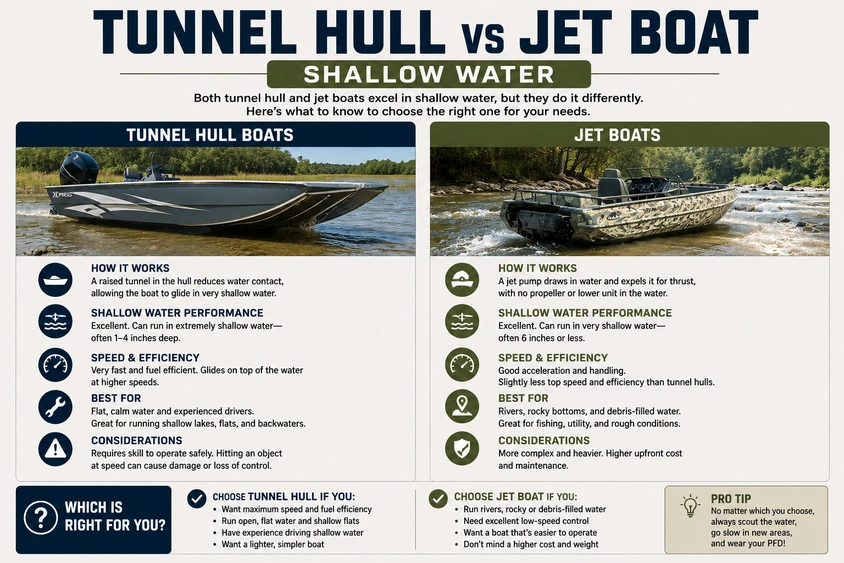
Tunnel Hull vs Jet Boat: Which Is Better for Shallow Water?
Choosing between a tunnel hull vs jet boat comes down to the kind of shallow water you run.
Both are designed to help boaters reach places a standard prop boat may not handle as well. Both can be strong options for river fishing, duck hunting, backwater exploring, and shallow-water access. But they solve the problem differently.
A tunnel hull uses a hull design that helps feed water to a propeller mounted higher than a standard setup. G3 describes the 2026 18 CCT tunnel hull as lifting the prop to help access extremely shallow rivers and backwaters while still delivering smooth handling.
A jet boat uses jet-drive propulsion instead of a traditional exposed propeller. G3 describes its 18 CCJ as built for skinny water and useful for fishing, hunting, or exploring waters that may be off-limits to traditional boats.
For shoppers in Virginia, Pennsylvania, Maryland, West Virginia, and nearby areas, MotoMember can help compare G3 Tunnel Jon and Jet Jon models, Yamaha power, trailers, accessories, financing, trade-ins, service needs, and real-world shallow-water setup decisions.
Quick Answer: Tunnel Hull vs Jet Boat
Choose a tunnel hull jon boat if you want shallow-water prop performance, good control, and a setup that still feels familiar to many outboard boat owners.
Choose a jet boat if you regularly run rocky rivers, riffles, shoals, gravel bars, skinny backwaters, or water where an exposed prop is a major concern.
| Buyer Priority | Better Fit |
|---|---|
| Shallow-water prop setup | Tunnel hull |
| Rocky rivers and shoals | Jet boat |
| Familiar outboard feel | Tunnel hull |
| No exposed propeller below the lower unit | Jet boat |
| Smooth shallow-water handling | Tunnel hull |
| Backwater exploring | Either |
| Serious river running | Often jet boat |
| Simpler prop-style ownership | Tunnel hull |
| Tight, responsive river handling | Jet boat |
| Fishing and hunting versatility | Either |
The better choice depends on your water, bottom type, load, distance traveled, operator experience, trailer access, and long-term service plan.
What Is a Tunnel Hull?
A tunnel hull is designed to help a prop-driven boat run shallower than a standard hull and outboard setup.
Instead of placing the propeller in the same position as a traditional deep-running prop setup, the tunnel design helps direct water toward the prop so it can operate higher. G3’s 18 CCT page explains this clearly: the tunnel hull design lifts the prop for access to extremely shallow rivers and backwaters.
That makes a tunnel hull appealing for boaters who still want prop-driven performance but need more shallow-water clearance.
Tunnel hulls can be strong for anglers and hunters who run shallow flats, backwaters, marsh edges, sandy bottoms, and moderate-depth river sections. They can also make sense for buyers who want shallow-water capability without moving all the way into a jet-drive setup.
What Is a Jet Boat?
A jet boat uses jet propulsion rather than a conventional exposed propeller.
In a shallow-water jon boat context, that usually means water is drawn into a jet intake and pushed out to move the boat. Because there is no traditional exposed propeller hanging down in the same way, jet boats are popular with river users who deal with rocks, shoals, riffles, gravel, and very shallow runs.
G3 describes the 18 CCJ DLX as ideal for rivers, streams, and backwaters where depth is limited, and notes that jet drives deliver agile handling, tight turns, and a responsive driving experience.
That makes a jet boat especially attractive for serious shallow-river use. It is not magic, and it still needs water to operate, but it is often the right tool when river access is the main reason you are buying.
How They Handle Shallow Water Differently
A tunnel hull and a jet boat both help in shallow water, but they do it in different ways.
A tunnel hull is still a prop-driven setup. The goal is to raise the prop and improve shallow-water access while keeping the feel and efficiency many boaters expect from a prop outboard. G3 positions the 18 CCT as a tunnel hull that gives confidence, control, and shallow-water access.
A jet boat removes the exposed propeller from the equation and uses jet propulsion. That can be a major advantage around rocks, riffles, gravel bars, and skinny river sections. G3’s 20 CCJ is described as built tough for shallow water, river running, backwater fishing, and adventure beyond the main channel.
The tunnel hull is usually the better fit for shallow prop performance. The jet boat is usually the better fit for shallow rocky river access.
When a Tunnel Hull Makes More Sense
A tunnel hull makes sense when shallow water matters, but you still want a prop-driven boat.
That may include shallow rivers, backwaters, sandy flats, marsh edges, and fishing or hunting areas where you need extra clearance but do not necessarily need a jet drive. Tunnel hulls can be especially appealing for boaters who like the way prop boats perform, load, steer, and service.
The G3 18 CCT is a good example of this category. G3 highlights its tunnel design, optional trolling motor capability, flip double-wide helm seat, and built-in cooler functionality.
Choose a tunnel hull if your shallow water is predictable, you want prop performance, and you do not constantly run rocky riffles or extreme skinny water.
When a Jet Boat Makes More Sense
A jet boat makes sense when the river is the reason you are buying.
If your normal water includes rocks, shoals, ledges, riffles, gravel bars, shallow channels, sudden depth changes, or hard-to-read backwaters, a jet setup deserves serious consideration.
G3’s 18 CCJ is positioned for skinny water, fishing, hunting, and exploring waters that may be off-limits to traditional boats. The larger 20 CCJ adds serious river-use capability, with G3 describing it as a strong choice for river running, backwater fishing, and adventure beyond the main channel.
Choose a jet boat if you are willing to accept a more specialized setup because your water demands it.
Fishing: Tunnel Hull vs Jet Boat
For fishing, the right choice depends on where you cast.
A tunnel hull can be excellent for anglers who fish shallow flats, backwaters, protected rivers, coves, and areas where prop clearance is helpful. It gives you shallow-water access while preserving the prop-driven setup many anglers already understand.
A jet boat is better for anglers who fish rivers with rocks, riffles, ledges, gravel, and changing water levels. River smallmouth anglers, catfish anglers, and backwater bass fishermen may appreciate the ability to run water that would be stressful in a standard prop boat.
G3’s Tunnel/Jet Jon Series includes 17- to 20-foot options, giving shoppers multiple shallow-water paths instead of one universal answer.
For many anglers, the best move is to describe your water to the MotoMember team before choosing the drivetrain.
Hunting: Tunnel Hull vs Jet Boat
Duck hunters should think about water depth, bottom type, distance, gear load, and how often they run in darkness or low visibility.
A tunnel hull can work well for marshes, backwaters, shallow river edges, and hunting areas where a prop setup still makes sense. It may feel more familiar for hunters who already know traditional outboards.
A jet boat can be a better fit when hunters run shallow rocky rivers, hidden ledges, riffles, or hard-bottom routes to reach blinds, islands, or remote banks. The tradeoff is that jet boats still require careful operation, clean water flow to the intake, and realistic load planning.
No shallow-water boat eliminates risk. For hunting, the right setup should leave room for decoys, waders, a dog, fuel, anchors, batteries, blind bags, life jackets, and safe movement.
Rocky Rivers: Jet Boat Advantage
For rocky rivers, the jet boat usually has the advantage.
That is because a jet setup avoids the traditional exposed propeller running below the boat. In water with rocks, riffles, gravel bars, and shoals, that can be a major benefit.
G3’s 18 CCJ DLX page specifically mentions rivers, streams, and backwaters where depth is limited, along with agile handling and responsive driving.
This does not mean a jet boat can run anywhere. A jet intake can still ingest debris, and shallow rocky water requires skill, planning, and judgment. But if your normal use is serious river running, the jet boat is usually the stronger shallow-water tool.
Sand, Mud, and Backwaters: It Depends
In sandy, muddy, or vegetated backwater areas, the answer can be less obvious.
A tunnel hull may be a smart choice if you have enough clean water for prop operation and want efficient shallow-water performance. A jet boat may be appealing if exposed-prop clearance is the main concern.
However, debris, weeds, mud, and sand can affect either setup. A tunnel hull still has a prop. A jet boat still has an intake. Neither is maintenance-free.
Before choosing, tell MotoMember what your shallow water actually looks like. Sandbars, mud flats, hydrilla, gravel, ledges, and moving current all push the decision in different directions.
Load Matters More Than Shoppers Think
Shallow-water performance changes when the boat is loaded.
A tunnel hull or jet boat that runs well with one person may behave differently with three anglers, a full fuel tank, batteries, tackle, anchors, coolers, hunting gear, decoys, and a dog.
That is why capacity, beam, layout, and weight distribution matter. G3’s 20 CCJ, for example, is the larger Jet Jon option and is positioned for more serious river and backwater use than smaller models.
Many shallow-water complaints come from mismatched expectations. The boat may be capable, but the load, water level, motor setup, or operator habits may not fit the conditions.
Steering and Handling
Tunnel hulls and jet boats feel different at the helm.
A tunnel hull with a prop setup may feel more familiar to boaters used to standard outboards. It can offer strong control and predictable handling when properly set up for the hull, motor, and water.
A jet boat can feel more responsive in tight river situations. G3 notes that jet drives deliver agile handling, tight turns, and responsive driving on the 18 CCJ DLX page.
That responsiveness is useful, but it also requires experience. Jet boats handle differently, especially at low speeds, in current, or when loaded heavily. Buyers moving from prop boats should plan to learn the setup instead of assuming it will feel the same.
Efficiency and Range
A tunnel hull may be the better fit if efficiency and familiar prop performance matter most.
Jet boats are specialized shallow-water tools. They often make sense because of access, not because they are the simplest or most efficient choice for every buyer.
If your water is shallow but not rocky, a tunnel hull may offer the balance you want. If your water is rocky, ledgy, and unpredictable, the access benefits of a jet may matter more than efficiency.
For longer runs, fuel capacity, load, current, speed, and water conditions all matter. Ask MotoMember to compare the exact G3 model, motor setup, and expected use before choosing.
Maintenance and Ownership
Tunnel hulls and jet boats both need maintenance, but they need attention in different areas.
A tunnel hull still has prop-related concerns, including prop condition, lower-unit clearance, trim, setup, and possible impact damage if used carelessly in shallow water.
A jet boat requires attention to the jet intake, impeller area, wear components, debris ingestion, and shallow-water operating habits. Rocks, sand, weeds, and sticks can all create issues if the boat is used in the wrong conditions or without inspection.
MotoMember’s role matters here. A shallow-water boat is not just a purchase; it is a setup and service relationship. MotoMember can help shoppers compare the boat, Yamaha power, trailer fit, accessories, and service needs before and after the sale.
G3 Tunnel/Jet Jon Models to Compare
G3’s Tunnel/Jet Jon Series includes several models in the 17- to 20-foot range, including tunnel and jet options.
The G3 18 CCT is the tunnel hull model to consider if you want a prop setup designed for shallow rivers and backwaters.
The G3 18 CCJ is a Jet Jon option built for skinny-water fishing, hunting, and exploring.
The G3 20 CCJ is the bigger Jet Jon choice for shoppers who need more boat for river running, backwater fishing, and serious shallow-water adventure.
The right model depends on how much room, power, capacity, fuel, and trailer size you need.
Tunnel Hull vs Jet Boat for First-Time Buyers
Most first-time shallow-water buyers should be careful about over-specializing.
A tunnel hull may be easier to understand if you already know prop boats and your shallow water is moderate. It gives you a shallow-water advantage without changing the entire propulsion experience as much as a jet setup.
A jet boat can be the right first shallow-water boat if your water clearly demands it. But it should be bought with realistic expectations. Jet boats require a learning curve, especially in current, tight channels, and changing water levels.
The smartest first-time buyer does not ask, “Which one is better?” They ask, “Which one matches my water 80 percent of the time?”
MotoMember Expert Tip
Before choosing a tunnel hull or jet boat, write down your three most common launch points and the shallowest water you actually run.
Then list the bottom type: rock, sand, mud, grass, gravel, ledges, wood, or mixed. Add your usual passengers, fuel, fishing gear, hunting gear, dog, batteries, and distance traveled.
Many shoppers say, “I need a shallow-water boat.” The better question is: Do I need shallow-water prop performance, or do I need a jet for rocky river access?
Our team can help you compare G3 Tunnel Jon and Jet Jon options based on your real water, not just the brochure.
Regional Advice for VA, PA, MD, WV, and Nearby Areas
For boaters in Virginia, Pennsylvania, Maryland, West Virginia, and nearby areas, shallow water can mean many different things.
Some shoppers run creeks, farm ponds, and protected backwaters. Others fish rocky river systems, shoals, shallow ledges, and changing current. Those are not the same problem.
MotoMember is a full-service powersports and marine dealership group with locations in Purcellville and Manassas, Virginia, and Chambersburg, Pennsylvania. MotoMember represents major powersports and marine brands including G3, Yamaha, SunCatcher, Can-Am, Sea-Doo, Polaris, Kawasaki, Slingshot, and others.
Current availability can vary by season, location, model year, motor package, color, trailer setup, and options. Check MotoMember inventory or contact the team before planning around one exact G3 Tunnel or Jet Jon configuration.
Safety Considerations
Shallow water is not automatically safe water.
Rocks, current, cold water, submerged wood, sudden depth changes, low light, debris, and remote access can all increase risk. This is especially important for hunters and river anglers who launch early, return late, or operate in changing water levels.
The U.S. Coast Guard says recreational vessels must carry a U.S. Coast Guard-approved wearable PFD for each person onboard. Pennsylvania’s Fish and Boat Commission states that boats 16 feet or more must also carry an immediately available throwable device. Virginia DWR states that operators of motorboats with a 10 hp or greater engine need to take a boating safety course.
Before launching, inspect life jackets, check weather and river levels, avoid overloading the boat, keep safety gear reachable, and know your route before running shallow water at speed.
Call to Action
Your G3 Tunnel and Jet Jon Headquarters starts at MotoMember.
Explore current G3 availability, compare tunnel hull and jet boat options, and talk with the MotoMember team about Yamaha power, trailer fit, shallow-water rigging, trolling motors, electronics, hunting setups, fishing layouts, financing, trade-ins, service, towing, and storage.
Large selection. Straightforward shopping. Real powersports and marine expertise.
Stop dreaming. Start riding—and boating—with MotoMember.
Conclusion
So, tunnel hull vs jet boat: which is better for shallow water?
Choose a tunnel hull if you want shallow-water prop performance, familiar handling, and a strong setup for rivers, backwaters, flats, and areas where prop clearance matters.
Choose a jet boat if rocky rivers, riffles, shoals, gravel bars, ledges, and skinny-water access are central to how you fish or hunt.
Neither is automatically better for every buyer. The right choice depends on water depth, bottom type, load, distance, handling expectations, maintenance comfort, and ownership support.
For shoppers in VA, PA, MD, WV, and nearby areas, MotoMember can help you compare G3 Tunnel and Jet Jon models so you choose the shallow-water boat that fits your real outdoor life.
FAQ
Is a tunnel hull better than a jet boat?
A tunnel hull may be better if you want shallow-water prop performance and familiar outboard handling. A jet boat may be better if you regularly run rocky rivers, riffles, shoals, and very shallow water where an exposed prop is a concern.
Is a jet boat best for shallow rivers?
A jet boat is often the better choice for shallow rocky rivers. G3 describes its 18 CCJ as built for skinny water and useful for fishing, hunting, or exploring waters that may be off-limits to traditional boats.
What does a tunnel hull do?
A tunnel hull helps lift the prop and feed water to it, allowing a prop-driven boat to access shallower water than many standard setups. G3 says the 18 CCT tunnel hull lifts the prop for access to extremely shallow rivers and backwaters.
Are jet boats hard to maintain?
Jet boats are not necessarily hard to maintain, but they require different attention than prop boats. Owners should inspect the intake, watch for debris, understand wear items, and operate carefully around rocks, sand, weeds, and shallow water.
How do I compare G3 Tunnel and Jet Jon boats at MotoMember?
Check MotoMember’s current inventory or contact the team directly. Availability, model year, motor package, trailer setup, color, equipment, pricing, and incoming units can change by season and location.