Small Pontoon Boats vs. Full-Size Pontoons

Small Pontoon Boats vs. Full-Size Pontoon Boats: Which One Should You Buy?
Shopping for a pontoon boat usually starts with one big question: Should you buy a small pontoon boat or a full-size pontoon boat?
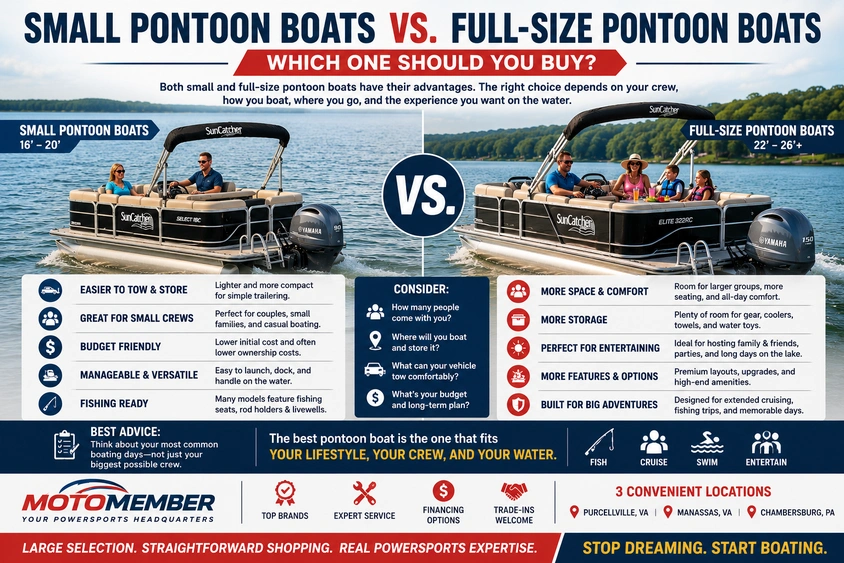
Both can be great choices. A small pontoon may be easier to tow, store, launch, and manage. A full-size pontoon may offer more seating, more storage, more comfort, and more room for family, guests, fishing gear, and long days on the water.
The right answer depends on how you plan to boat.
For shoppers in Virginia, Pennsylvania, Maryland, West Virginia, and nearby areas, MotoMember helps compare new pontoon boats, available layouts, financing options, accessories, trailer needs, service support, and ownership considerations. MotoMember inventory pages include SunCatcher pontoon models such as Select 18C, Select 20C, Select 22RF, Select 22SL, and larger Diamond Elite models, though availability, pricing, model year, and equipment can change. Always check current MotoMember inventory or contact the team before visiting.
What Counts as a Small Pontoon Boat?
A small pontoon boat is usually a more compact model designed for easier handling, smaller crews, simpler storage, and relaxed cruising. Many compact pontoons appeal to first-time boat owners, couples, smaller families, anglers, and buyers who want a manageable boat without giving up the comfort and stability pontoons are known for.
MotoMember inventory pages have included compact SunCatcher models such as the Select 18C and Select 18F, along with 20-foot class options like the Select 20C and Select 20FC. Current listings and specifications can vary, so shoppers should confirm details with MotoMember directly.
A small pontoon may be a strong fit if you usually boat with a smaller group, fish casually, cruise on calmer inland water, tow regularly, or have limited storage space.
What Counts as a Full-Size Pontoon Boat?
A full-size pontoon boat is built for more room, more passengers, more comfort, and more flexibility. These boats are often chosen by larger families, lake homeowners, entertainers, and buyers who want longer days on the water with more seating, storage, and amenities.
Full-size pontoons can include larger cruise layouts, rear-facing lounge layouts, fishing-and-cruise configurations, and premium models. MotoMember inventory pages have included larger SunCatcher listings such as the Select 22RF, Select 22SL, Select 22RC, Select 320RCX, and Diamond Elite 322RC. Availability and model details can change, so live inventory is the best source before visiting.
A full-size pontoon may be the better choice if you often bring guests, want more lounge space, carry lots of gear, enjoy entertaining, or plan to spend full days on the water.
Start With Your Real Boating Day
Before comparing small pontoon boats and full-size pontoon boats, picture your normal day on the water.
Are you usually boating with two to four people? Are you bringing kids, grandparents, friends, coolers, towels, fishing rods, water toys, and extra bags? Are you trailering to different lakes? Are you keeping the boat at a marina? Do you want simple evening cruises or all-day weekend outings?
Many shoppers make the mistake of buying for the biggest possible group they might host one day. Others buy too small and quickly realize they need more room. The goal is to match the boat to your most common use, then consider how often you truly need extra capacity.
Small Pontoon Boats: Key Advantages
Easier to Manage
One of the biggest reasons shoppers choose a small pontoon is confidence. A compact pontoon can feel less intimidating for first-time owners, especially when towing, launching, docking, and storing.
If one person in your household will usually handle towing or launching, a smaller boat may make ownership feel more approachable.
Easier to Store
Storage is a major part of boat ownership. A smaller pontoon may fit more storage situations, including certain driveways, barns, covered storage spaces, or seasonal storage facilities.
Before buying, measure your available space and talk with the MotoMember team about trailer length, cover needs, and storage clearance.
Good for Smaller Crews
If your normal boating group is two to six people, a smaller pontoon may provide enough room without adding unnecessary size.
Compact pontoons can still be comfortable, especially if you choose a smart layout that fits your use. A couple who mostly cruises in the evening may not need the same boat as a family that hosts eight guests every Saturday.
Often a Practical First Boat
Small pontoon boats can be appealing for first-time buyers because they offer the pontoon experience in a more manageable package.
You can enjoy stable seating, open deck space, shade options, and simple lake days without stepping into a larger boat before you are ready.
Good for Fishing and Casual Cruising
Some smaller pontoons are designed with fishing-friendly layouts. MotoMember inventory pages have included the SunCatcher Select 18F, which is described with fishing-oriented features such as bow fishing stations, rod holders, an aerated livewell, and a stern fishing center.
For anglers who also want a comfortable boat for family cruising, a small fishing pontoon can be a practical middle ground.
Small Pontoon Boats: Possible Trade-Offs
Less Seating
A smaller pontoon naturally has less seating and deck space than a full-size model. That may not matter for couples or small families, but it can become noticeable when guests come along.
Think about your normal passenger count and your realistic maximum passenger count.
Less Storage
Smaller boats usually have less room for towels, coolers, life jackets, fishing gear, dock lines, fenders, bags, snacks, and water toys.
Storage can make or break a family lake day. Open compartments in person and imagine your actual gear onboard.
Less Room for Entertaining
If your boating dream includes hosting friends, stretching out, anchoring for lunch, and bringing plenty of supplies, a compact pontoon may feel tight.
A small pontoon can still be fun and comfortable, but it may not deliver the same social space as a larger layout.
More Sensitivity to Passenger Load
Any boat can feel different depending on passengers, gear, water, and engine setup. With smaller pontoons, passenger load and gear placement may be more noticeable.
Talk with MotoMember about how you plan to use the boat so the team can help compare appropriate layouts and power options.
Full-Size Pontoon Boats: Key Advantages
More Seating and Comfort
Full-size pontoons are popular because they give passengers room to relax. Larger layouts can include more lounge seating, rear-facing seats, tables, larger helm areas, and more open deck space.
For families, this can mean less crowding and more comfort over a full day.
Better for Guests
If you regularly bring friends, relatives, kids, or neighbors, a full-size pontoon may make more sense. More seating and more deck space help the boat feel social instead of crowded.
A larger boat can also make it easier for people to move around without stepping over bags, coolers, and gear.
More Storage
Full-size pontoons often provide more space for gear. This matters for families that bring towels, water toys, snacks, coolers, fishing tackle, life jackets, anchors, and cleaning supplies.
A clean deck is more comfortable and easier to enjoy.
Stronger Entertainment Layouts
If your idea of boating includes lake parties, sunset cruises, family gatherings, swimming stops, and long weekends, full-size pontoons are worth a close look.
Larger models can offer seating arrangements that feel more like an outdoor living room.
More Premium Options
Full-size pontoons often open the door to more premium layouts, comfort packages, and feature combinations. MotoMember inventory pages have included larger and premium SunCatcher models such as the Select 320RCX and Diamond Elite 322RC, with descriptions focused on upscale comfort and refined on-water use.
Full-Size Pontoon Boats: Possible Trade-Offs
More Boat to Tow
A larger pontoon may require more planning around tow vehicle capability, trailer size, storage length, launch ramps, and driver confidence.
Before buying, discuss your tow vehicle, towing experience, storage situation, and local launch conditions.
More Storage Space Needed
Full-size pontoons need more room when they are not on the water. That may mean marina storage, seasonal storage, a larger driveway area, or a dedicated storage plan.
Do not choose a larger boat until you know where it will live.
More to Clean and Maintain
A larger pontoon may mean more seating, more deck surface, more cover area, and more equipment to clean and maintain.
That does not mean you should avoid a larger model. It simply means you should plan for ownership, not just purchase day.
May Be More Than Some Buyers Need
A full-size pontoon can be fantastic, but not every shopper needs one. If you usually boat with a small crew, tow frequently, and prefer simple outings, a compact pontoon may be easier to use more often.
The best boat is the one you will actually enjoy regularly.
Small Pontoon vs. Full-Size Pontoon: Comfort
Comfort depends on more than length. Seating shape, cushion support, shade, layout, helm position, storage, and traffic flow all matter.
A smaller pontoon with a smart layout may feel very comfortable for a small family. A full-size pontoon may feel more comfortable for larger groups because passengers have space to spread out.
When comparing boats, sit in every seat. Walk through the deck. Open storage compartments. Picture a real outing with passengers onboard.
Small Pontoon vs. Full-Size Pontoon: Seating
Seating is one of the clearest differences.
A small pontoon may be ideal for couples, small families, anglers, or relaxed cruising. A full-size pontoon is usually better for larger families, guests, entertaining, and longer lake days.
Ask yourself:
How many people come most often?
How many people come occasionally?
Do passengers need lounge seating?
Will kids, grandparents, or guests need easier movement?
Will people fish, swim, eat, and relax onboard?
Do not focus only on maximum capacity. Focus on comfort and how passengers will use the space.
Small Pontoon vs. Full-Size Pontoon: Storage
Storage is easy to underestimate.
Small pontoons may offer enough space for basic gear, but full-size pontoons usually make it easier to keep the deck clean during all-day outings.
For family boating, storage should cover life jackets, anchor, dock lines, fenders, towels, sunscreen, cooler, snacks, first-aid kit, bags, cleaning supplies, and cover equipment.
For fishing, add rods, tackle, bait, net, electronics, and livewell access to the list.
Small Pontoon vs. Full-Size Pontoon: Fishing
Both small and full-size pontoons can work for fishing.
A small fishing pontoon may be easier to maneuver, store, and trailer. It can be a good fit for casual anglers, couples, and smaller crews.
A full-size fishing or fish-and-cruise pontoon may be better if you fish with family, bring more gear, want more comfort, or need extra deck space.
MotoMember inventory has included SunCatcher fishing-focused models such as the Select 18F and larger pontoon layouts that may suit mixed fishing and cruising needs, depending on current availability.
Small Pontoon vs. Full-Size Pontoon: Family Use
For families, the decision often comes down to space.
A small pontoon can work very well for a young family or a household that keeps outings simple. It may be easier to tow, launch, and store, which can encourage more frequent use.
A full-size pontoon may be better if your family brings friends, spends all day on the water, swims often, packs lots of gear, or wants a more comfortable entertaining layout.
Families should not shop by size alone. Bring a realistic list of what you carry: life jackets, towels, coolers, snacks, floats, toys, fishing gear, sunscreen, bags, and extra clothes.
Small Pontoon vs. Full-Size Pontoon: Trailering
Trailering is one of the biggest practical differences.
A smaller pontoon may feel easier to tow, launch, park, and store. That can be especially helpful for buyers who travel to different lakes across Pennsylvania, Maryland, Virginia, West Virginia, and nearby areas.
A full-size pontoon may still be very manageable with the right trailer, tow vehicle, and experience. But it requires more planning.
Before buying, tell the MotoMember team what you drive, where you plan to launch, how far you expect to tow, and where the boat will be stored.
Small Pontoon vs. Full-Size Pontoon: Budget
Budget is about more than purchase price.
A smaller pontoon may help reduce some ownership costs, depending on trailer needs, storage, accessories, fuel use, and maintenance. A full-size pontoon may cost more to buy, store, outfit, and maintain, but it may also deliver the comfort and capacity your family needs.
MotoMember offers financing resources for new and used powersports vehicles and boats, including an online application path. Financing options, approvals, and terms vary by customer and lender.
When budgeting, include safety gear, insurance, registration, storage, service, fuel, cleaning supplies, trailer equipment, accessories, and seasonal maintenance.
Safety Considerations for Any Pontoon Size
Whether you choose a small pontoon or full-size pontoon, safety gear matters.
The National Safe Boating Council states that federal law requires a wearable U.S. Coast Guard-approved life jacket in good and serviceable condition and the appropriate size for each person onboard. It also notes that boats greater than 16 feet must carry a U.S. Coast Guard-approved throwable device, except canoes and kayaks.
The U.S. Coast Guard states that children under 13 must wear a USCG-approved life jacket while a vessel is underway, with limited exceptions, and reminds boaters that state laws may vary.
Before your first trip, ask about required and recommended safety equipment for your boat, your passengers, and your state.
Which Pontoon Size Is Better for First-Time Buyers?
Many first-time buyers lean toward small pontoon boats because they seem easier to manage. That can be a smart choice.
However, first-time buyers should not automatically avoid full-size pontoons. If your family needs more space, you plan to keep the boat at a marina, or you have experienced boaters helping you, a full-size model may still be the right fit.
The best first boat is one that fits your comfort level, passenger needs, storage plan, and intended use.
Which Pontoon Size Is Better for Entertaining?
Full-size pontoons usually have the advantage for entertaining.
More seating, more open deck space, more storage, and more comfort can make a big difference when guests are onboard. A larger layout can also make it easier to serve food, store coolers, and give passengers room to relax.
That said, a small pontoon can still be great for simple evenings, couples’ cruises, and small group outings.
Which Pontoon Size Is Better for Fishing?
It depends on how you fish.
A small fishing pontoon may be ideal for casual anglers who want easy handling and enough room for basic fishing gear. A larger fishing or fish-and-cruise pontoon may be better for multiple anglers, family fishing trips, and more gear.
Before choosing, think about rod storage, livewell needs, casting space, electronics, passenger seating, and how often non-anglers come along.
Which Pontoon Size Is Better for Regional Shoppers?
For buyers in VA, PA, MD, WV, and nearby areas, local use matters.
If you plan to tow frequently to different lakes and storage is limited, a smaller pontoon may be easier to live with. If you have a seasonal slip, larger storage option, or regularly bring family and guests, a full-size pontoon may be worth the extra size.
MotoMember’s dealership network includes locations in Purcellville, Manassas, and Chambersburg, and its inventory pages show pontoon listings across its regional network. Current availability can vary, so contact the team before making a trip.
MotoMember Expert Tip
Do not decide based only on boat length.
Bring the MotoMember team four details: your normal passenger count, your tow vehicle, your storage plan, and your top three activities. For example: “Four people most weekends, stored at home, trailered to regional lakes, mostly cruising and fishing.”
That information helps narrow the decision faster than simply asking for a small or large pontoon. A compact model may be perfect for one shopper, while another family may need the comfort and storage of a full-size pontoon.
Questions to Ask Before You Buy
How many people will usually be onboard?
Buy for your normal use first, then think about occasional guests.
Where will the boat be stored?
Storage can determine which size is realistic.
Will you trailer often?
Frequent towing may make a smaller pontoon more appealing.
What activities matter most?
Cruising, fishing, swimming, entertaining, and watersports can all point toward different layouts.
How much gear do you bring?
Storage matters more once the boat is full of real-life items.
What safety gear do you need?
Requirements vary by vessel and location, so review official guidance and ask the dealership before launching.
Internal Links for Pontoon Shoppers
Start with the MotoMember homepage to browse dealership information, inventory access, and contact options.
You can also review MotoMember’s financing page before visiting.
For live pontoon availability, use MotoMember’s current inventory pages or contact the team directly. Inventory, pricing, model year, equipment, and availability can change.
Call to Action
Ready to compare small pontoon boats vs. full-size pontoon boats?
Visit MotoMember online or contact the team to review current SunCatcher pontoon availability, compare layouts, ask about trailering and storage, explore financing options, and get practical dealership guidance before you buy.
Large selection. Straightforward shopping. Real powersports expertise.
Conclusion
Small pontoon boats and full-size pontoon boats both have clear advantages.
A small pontoon may be easier to tow, launch, store, and manage. It can be a great fit for couples, smaller families, casual anglers, and first-time buyers.
A full-size pontoon may be better for larger families, entertaining, all-day comfort, more storage, and guests.
The best choice is the boat that fits your real life: your passengers, your water, your storage, your towing plan, your budget, and your favorite ways to enjoy the day.
For shoppers in Virginia, Pennsylvania, Maryland, West Virginia, and nearby areas, MotoMember can help you compare your options and choose with confidence.
FAQ
Is a small pontoon boat better than a full-size pontoon?
A small pontoon may be better if you want easier towing, storage, launching, and handling. A full-size pontoon may be better if you need more seating, storage, comfort, and room for family or guests.
Are small pontoon boats good for families?
Yes, small pontoon boats can work well for small families, couples, and first-time buyers. Larger families or shoppers who bring guests often may prefer a full-size pontoon.
Are full-size pontoon boats hard to tow?
Full-size pontoons can require more planning around tow vehicle capability, trailer size, storage, and launch ramps. Ask MotoMember about trailer setup and towing considerations before choosing a model.
Does MotoMember sell small and full-size pontoon boats?
MotoMember inventory pages have included compact SunCatcher models such as Select 18C and 18F, along with larger models such as Select 22RF, Select 22SL, Select 320RCX, and Diamond Elite 322RC. Availability, equipment, and pricing can change, so check live inventory or contact MotoMember.
Can I finance a pontoon boat through MotoMember?
MotoMember offers financing resources for new and used powersports vehicles and boats. Financing approvals, terms, and options vary by customer and lender, so contact MotoMember for current details.