
Polaris Ranger vs Gator: Key Differences

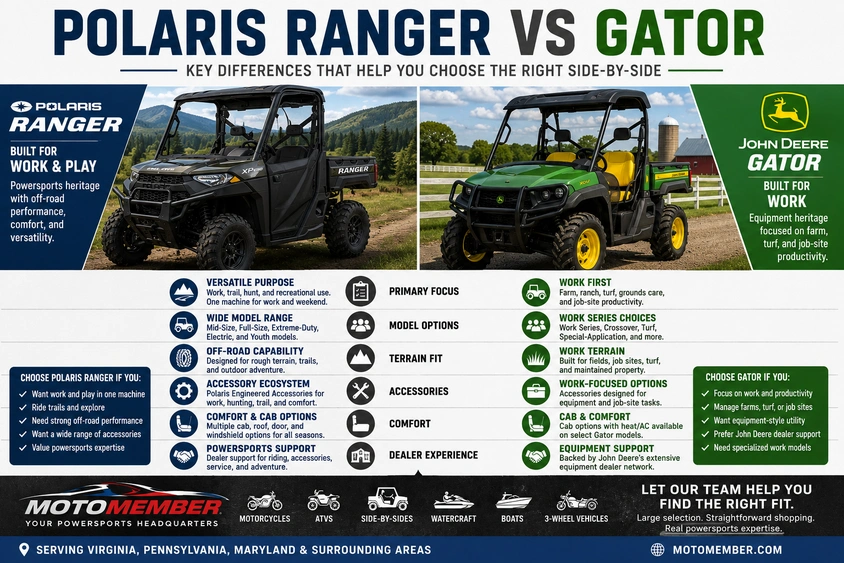
Polaris Ranger vs Gator: Key Differences
When shoppers compare a Polaris Ranger vs Gator, they are usually trying to answer one practical question: which side-by-side fits the way I actually work and ride?
Both the Polaris RANGER and John Deere Gator are utility vehicles with strong name recognition. Both can help with property chores, hauling, towing, grounds maintenance, hunting land, farm work, and all-season use. But they are not identical machines, and the better choice depends on your terrain, workload, comfort expectations, accessory plans, dealer support, and whether you want more work-focused utility, more recreational capability, or a blend of both.
Polaris positions the RANGER lineup as utility side-by-sides built for “work and play,” with current categories including mid-size, full-size, extreme-duty, electric, and youth models. John Deere positions the Gator lineup around utility work, with Work Series, Crossover, Turf, and special-application models available across gas, diesel, and electric options.
For riders, landowners, hunters, farmers, and property managers in VA, PA, MD, and nearby areas, MotoMember can help you compare Polaris RANGER models, check current availability, discuss accessories, and decide whether a RANGER fits your property, trails, towing needs, and ownership goals.
The Simple Difference: Powersports Utility vs Equipment Utility
The biggest difference between a Polaris RANGER and a John Deere Gator is the way each brand approaches the utility vehicle category.
A Polaris RANGER comes from a powersports-focused brand. Polaris builds off-road vehicles for work, trail riding, hunting, recreation, and outdoor use. The RANGER lineup is designed to serve utility buyers who still want comfort, off-road capability, accessories, and recreational flexibility after the work is done.
A John Deere Gator comes from an agricultural and equipment-focused brand. Gator models often appeal to buyers already connected to farm equipment, grounds care, landscaping, golf course work, commercial maintenance, or John Deere equipment ownership.
That does not mean one is automatically better. It means the buying decision should start with use case.
Many shoppers start by asking:
Do I need a work machine first?
Do I also want weekend trail capability?
Will I carry passengers often?
Do I need cab comfort?
Will I haul, tow, plow, hunt, or ride recreationally?
Which dealership can support me after the sale?
The answer to those questions often points you toward the right machine.
Polaris RANGER: What Makes It Stand Out?
The Polaris RANGER is one of the most recognized names in utility side-by-sides. Polaris describes the RANGER as its most capable UTV and emphasizes capability, comfort, durability, on-demand all-wheel drive, towing, hauling, and Polaris Engineered accessories.
Built for Both Work and Recreation
One major reason shoppers choose a RANGER is versatility. It can be used for property work during the week and outdoor recreation on the weekend.
For example, a RANGER may be used for:
Hauling tools around acreage
Checking fence lines
Managing hunting property
Pulling a small trailer
Plowing snow with compatible equipment
Carrying gear to a cabin or campsite
Riding trails where permitted
Moving supplies between barns, sheds, docks, or fields
That work-and-play identity is important. If you want one machine that can support chores and still feel comfortable for trail rides or weekend use, the RANGER is usually worth a close look.
Broad Model Range
Polaris currently lists RANGER model categories that include mid-size, full-size, extreme-duty, electric, and youth models.
That variety matters because not every buyer needs the same footprint. A landowner with narrow wooded trails may care about maneuverability. A farmer or property manager may care more about payload, towing, cab comfort, and passenger space. A family may want a Crew model. A buyer interested in quiet operation may want to compare electric options.
Current availability can vary, so check MotoMember or contact the team before choosing a specific model.
Accessory Ecosystem
RANGER shoppers often care about accessories. Polaris promotes Polaris Engineered accessories for customizing the vehicle to the task at hand.
Common RANGER accessories include:
Roofs
Windshields
Doors
Rear panels
Cab systems
Winches
Plows
Lighting
Storage boxes
Gun boots or hunting accessories
Mirrors
Bumpers
Skid plates
Audio and tech accessories
Accessory fitment matters. A roof, windshield, cab, and door setup should be checked as a system, not chosen one part at a time without verifying compatibility.
Powersports Dealer Support
A Polaris RANGER buyer often benefits from working with a powersports dealership team that understands riding conditions, accessories, maintenance, trail use, seasonal setup, and side-by-side ownership.
MotoMember helps customers compare Polaris models, discuss fitment, review accessories, plan service, and choose a side-by-side based on real-world use. For riders in Virginia, Pennsylvania, Maryland, and surrounding areas, that local support can matter as much as the machine itself.
John Deere Gator: What Makes It Stand Out?
The John Deere Gator is a familiar choice for farms, campuses, estates, golf courses, landscaping operations, grounds crews, and property owners.
John Deere describes its Work Series Gator UTVs as available in gas, diesel, and electric, with 2WD, 4WD, and 6-wheel designs. The company also offers full-size Crossover Gator models with two-, three-, and four-seat options, plus available cab features on certain models.
Strong Equipment and Work Identity
The Gator name is closely tied to John Deere’s equipment heritage. For buyers who already own John Deere tractors, mowers, compact equipment, or farm machinery, a Gator may feel like a natural extension of that equipment ecosystem.
Gator shoppers often include:
Farm owners
Grounds crews
Golf course teams
Municipal crews
Estate managers
Landscapers
Commercial property teams
Facilities departments
For strictly work-focused use, especially where John Deere dealer relationships already exist, a Gator can be a logical machine to compare.
Work Series and Crossover Options
John Deere separates Gator models into categories including Work Series, Full-Size Crossover, Mid-Size Crossover, Turf, and special-application vehicles.
That gives shoppers a range of choices, from turf-friendly models to crossover utility vehicles and work-focused configurations. Some buyers may appreciate diesel availability, 6-wheel designs, or specialized grounds-care options depending on the job.
Grounds and Turf Applications
Gator vehicles are especially common around turf, campuses, groundskeeping, and facility maintenance. John Deere specifically highlights Turf Utility Vehicles for sports, golf, and turf applications.
That can make a Gator appealing when the primary use is grounds maintenance rather than recreational riding or powersports-style off-road use.
Polaris Ranger vs Gator: Work Capability
Both machines can work. The difference is how each one tends to feel in the buying conversation.
A Polaris RANGER often appeals to shoppers who want strong utility capability plus a side-by-side that still feels at home on trails, hunting land, wooded property, and recreational rides. Polaris markets the RANGER around work, farm, hunt, trail, towing, hauling, comfort, and off-road capability.
A John Deere Gator often appeals to shoppers who think in terms of equipment, commercial property maintenance, turf, farm chores, and grounds work. John Deere markets Gator UTVs around work applications, Gator Work Series utility, Crossover models, Turf models, and equipment-style ownership support.
For property owners, both can make sense. The better question is this:
Do you want a utility vehicle that leans toward powersports versatility, or one that leans toward equipment-style work support?
Polaris Ranger vs Gator: Trail and Recreational Use
This is where many shoppers see a clear difference.
The RANGER is designed by a powersports company with deep off-road roots. It is commonly compared by shoppers who want a machine for land management, hunting, trail access, and weekend riding. Polaris itself references work, trail, farm, and hunt use in its RANGER positioning.
A Gator can certainly handle off-road property use, and John Deere Crossover models are designed for utility use beyond smooth pavement. But many Gator shoppers are focused more on equipment-style work, turf, grounds, farm chores, and practical transport.
If you want a side-by-side that feels more naturally connected to the powersports world, the Polaris RANGER may have the edge. If your use is primarily around a farm, golf course, campus, or maintenance property, a Gator may still deserve a look.
Polaris Ranger vs Gator: Hauling and Towing
Do not assume one brand always beats the other on hauling or towing. Ratings vary by model, trim, year, and configuration.
For example, Polaris lists the 2026 RANGER 1000 with a 1,000-lb box and 2,500-lb towing rating, while John Deere lists certain full-size Gator XUV models with up to 4,000-lb towing capacity.
Those numbers are model-specific, not universal brand-wide claims. Always check the exact model you are considering, read the owner’s manual, and ask the dealer to confirm whether the vehicle matches your real towing and hauling needs.
For many shoppers, the better comparison is not “RANGER vs Gator overall.” It is:
Which exact RANGER model vs which exact Gator model?
What load do you carry most often?
What trailer will you tow?
Is the terrain flat, hilly, muddy, rocky, or snow-covered?
Will you tow every day or occasionally?
Do you need passengers and cargo at the same time?
MotoMember can help you compare Polaris RANGER models around your property, workload, and accessory needs.
Polaris Ranger vs Gator: Comfort and Cab Options
Comfort matters more than many first-time buyers expect. A side-by-side used every week for property work, hunting, snow removal, or long-distance trail riding should be comfortable enough that you actually want to use it.
Both brands offer models with cab and comfort options. John Deere highlights full-size Crossover Gator models with available sealed cab features, heat, and A/C on certain configurations. Polaris also offers RANGER models and accessories that support weather protection, comfort, and all-season use, depending on model and configuration.
Before choosing, think about:
Do you ride in winter?
Do you plow snow?
Do you work in rain?
Do you need doors and a windshield?
Do you need heat or an enclosed cab?
Do you ride with passengers?
Do you need quiet operation for livestock, hunting, or residential use?
For customers in VA, PA, MD, and nearby areas, weather can vary enough that cab planning should be part of the buying conversation, not an afterthought.
Polaris Ranger vs Gator: Accessories and Customization
Both the RANGER and Gator can be accessorized, but the feel of the accessory ecosystem may differ.
Polaris RANGER accessories are often aligned with powersports utility and recreation. Buyers commonly shop for winches, plows, windshields, roofs, doors, storage, lighting, hunting accessories, protection parts, audio, mirrors, and trail-oriented upgrades.
John Deere Gator accessories often align with work, grounds care, turf, property maintenance, cargo management, cab comfort, and equipment-style add-ons.
For a MotoMember shopper, the key is not just what accessory exists. It is whether that accessory fits your exact model and works with your other installed parts.
For example:
A windshield should work with your roof.
Doors should work with your cab setup.
A plow may require a compatible mount and winch.
Lighting may require proper wiring.
Storage should match your bed and passenger needs.
Tires should match terrain, not just appearance.
Our team can help you compare Polaris RANGER accessories based on how you actually use the machine.
Polaris Ranger vs Gator: Dealer Experience
The dealership relationship is a major difference many shoppers overlook.
A John Deere Gator buyer may be working with an agricultural, equipment, or grounds-care dealer. That can be a good fit for buyers who already operate John Deere equipment and want everything under one equipment-dealer relationship.
A Polaris RANGER buyer often works with a powersports dealership. That can be a better fit for customers who want help with side-by-side accessories, trail riding, off-road service, powersports financing, trade-ins, gear, and long-term ownership support.
MotoMember serves powersports customers across Virginia, Pennsylvania, Maryland, and surrounding areas with motorcycles, ATVs, side-by-sides, personal watercraft, boats, 3-wheel vehicles, accessories, service, financing, trade-ins, and ownership support. That broader powersports focus can be helpful if your RANGER is part work tool, part recreation machine, and part family adventure vehicle.
MotoMember Expert Tip
When comparing a Polaris RANGER to a John Deere Gator, do not start with brand loyalty. Start with your top five jobs.
Write down what you will actually do every week: haul firewood, check fences, tow a trailer, plow snow, carry hunting gear, maintain trails, transport tools, move around a farm, or ride with family.
Then compare machines based on those jobs. The right choice is the one that fits your land, your passengers, your cargo, your terrain, your storage space, and your service support.
Which One Is Better for Property Owners?
For many property owners, the Polaris RANGER is a strong choice because it blends utility and recreation well. It can help with chores and still feel like a powersports vehicle when the workday ends.
The Gator may be the better fit if your property management needs are more closely tied to turf, farm equipment, groundskeeping, or John Deere equipment support.
Choose a Polaris RANGER if you want:
A powersports-oriented side-by-side
Strong work-and-play versatility
Broad model choices
Trail, hunt, farm, and landowner capability
A wide range of Polaris Engineered accessories
Powersports dealership support from MotoMember
Choose a John Deere Gator if you want:
A utility vehicle tied to an equipment brand
A work-first ownership experience
Turf, grounds, farm, or commercial maintenance focus
John Deere equipment-dealer support
Certain diesel, electric, or specialized work configurations
There is no one-size-fits-all answer. The best choice depends on your work, property, and riding style.
Which One Is Better for Trail Riders?
If trail riding is a major part of your plan, most shoppers should start by looking at the Polaris RANGER.
The RANGER is not a pure sport side-by-side like a Polaris RZR, but it fits buyers who want a utility vehicle with recreational capability. Polaris markets RANGER models for landowners, farmers, hunters, trail riders, and work-and-play use.
A Gator can work well around properties and off-road job sites, but its identity is more equipment and utility focused. If your weekends involve trails, hunting land, cabins, camping, or outdoor recreation, the RANGER may feel more aligned with your lifestyle.
Which One Is Better for Farms?
This depends on the farm.
A Gator may appeal to farmers already invested in John Deere equipment, especially where the vehicle is used as another work tool alongside tractors, mowers, and farm implements.
A Polaris RANGER may appeal to farmers who want a machine that handles farm chores while also supporting hunting, trail riding, family use, and recreational riding.
Before choosing, think about:
How often will you tow?
How much cargo do you carry?
Do you need diesel or gas?
Do you need a crew cab?
Will you ride trails after work?
Do you want powersports accessories?
Which dealer is easier to work with for service?
For many mixed-use farms and rural properties, a Polaris RANGER can be a very practical fit.
Which One Is Better for Hunting Land?
A Polaris RANGER is often a strong fit for hunting land because it combines cargo space, passenger capacity, off-road capability, accessory options, and recreational utility.
Hunters often think about:
Quiet operation
Storage
Lighting
Winch options
Tires
Cab enclosure
Gun boot or gear storage
Passenger room
Cargo bed space
Trail access
Recovery gear
Gator models can also serve hunters well, especially on managed properties or farms. But if the vehicle will be used for hunting, trail riding, land management, and family recreation, the RANGER is often a natural place to start.
Used Polaris Ranger vs Used Gator
Used side-by-side shopping requires extra care. Condition matters more than the badge on the hood.
Before buying any used RANGER or Gator, inspect:
Hours and mileage
Maintenance records
Belt or driveline condition
Tires
Brakes
Suspension
Steering
Frame condition
Cargo bed condition
Cab components
Winch and accessory wiring
Signs of mud, water, abuse, or poor maintenance
Recall and service history where applicable
Polaris offers a VIN lookup tool for RANGER owners that can show model information, warranty details, guides, manuals, recalls, and safety bulletins tied to a 17-digit VIN.
MotoMember can help you compare new and used Polaris inventory, trade-in options, service history questions, and ownership support before you commit.
Maintenance and Ownership Support
Both a RANGER and a Gator require maintenance. The right choice should include a plan for parts, service, accessories, and seasonal inspections.
Polaris provides RANGER owner resources, including manuals, maintenance tips, and FAQs.
For a Polaris RANGER, common ownership topics include:
Oil and filter service
Air filter inspection
Drive belt condition
Brake inspection
Tire pressure and wear
Battery health
Suspension and steering components
Coolant and fluids where applicable
Winch and accessory checks
Seasonal storage and prep
If you are using a side-by-side for work, do not wait until something breaks. Preventive maintenance helps keep the vehicle ready for chores, trail rides, hunting season, snow removal, and property checks.
Safety Considerations
Whether you choose a Polaris RANGER or a John Deere Gator, safe operation matters.
Always follow the owner’s manual, use seat belts, wear appropriate safety gear, avoid overloading the vehicle, operate at safe speeds, and make sure anyone driving the machine understands how to use it responsibly.
Side-by-sides are useful tools, but they are not toys. Terrain, speed, cargo, passengers, weather, visibility, and driver experience all affect safety.
Questions to Ask Before You Buy
Before comparing a Polaris RANGER and a Gator, answer these questions:
How many passengers do I need?
What do I haul most often?
Will I tow, and how often?
Do I need a cab, heat, or winter setup?
Will I ride trails or mainly work around property?
Is my terrain flat, hilly, muddy, rocky, wooded, or snowy?
Do I need turf-friendly use?
Do I already have a dealer relationship?
Which machine has the accessories I actually need?
Who will service it after the sale?
These answers will make the decision clearer than brand reputation alone.
Call to Action
Trying to decide between a Polaris RANGER and a Gator?
Contact MotoMember or visit the team to compare Polaris RANGER models, new and used inventory, accessories, service options, financing, and trade-in opportunities. Our team can help you match the right side-by-side to your land, workload, passengers, towing needs, seasonal chores, and weekend riding plans.
For riders and property owners in Virginia, Pennsylvania, Maryland, and nearby areas, MotoMember is your source for large selection, straightforward shopping, and real powersports expertise.
Conclusion
The main difference between a Polaris RANGER and a John Deere Gator comes down to identity and use case. The RANGER leans into powersports utility, off-road versatility, work-and-play capability, and accessory customization. The Gator leans into equipment-style utility, farm and grounds care, turf work, and John Deere’s broader equipment ecosystem.
Both can be useful machines. The right one depends on your property, your daily jobs, your passengers, your terrain, and the support you want after the sale.
For many shoppers who want a side-by-side that can work hard and still feel ready for recreation, a Polaris RANGER is a smart place to start.
FAQ
Is a Polaris RANGER better than a John Deere Gator?
It depends on how you plan to use it. A Polaris RANGER is often a better fit for shoppers who want a utility side-by-side with powersports capability, trail use, hunting support, accessories, and work-and-play versatility. A Gator may be a better fit for equipment-focused farm, turf, grounds, or commercial maintenance use.
What is the biggest difference between a RANGER and a Gator?
The biggest difference is brand focus. Polaris is a powersports brand with side-by-sides built for off-road utility and recreation. John Deere is an equipment brand with Gator models often tied to farm, turf, grounds, and work applications.
Can a Polaris RANGER be used for farm work?
Yes. A Polaris RANGER can be a strong farm and property vehicle when matched to the right workload. It can help with hauling, towing, checking land, moving tools, carrying passengers, and supporting seasonal chores. Always compare exact model ratings before towing or hauling.
Is a Gator more of a work vehicle than a RANGER?
Some Gator models are very work-focused, especially for farms, turf, grounds care, and commercial properties. However, Polaris RANGER models are also built for utility work. The difference is that the RANGER often adds more powersports-style versatility for trail, hunting, and recreation use.
Can MotoMember help me compare Polaris RANGER models?
Yes. MotoMember can help shoppers in VA, PA, MD, and surrounding areas compare Polaris RANGER models, accessories, service needs, financing options, trade-ins, and current inventory. Current availability can vary, so contact the team before choosing a specific model.