
Polaris RANGER 500 vs. 1000: Which to Buy?

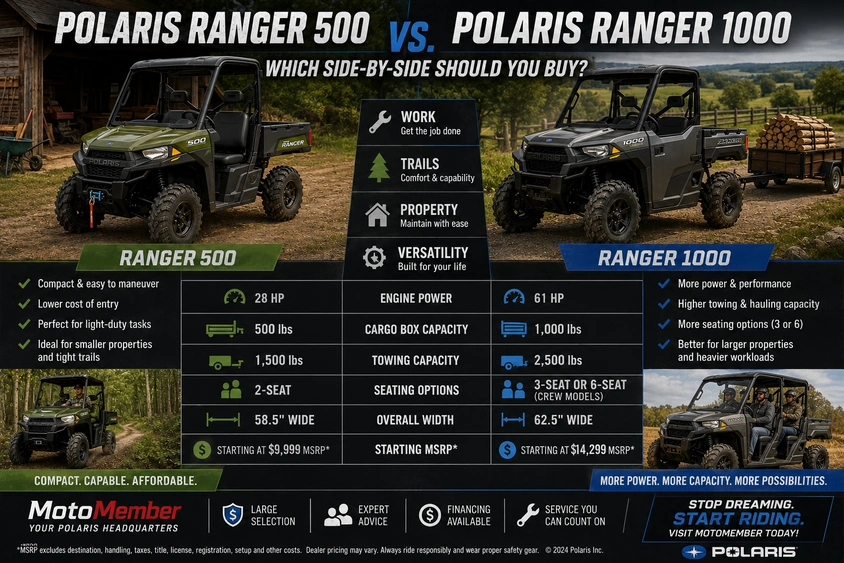
Polaris RANGER 500 vs. Polaris RANGER 1000: Which Side-by-Side Should You Buy?
Choosing between the Polaris RANGER 500 and Polaris RANGER 1000 comes down to one simple question: how much side-by-side do you really need?
Both models are practical utility side-by-sides built for work, property use, outdoor chores, and trail access. But they serve different buyers. The RANGER 500 is the smaller, more affordable, easier-to-manage option. The RANGER 1000 is the larger, stronger, more capable machine for riders who need more seating, more hauling, and more towing.
For shoppers in VA, PA, MD, and nearby areas, this comparison matters because riding conditions can vary widely. One buyer may need a compact machine for a wooded property, barn lane, garden, or hunting camp. Another may need a full-size UTV for acreage, trailers, firewood, farm chores, or carrying more passengers.
MotoMember helps riders compare Polaris RANGER models based on real use, not just spec sheets. Current inventory, colors, trims, pricing, and incentives can vary, so check MotoMember or contact the team for the latest availability before choosing your machine.
Quick Answer: RANGER 500 or RANGER 1000?
Buy the Polaris RANGER 500 if you want a simple, compact, budget-friendly side-by-side for light-duty property work, small trails, yard chores, and two-person riding.
Buy the Polaris RANGER 1000 if you need more power, more towing capacity, a larger cargo box, three-seat or Crew seating, and stronger capability for larger properties or heavier work.
Polaris lists the 2026 RANGER 500 as a two-seat mid-size model starting at $9,999 MSRP, while the 2026 RANGER 1000 starts at $14,299 MSRP and offers three-seat and six-seat configurations. Polaris notes that MSRP excludes destination, handling, taxes, title, license, registration, setup, and other costs, and dealer pricing may vary.
Polaris RANGER 500 Overview
The Polaris RANGER 500 is designed for buyers who want useful side-by-side capability without stepping into a larger, more expensive full-size machine.
Polaris describes the 2026 RANGER 500 as a practical option for property tasks, with a dump box, towing capability, and a standard winch. Polaris lists the model with a 500-pound dump box, 1,500-pound towing capacity, standard 2-inch hitch receiver, factory-installed 2,500-pound winch, 28-horsepower engine, and 58.5-inch width.
That makes it a smart fit for:
Light property maintenance
Yard work and landscaping
Garden chores
Small acreage
Camp and cabin use
Hunting property access
Trail riding at moderate speeds
Buyers who want a lower-cost entry into the RANGER lineup
The RANGER 500 is not trying to be the biggest or most powerful RANGER. Its strength is simplicity. It gives you a useful cargo bed, towing ability, compact size, and a more approachable ownership experience.
Polaris RANGER 1000 Overview
The Polaris RANGER 1000 is a full-size utility side-by-side for shoppers who need more capability.
Polaris lists the 2026 RANGER 1000 with a 61-horsepower ProStar engine, 1,000-pound box capacity, 2,500-pound towing capacity, 25-inch tires, and 12 inches of ground clearance. Polaris also lists RANGER 1000 dimensions with a larger cargo box, standard 2-inch receiver, 1,500-pound payload capacity on the base model, and three-person seating.
The RANGER 1000 is a better fit for:
Larger acreage
Regular towing
Heavier property work
Farm and landowner use
Firewood, feed, tools, fencing, and landscaping material
Riders who want three seats
Families or crews considering a Crew model
Buyers who want a more substantial utility machine
MotoMember currently lists Polaris RANGER 1000 model pages and inventory options, including RANGER 1000 configurations for shoppers comparing full-size utility side-by-sides.
Size and Maneuverability
RANGER 500: Easier in Tight Areas
The RANGER 500’s smaller footprint is one of its biggest advantages. Polaris highlights its 58.5-inch width as helpful for storage and navigating smaller spaces.
That can matter if you have:
Narrow trails
Small sheds
Tight barn aisles
Gates or wooded paths
Limited trailer space
A smaller garage or storage building
For many property owners, smaller is not a drawback. It can make the machine easier to live with every day.
RANGER 1000: More Room, More Machine
The RANGER 1000 is physically larger and feels more substantial. Polaris lists the 2026 RANGER 1000 base model at 120 inches long, 62.5 inches wide, and 76 inches tall.
That size gives you a larger cargo box, more seating flexibility, and more utility capability. The tradeoff is that it needs more storage space and may feel less nimble on tight wooded trails.
For open acreage, farms, driveways, fields, and wider trails, the RANGER 1000’s size is usually an advantage. For tight properties, the RANGER 500 may be easier to manage.
Power and Performance
RANGER 500: Enough for Everyday Light-Duty Use
The RANGER 500’s 28-horsepower engine is designed for practical property use, not high-performance riding. Polaris positions it as a machine for navigating your property quickly and efficiently.
It is enough for many buyers who need to move around the property, carry tools, haul small loads, pull yard debris, or access hunting areas.
Choose the RANGER 500 if your work is mostly light-duty and your rides are shorter, slower, and more utility-focused.
RANGER 1000: More Power for Heavier Work
The RANGER 1000’s 61-horsepower ProStar engine gives it a major performance advantage.
That extra power matters when you are climbing grades, towing, carrying heavier loads, riding with passengers, or working on larger properties. It also helps the machine feel more confident when the day’s jobs are less predictable.
Choose the RANGER 1000 if you do not want to wonder whether your machine is strong enough for the next project.
Hauling and Towing
This is one of the biggest differences between the two models.
The RANGER 500 can haul up to 500 pounds in the dump box and tow up to 1,500 pounds.
The RANGER 1000 can haul up to 1,000 pounds in the box and tow up to 2,500 pounds.
That means the RANGER 1000 effectively doubles the cargo box rating and adds 1,000 pounds of towing capacity compared with the RANGER 500.
Choose the RANGER 500 for:
Mulch bags
Garden tools
Small landscaping loads
Light firewood hauling
Yard debris
Coolers and hunting gear
Small utility trailers
Choose the RANGER 1000 for:
Larger firewood loads
Feed and farm supplies
Fencing material
Heavier trailers
Food plot equipment
Bigger property projects
More frequent hauling and towing
Many shoppers start by thinking, “I only need a small machine.” But if you tow often or regularly load the cargo bed, the RANGER 1000 may be the better long-term choice.
Seating: Two Seats vs. Three or Six
The RANGER 500 is a two-seat model. Polaris lists the 2026 RANGER 500 with two-seat availability.
That is ideal for one rider plus one passenger. It works well for property owners who usually ride solo or with a spouse, friend, child, or hunting partner.
The RANGER 1000 offers more seating flexibility. Polaris lists the 2026 RANGER 1000 with three-seat and six-seat options.
That makes the RANGER 1000 a better fit for families, work crews, hunting groups, and buyers who regularly carry more than one passenger.
Before choosing, think about who will ride with you most often. If you frequently say, “We need room for one more person,” the RANGER 1000 or RANGER 1000 Crew deserves serious consideration.
Trail Riding Comparison
RANGER 500 on Trails
The RANGER 500 is a practical trail machine for riders who value manageable size over maximum power. It is easier to place on narrow paths and can feel less intimidating for newer side-by-side owners.
It is a good fit for:
Wooded property trails
Cabin access roads
Hunting paths
Slow-to-moderate recreational riding
Riders who want utility first, trail fun second
RANGER 1000 on Trails
The RANGER 1000 brings more power, more size, and more passenger flexibility. It is better suited for wider trails, larger properties, and riders who want a stronger all-around machine.
It is a good fit for:
Longer rides
Rougher property roads
More passengers
Mixed work and recreation
Riders who want a full-size feel
Neither model is a pure sport side-by-side. If trail speed and suspension performance are your top priorities, a Polaris RZR or Polaris GENERAL may be worth comparing. If utility is the priority, both RANGER models make sense.
Property Use: Which One Makes More Sense?
For property use, the best choice depends on the size of your property and the kind of work you do.
Choose the RANGER 500 for Smaller Properties
The RANGER 500 makes sense for homeowners, cabin owners, smaller landowners, and buyers who need help with chores but do not need a large machine.
It is especially practical for:
Moving bags of mulch
Cleaning up branches
Carrying hand tools
Light garden work
Checking trails
Running between house, shed, barn, and garden
Hunting camp transportation
For many shoppers, the RANGER 500 is the right answer because it handles the jobs they actually do without adding unnecessary size or cost.
Choose the RANGER 1000 for Bigger Properties
The RANGER 1000 makes sense when the property is larger, the work is heavier, or the machine will be used more often.
It is especially practical for:
Farm work
Large acreage
Frequent towing
Hauling firewood
Moving fencing supplies
Carrying multiple passengers
Food plots and hunting land
More demanding year-round use
For riders in rural Virginia, Pennsylvania, Maryland, and nearby areas, the RANGER 1000 often becomes the better long-term choice when the side-by-side will be used weekly or daily.
Comfort and Features
The RANGER 500 keeps things simple. That is part of its appeal. It gives buyers the essentials without pushing them into a higher price category.
Polaris highlights user-friendly RANGER 500 features such as selectable Turf Mode, interior storage, easier access for maintenance, and a dump box.
The RANGER 1000 offers more room, more trim choices, and more upgrade potential. Depending on trim and availability, shoppers may compare EPS, Premium, cab, and Crew configurations. Polaris also introduced a 2026 RANGER 1000 CAB with an enclosed cab and factory-installed heat for cooler-weather use.
If you ride in cold, wet, dusty, or windy conditions, a RANGER 1000 CAB or another enclosed RANGER model may be worth comparing with the MotoMember team.
Value: Which One Is the Smarter Buy?
The RANGER 500 is the smarter buy when you want lower cost, compact size, and practical utility.
The RANGER 1000 is the smarter buy when you want more capability, more seating, and more room to grow into future needs.
A common dealership conversation goes like this: a shopper starts by comparing price, then realizes they also need to consider towing, cargo, passenger space, storage, and accessories. The lowest purchase price is not always the lowest ownership frustration.
If the RANGER 500 fits your work perfectly, it can be a great value. If you will push it near its limits every weekend, the RANGER 1000 may be the better value over time.
MotoMember Expert Tip
Before choosing between the Polaris RANGER 500 and RANGER 1000, make a list of your heaviest normal job, not your easiest job.
If your normal use is carrying tools, mulch, and small loads, the RANGER 500 may be ideal. If your normal use includes towing trailers, hauling firewood, carrying multiple passengers, or working larger acreage, the RANGER 1000 is likely the better fit.
Our team can help you compare both models in person, review current inventory, discuss accessories, and match the machine to your property, trails, storage space, and budget.
Accessories to Think About Before You Buy
Accessories can affect which model makes the most sense. Before choosing, consider whether you may want:
Roof
Windshield
Winch
Rear panel
Cab enclosure
Heater
Plow
Lighting
Storage boxes
Gun boot or hunting accessories
Trailer hitch accessories
Sprayer setup
Mirrors
Tie-downs and cargo management
The RANGER 500 already includes a factory-installed winch, according to Polaris. The RANGER 1000 may be better if you plan to build a more heavily accessorized work machine, especially if you need more room, more power, or Crew seating.
New or Used: What Should You Consider?
A new RANGER gives you current model-year features, current trim choices, and the ability to choose the setup you want. A used RANGER may help lower the purchase price, depending on availability, condition, mileage, hours, accessories, and service history.
MotoMember offers new powersports inventory and used inventory options across multiple categories, including side-by-sides, ATVs, motorcycles, watercraft, and more.
When comparing new and used, ask about:
Hours and mileage
Service history
Accessory installation
Tire condition
Winch condition
Cab, roof, and windshield condition
Trade-in value
Financing options
Availability of similar new models
A clean used RANGER 1000 may compete with a new RANGER 500 in some budgets, but the right choice depends on condition, warranty status, accessories, and how you plan to use it.
Call to Action
Ready to compare the Polaris RANGER 500 vs. Polaris RANGER 1000 in person?
Visit MotoMember to explore Polaris side-by-side inventory, compare current RANGER models, ask about financing, value your trade, and talk with a team that understands how riders in VA, PA, MD, and nearby areas use their machines. MotoMember serves powersports shoppers through locations including Purcellville, Manassas, and Chambersburg.
Your Polaris Headquarters starts at MotoMember.
Large selection. Straightforward shopping. Real powersports expertise.
Stop dreaming. Start riding.
Conclusion
The Polaris RANGER 500 and Polaris RANGER 1000 are both useful side-by-sides, but they are built for different buyers.
The RANGER 500 is compact, approachable, and practical. It is a great fit for light-duty work, smaller properties, two-person riding, yard chores, and buyers who want a simple way into the Polaris RANGER lineup.
The RANGER 1000 is larger, stronger, and more versatile. It is the better choice for heavier work, more towing, larger cargo needs, three-seat or Crew seating, and long-term property use.
For many shoppers, the RANGER 500 is enough. For others, the RANGER 1000 is the machine they will be happier owning five years from now. MotoMember can help you make that call with real inventory, practical advice, and local dealership support.
FAQ
Is the Polaris RANGER 500 big enough for property work?
Yes, for light-duty property work. Polaris lists the 2026 RANGER 500 with a 500-pound dump box and 1,500-pound towing capacity, making it useful for yard work, small trailers, mulch, tools, and light hauling.
Is the Polaris RANGER 1000 worth the upgrade?
The RANGER 1000 is worth the upgrade if you need more power, more towing, more cargo capacity, or more seating. Polaris lists the 2026 RANGER 1000 with 61 horsepower, 1,000-pound box capacity, and 2,500-pound towing capacity.
Which is better for tight trails, RANGER 500 or RANGER 1000?
The RANGER 500 is usually better for tight trails because it is narrower and more compact. Polaris highlights its 58.5-inch width as helpful for small spaces.
Can the Polaris RANGER 1000 carry more passengers?
Yes. Polaris lists the 2026 RANGER 1000 with three-seat and six-seat options, while the RANGER 500 is listed as a two-seat model.
Should I buy a RANGER 500 or RANGER 1000 for hunting property?
Choose the RANGER 500 for smaller hunting properties, tighter trails, and lighter gear loads. Choose the RANGER 1000 if you carry multiple passengers, tow trailers, haul feed or stands, or maintain larger acreage. Current availability can vary, so check MotoMember inventory or contact the team before deciding.