
New vs. Used Personal Watercraft: Budget Guide

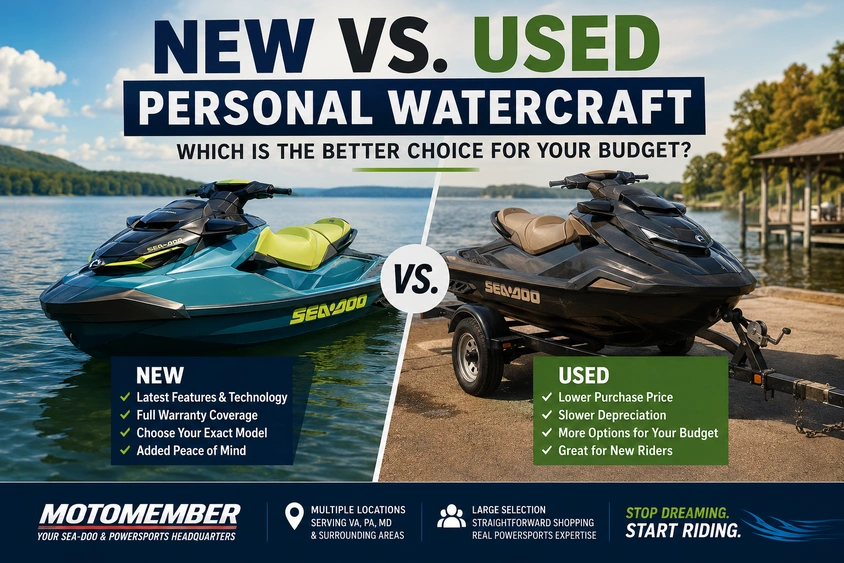
New vs. Used Personal Watercraft: Budget Guide
Buying a personal watercraft is one of the fastest ways to turn a free weekend into something memorable. Whether you are cruising with family, exploring the lake, pulling a tube, or just looking for a fun escape after work, the right PWC can deliver a lot of value for the money.
But one question comes up early for most shoppers: should you buy new or used?
The answer depends on your budget, how often you plan to ride, how much warranty protection matters to you, and whether you want the latest features or the lowest possible entry price. At MotoMember, shoppers can compare new powersports inventory, pre-loved options, service support, parts, financing resources, and multiple locations across Virginia and Pennsylvania in one place. MotoMember also carries major powersports brands including Sea-Doo, Yamaha, Kawasaki, Can-Am, Polaris, and more.
New vs. Used Personal Watercraft: The Big Picture
A new personal watercraft gives you the latest model-year features, a clean ownership history, current styling, and potential warranty coverage. It is usually the best fit for riders who want confidence, convenience, and the ability to choose the exact model, color, feature package, and accessory setup they want.
A used personal watercraft can offer a lower purchase price and slower depreciation after the first owner has already absorbed the biggest value drop. It can be a smart choice for budget-conscious buyers, seasonal riders, or anyone entering the sport for the first time.
Neither choice is automatically better. The better choice is the one that fits your real cost of ownership.
That means looking beyond the sticker price.
What Costs Should You Compare?
Purchase Price
Purchase price is the first number most shoppers focus on, and it matters. Used PWCs often cost less upfront than comparable new models. That lower starting price can free up money for a trailer, safety gear, storage, accessories, registration, insurance, and maintenance.
New PWCs typically cost more upfront because you are buying the newest model year, unused mechanical components, updated technology, and the ability to choose from current manufacturer lineups. Sea-Doo and Yamaha both offer multiple PWC categories, from more approachable recreation models to higher-end touring, luxury, fishing, and performance choices.
The key is not simply “new costs more” or “used saves money.” The key is what you get for the price.
Financing
Financing can make a major difference in your monthly budget. New personal watercraft may qualify for manufacturer-backed promotions or dealership financing options, while used units may vary depending on age, mileage or hours, condition, and lender guidelines.
MotoMember provides financing resources, including prequalification and credit application options, so shoppers can compare payment paths before making a final decision.
When comparing new vs. used, ask yourself:
Can I comfortably afford the monthly payment?
Do I want a shorter term with less total interest?
Would a lower used price help me keep more cash available for gear and maintenance?
Would a new model’s warranty and features justify the higher payment?
A lower payment is helpful, but the best budget decision is the one that protects your total finances.
Depreciation
New personal watercraft usually depreciate most during the early ownership period. That does not mean buying new is a bad move. It simply means the first owner pays for the benefit of having a brand-new machine, the newest features, and no previous-use concerns.
Used PWCs may have already gone through the steepest depreciation phase. That can make them attractive if you plan to ride for a few seasons and then trade or sell. However, a used unit’s resale value will depend heavily on condition, hours, brand reputation, maintenance history, and local market demand.
If you plan to keep your PWC for many years, depreciation may matter less than reliability, comfort, and how much you enjoy owning it.
Maintenance and Repairs
Maintenance is part of owning any watercraft. A new PWC usually starts with fresh components and fewer unknowns. A used PWC can still be a great buy, but condition matters more.
MotoMember notes that its used vehicles are inspected by its maintenance department experts, which can give shoppers more confidence than buying from a private seller with little documentation.
Before buying used, ask about:
Service history
Engine hours
Previous storage habits
Hull condition
Corrosion or saltwater exposure
Trailer condition, if included
Signs of poor maintenance
For new and used PWCs, you should also budget for seasonal service, battery care, winterization where needed, and wear items.
When Buying New Makes More Sense
You Want the Latest Features
New models often include updated displays, ride modes, improved ergonomics, better storage solutions, premium audio options, smarter accessory systems, and refined hull designs. For some riders, those features are not luxuries. They are what make the machine easier and more enjoyable to own.
Sea-Doo’s current lineup includes models for recreation, tow sports, touring, fishing, and performance, giving new buyers a wide range of use-case-specific choices. Yamaha’s WaveRunner lineup also spans rec-lite, recreation, luxury, performance, freestyle, and larger lifestyle-oriented models.
If you already know exactly how you want to ride, buying new can help you get a machine designed around that purpose from day one.
You Want Warranty Confidence
Warranty protection can be one of the strongest reasons to buy new. It can reduce uncertainty and help you feel more comfortable with your purchase, especially if you are new to personal watercraft ownership.
A used PWC may still have remaining warranty coverage depending on the model year, warranty terms, and transfer rules, but you should verify that before buying.
For many shoppers, the peace of mind of starting fresh is worth the higher initial cost.
You Want Easier Shopping
Buying new can simplify the process. You do not have to investigate how the previous owner rode it, stored it, serviced it, or transported it. You can choose the model, trim, accessories, and financing approach that fits your needs.
That is especially helpful for first-time buyers who want expert guidance. MotoMember’s dealership experience, multiple locations, and broad brand selection make it easier to compare options in person rather than guessing online.
You Plan to Ride Often
If you expect to ride frequently, buying new may be the better long-term value. You will get the most usable life from the machine, and you can maintain it properly from the beginning.
Frequent riders may also benefit more from upgraded comfort, storage, fuel capacity, tow-sports features, and technology. A rider who spends many weekends on the water will notice those details more than someone who rides only a few times per summer.
When Buying Used Makes More Sense
You Want a Lower Entry Price
Used personal watercraft are often attractive because they reduce the initial cost of getting on the water. That matters if your budget also needs to cover a trailer, riding gear, dock fees, insurance, or storage.
A used PWC may let you buy into a higher trim level than you could afford new. For example, a used touring or recreation model may offer more comfort and storage than a new entry-level machine at a similar budget.
You Are New to the Sport
If this is your first PWC, buying used can be a practical way to learn what you actually like.
Some first-time riders discover they want a smaller, more playful machine. Others realize they want more seating stability, more storage, or a model better suited for longer rides. Starting with a well-inspected used PWC can help you learn without stretching your budget too far.
Once you know your riding style, you can upgrade later with more confidence.
You Ride Seasonally or Occasionally
If you only plan to ride a handful of weekends each year, a used personal watercraft may make more financial sense. You still get access to the water, but you are not tying up as much money in a machine that spends much of the year stored.
That said, occasional use does not eliminate maintenance. A machine that sits needs proper storage, battery care, fuel system care, and seasonal checks.
You Find a Well-Maintained Unit
A used PWC with clear maintenance records, reasonable hours, clean storage history, and a professional inspection can be an excellent value.
This is where dealership support matters. Buying from a trusted powersports dealer can give you more transparency than buying from a private seller. MotoMember’s pre-loved department and maintenance support are designed to help shoppers find quality machines with more confidence.
Budget Factors New Buyers Sometimes Miss
Trailer Costs
Some personal watercraft purchases include a trailer, and some do not. Always confirm what is included before comparing prices.
A trailer affects your total budget, storage plan, towing setup, and launch routine. A lower-priced used PWC may not be the better deal if you need to buy a trailer separately.
Safety Gear
Personal flotation devices are not optional gear. BoatUS notes that PWC riders must wear properly fitting, Coast Guard-approved personal flotation devices, and riders may need boating education depending on local laws.
You should budget for:
Coast Guard-approved life jackets
Whistle or sound-signaling device where required
Dock lines
Fire extinguisher where applicable
Dry bag
Anchor
Riding gloves or water shoes
Safety lanyard
Waterproof phone case
Safety equipment is part of the true cost of ownership.
Insurance
Insurance needs can vary by state, lender, storage situation, and how the machine is used. Even where boat insurance is not universally required, coverage can help protect you from liability, damage, theft, and unexpected losses. A 2025 Reuters Legal News article noted that many boaters overlook the complexity of watercraft coverage and that homeowners or general liability policies may contain exclusions for motorized watercraft.
Before buying, contact your insurance provider with the exact year, make, model, horsepower, and storage location.
Storage
Where will the PWC live when you are not riding?
At home in a garage?
On a trailer in the driveway?
At a marina?
In paid storage?
In seasonal indoor storage?
Storage costs can change the new vs. used decision. A compact model may be easier to tow and store, while a larger touring or fishing-focused model may require more space.
Sea-Doo describes its Spark as lightweight, compact, easy to tow, and easy to store, making it one example of how size can affect ownership convenience.
Maintenance Schedule
Ask about recommended maintenance before you buy. New buyers should understand the manufacturer’s service intervals. Used buyers should verify what has already been done and what may be due soon.
Budgeting for maintenance is not negative. It is how you protect your investment.
New vs. Used by Rider Type
Best for First-Time Riders
A used PWC can be a smart first step if your main goal is affordability. It lets you learn, practice docking, understand local waterways, and figure out your preferences.
A new entry-level or recreation model can also be a great first PWC if you want warranty coverage, easy ownership, and current safety and convenience features.
Best budget move: compare both side by side. Do not assume used is always better.
Best for Families
Families often benefit from stability, seating comfort, storage, boarding ease, and predictable reliability. A new recreation or touring model may be worth the extra cost if you will ride often with passengers.
A used family-friendly model can still be a strong choice if it has been well maintained and professionally inspected.
Best budget move: prioritize condition and comfort over maximum horsepower.
Best for Performance Riders
Performance-focused riders may lean new because they want the latest power, handling, ride modes, and technology. Used performance models can save money, but they deserve extra inspection because hard riding can increase wear.
Best budget move: buy the cleanest, best-documented unit you can afford.
Best for Occasional Weekend Riders
A used PWC often makes the most sense for casual weekend use. You get access to the water without committing to the highest purchase price.
Best budget move: save room in your budget for maintenance, storage, and gear.
Best for Long-Term Owners
If you plan to keep your PWC for many years, buying new may be easier to justify. You can control maintenance from day one, choose the exact model you want, and spread the value over many seasons.
Best budget move: buy the model that fits your long-term riding style, not just today’s lowest price.
Inspection Tips for Used Personal Watercraft
Check the Hull
Look for cracks, deep gouges, repairs, impact damage, and signs of beaching. Cosmetic scratches may be normal, but structural damage is a different issue.
Review Engine Hours
Engine hours are not the only factor, but they help tell the story. Low hours can be good, but poor storage can still create problems. Higher hours are not automatically bad if maintenance has been consistent.
Ask About Service Records
A well-kept PWC should have some maintenance history. Ask about oil changes, winterization, battery replacement, wear ring or impeller service, spark plugs, and any repairs.
Look at the Trailer
If a trailer is included, inspect tires, bearings, bunks, lights, winch, straps, frame condition, and registration. A neglected trailer can become an immediate expense.
Ask for Professional Support
A dealership inspection can help identify issues a casual buyer might miss. That matters because watercraft problems can be expensive if they are discovered after purchase.
Buying New: Questions to Ask
Before buying a new PWC, ask:
Which model fits my riding style?
What warranty coverage is included?
Are there current promotions?
Is a trailer included?
What accessories should I add now?
What maintenance is required during the first season?
What financing options are available?
What is the best storage and winterization plan?
These questions help you understand the total ownership picture, not just the sale price.
Buying Used: Questions to Ask
Before buying a used PWC, ask:
How many hours are on it?
Was it used in fresh water, salt water, or both?
Are service records available?
Has it been winterized regularly?
Has it ever been repaired after damage?
Is the trailer included?
Has the unit been inspected?
Are parts and service available locally?
A used PWC can be a great budget choice, but only when you know what you are buying.
Why Shopping at MotoMember Helps Your Budget
Budget shopping is not just about finding the lowest price. It is about avoiding surprises.
MotoMember gives shoppers access to new vehicles, used inventory, marine options, finance resources, service, parts, and multiple dealership locations. The company lists locations in Purcellville, Manassas, and Chambersburg, helping serve riders across Virginia, Pennsylvania, Maryland, and surrounding areas.
That matters when you are comparing new vs. used because you can look at multiple options, ask real questions, and get help from a team that understands powersports ownership.
Large selection. Straightforward shopping. Real powersports expertise.
That is the kind of experience that helps you make a smarter decision.
So, Which Is Better for Your Budget?
Choose New If…
You want the latest features.
You want warranty confidence.
You plan to ride often.
You want the easiest ownership experience.
You want to choose your exact model and setup.
You are keeping the machine long term.
Choose Used If…
You want a lower purchase price.
You are new to the sport.
You ride occasionally.
You want to reduce depreciation.
You found a well-maintained unit.
You want more machine for the money.
The better choice is not universal. It depends on how you ride, where you ride, how long you plan to own it, and how much risk you are comfortable taking.
Smart Budget Strategy: Compare Total Cost, Not Just Price
Here is the simplest way to make the right decision.
Take the purchase price and add estimated costs for trailer, insurance, registration, taxes, safety gear, accessories, storage, maintenance, and financing. Then compare the total.
A used PWC with deferred maintenance may cost more than expected. A new PWC with strong financing and warranty coverage may be more manageable than the sticker price suggests. A clean used unit from a trusted dealer may be the sweet spot.
Stop dreaming. Start riding.
The best budget is the one that gets you on the water with confidence.
Call to Action
Ready to compare new vs. used personal watercraft in person? Visit MotoMember to explore available marine inventory, pre-loved options, financing resources, parts, accessories, and service support. Your Sea-Doo and powersports headquarters starts at MotoMember, with helpful teams serving riders across VA, PA, MD, and surrounding areas.
Conclusion
New and used personal watercraft can both be smart buys. New gives you the latest features, clean ownership history, and added confidence. Used can lower your upfront cost and help you get on the water for less.
The right answer comes down to your budget, riding style, ownership plans, and comfort level with maintenance history.
At MotoMember, you can compare options with a team that understands the full powersports ownership experience. Whether you are buying your first PWC or upgrading for the season, the goal is simple: find the right machine, protect your budget, and enjoy more time on the water.
FAQ
Is it better to buy a new or used personal watercraft?
It depends on your budget and priorities. Buy new if you want the latest features, warranty confidence, and a clean ownership history. Buy used if you want a lower purchase price and are comfortable reviewing condition, hours, and maintenance history.
What should I check before buying a used PWC?
Check the hull, engine hours, service records, trailer condition, signs of corrosion, storage history, and whether the unit has been professionally inspected. A well-maintained used PWC can be a strong value.
Are new personal watercraft worth the extra cost?
They can be, especially if you ride often, want current technology, prefer warranty protection, or plan to keep the machine for many seasons. The higher upfront cost may be easier to justify over long-term ownership.
What extra costs should I budget for besides the PWC?
Budget for a trailer if needed, registration, taxes, insurance, safety gear, storage, maintenance, accessories, and seasonal service. These costs can affect whether new or used is the better financial choice.
Can MotoMember help me compare new and used options?
Yes. MotoMember offers new vehicles, pre-loved inventory, finance resources, service, parts, accessories, and multiple dealership locations, making it easier to compare options and shop with confidence.