
Jon Boat Livewells Explained: What Anglers Should Look For

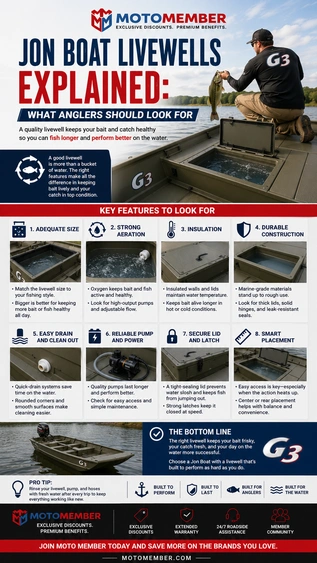
Jon Boat Livewells Explained: What Anglers Should Look For
A jon boat livewell can make a big difference in how useful a fishing boat feels on the water.
For some anglers, a livewell is mainly for keeping fish healthy during a tournament or holding legal fish during a long day. For others, it may help manage bait, separate species, or keep the deck cleaner by giving fish a dedicated place instead of relying only on buckets or coolers.
G3 Gator Tough jon boats give shoppers several livewell layouts to compare. For example, the G3 18 CC includes a 14-gallon under-seat console livewell, while the G3 20 CC adds both a 14-gallon livewell under the console seat and a 31-gallon divided bow livewell with side storage.
For shoppers in Virginia, Pennsylvania, Maryland, West Virginia, and nearby areas, MotoMember can help compare G3 livewell layouts, Yamaha power, trailers, trolling motors, electronics, storage, financing, trade-ins, and service support before you choose a jon boat.
What Is a Livewell on a Jon Boat?
A livewell is a built-in water-holding compartment designed to help keep fish or bait alive while you are on the water.
On a jon boat, the livewell may be located under a console seat, under a helm seat, in the bow, near the stern, or in another built-in storage area depending on the model. Some boats have one livewell. Others have two.
The key features to look for are capacity, location, aeration, access, drainage, cleaning ease, and how the livewell fits the way you fish.
A livewell should help your fishing day feel more organized. It should not block movement, crowd the deck, or make the boat harder to use.
Why Livewell Size Matters
Livewell size affects how useful the system is.
A small livewell may be enough for casual fishing, bait, or shorter days. A larger livewell can be helpful for tournament anglers, crappie anglers, multi-species anglers, or anyone who spends long hours on the water.
G3’s 18 SC and 20 SC both use a 14" x 34" 31-gallon livewell, giving side-console shoppers a useful livewell setup while preserving open deck space.
Capacity matters, but bigger is not always better. A larger livewell takes up boat space and adds water weight when full. The best livewell is the one that fits your fishing style without making the boat feel crowded.
Livewell Location: Bow, Console, or Stern?
Location is just as important as size.
A console livewell is convenient because it places the livewell close to the helm and often doubles as seating. G3’s 18 CC uses a 14-gallon livewell under the center-console seat, which keeps the feature integrated without taking over the deck.
A bow livewell can be useful for anglers who fish from the front deck. The G3 20 CC includes a 31-gallon divided bow livewell with side storage, which can be helpful for anglers who want livewell access near the casting deck.
A stern livewell may be useful for river anglers, catfish anglers, or multi-angler setups. The G3 20 CCJ Jet Jon includes a 31-gallon divided stern livewell with jump seats on each side.
Before choosing a model, think about where you stand when fishing and where you want fish or bait access to happen.
Aeration and Water Circulation
A livewell is not just a box that holds water. The system matters.
G3 owner information explains that livewell aerator switches control the aerator pump, and some systems allow manual or automatic operation. The same owner information notes that a recirculation position can provide aeration, while drain controls manage filling, recirculating, and emptying depending on the system.
For anglers, this means you should learn the livewell controls before the first serious fishing trip. Know how to fill it, aerate it, recirculate it if equipped, and drain it.
A livewell that is easy to operate is more useful than one you only understand halfway.
Divided vs Single Livewells
A divided livewell can be useful when anglers want to separate fish, bait, or species.
For example, the G3 20 CC’s 31-gallon bow livewell is described as divided, and the G3 20 CCJ also uses a divided 31-gallon stern livewell.
A divided livewell may help if two anglers are fishing together, if you want to separate bait from fish, or if you fish multiple species in one trip.
A single livewell may be simpler and easier to use for casual anglers. It can also be enough if you mostly catch and release or only need occasional livewell use.
The best choice depends on your fishing routine.
Livewell Needs by Fishing Style
Bass Fishing
Bass anglers often care about livewell location, aeration, and tournament-friendly access.
If you fish bass casually, a single livewell may be plenty. If you fish longer days, local events, or keep fish temporarily before release, livewell design becomes more important.
The G3 18 CC is a strong all-around bass-friendly jon boat because it combines center-console control, side rod storage, upright rod holders, space for optional electronics, and a 14-gallon console livewell.
Crappie Fishing
Crappie anglers often carry multiple rods, bait, tackle trays, and coolers.
A larger livewell can be useful for legal fish during the day, while open deck space remains important for long rods and rod-holder setups. The G3 18 SC and 20 SC are good examples because their side-console layouts preserve usable interior space while still including a 31-gallon livewell.
Catfishing
Catfish anglers may use livewells differently.
Some rely more on coolers, especially for larger fish. Others use livewells for bait, smaller legal fish, or temporary holding. For catfishing, livewell usefulness should be balanced against open floor space, rod holders, anchor gear, lighting, and cooler placement.
The G3 20 SC can be appealing because it gives anglers wide open areas, under-seat storage, side rod holders, bow storage, tackle tray storage, and a livewell.
River Fishing
River anglers should think about livewell access and weight distribution.
A full livewell adds weight. In shallow rivers, rocky water, or jet boat setups, load placement matters. The G3 20 CCJ gives serious river anglers a larger Jet Jon platform with a divided stern livewell, rod storage, jump seats, and shallow-water-focused design.
Livewell Access and Deck Flow
A good livewell should be easy to reach without interrupting fishing.
If the livewell lid is blocked by a cooler, tackle bag, battery box, or passenger seat, it becomes frustrating. If the lid opens into a walkway, it can create a tripping point. If the livewell is too far from where fish are usually landed, anglers may end up carrying fish across the deck.
Deck flow matters. Think about where you cast, where you net fish, where your rods sit, where passengers move, and where the livewell opens.
Many shoppers focus only on gallons. Experienced anglers also look at lid access, walking space, and how the livewell fits the boat’s layout.
Cleaning and Maintenance
Livewell maintenance should be simple and consistent.
G3 owner information recommends rinsing the livewell and baitwell with fresh, clean water after use, removing debris from pickup and drain screens, allowing the livewell to air-dry, and checking screens before each use to support system performance and longevity.
That is practical advice for any angler. Fish scales, bait residue, weeds, sand, mud, and debris can affect how a livewell smells and performs.
A clean livewell is easier to use, easier to inspect, and better for long-term ownership.
What to Look For When Comparing Jon Boat Livewells
When comparing jon boats, ask these questions:
How many gallons does the livewell hold?
Is it aerated?
Is it divided?
Where is it located?
Can I reach it from where I fish?
Does the lid open cleanly?
Does it double as seating?
How does it drain?
Is it easy to rinse and dry?
Does it take up space I need for rods, tackle, batteries, or coolers?
Does it fit my main species?
A livewell should support your fishing style. It should not be included just because it looks good on a spec sheet.
G3 Livewell Examples to Compare
The G3 18 CC is a good example for anglers who want a center-console jon boat with an integrated under-seat livewell, rod storage, and electronics space.
The G3 18 SC is a strong side-console choice with a 31-gallon livewell, under-seat storage, tackle trays, bow storage, and a layout built for fishing, hunting, utility work, or adventure.
The G3 20 CC is the stronger choice for anglers who want two livewells, including a 14-gallon livewell under the console seat and a 31-gallon divided bow livewell.
The G3 20 SC is a strong open-layout option with a side console, under-seat storage, side rod holders, bow storage, tackle tray storage, and a 31-gallon livewell.
The G3 20 CCJ is the serious river option, with a divided 31-gallon stern livewell, jump seats, port-side rod storage, and a shallow-water Jet Jon layout.
One Livewell vs Two Livewells
One livewell is enough for many anglers.
If you fish casually, catch and release most fish, or only need a place for bait or occasional legal fish, one well may do the job.
Two livewells make more sense if you fish longer days, carry bait and fish separately, fish with partners, or want more flexibility. The G3 20 CC is a good example of a jon boat with two livewell locations that support more fishing-specific organization.
The tradeoff is space. Two livewells may be useful, but they also shape the deck and storage layout. Choose based on how you fish most often.
Livewell vs Cooler
A livewell and cooler are not the same tool.
A livewell is designed to hold water and help keep fish or bait alive. A cooler is designed to keep items cold. Some anglers use both. Others may use one more than the other depending on species, regulations, and personal fishing style.
Catfish anglers may prioritize cooler placement. Bass anglers may prioritize livewell function. Crappie anglers may need both livewell utility and cooler space for drinks, food, and legal harvest.
Before choosing a boat, decide what actually goes in the livewell and what goes in the cooler.
MotoMember Expert Tip
Do not choose a jon boat livewell by gallons alone.
Stand in the boat and picture your fishing day. Where do you land fish? Where are your rods? Where is the net? Where do passengers sit? Where does the cooler go? Where are the batteries? Can you open the livewell without stepping over gear?
Many shoppers ask, “How big is the livewell?” The better question is: Will this livewell be easy to use while I am actually fishing?
Our team can help you compare G3 center-console, side-console, Package Jon, Tunnel/Jet Jon, and Loose Jon options based on your species, water, gear, and layout needs.
Regional Buying Advice for VA, PA, MD, WV, and Nearby Areas
For anglers in Virginia, Pennsylvania, Maryland, West Virginia, and nearby areas, livewell needs often depend on local fishing style.
Bass anglers may want strong aeration and easy access. Crappie anglers may want livewell capacity without sacrificing rod space. Catfish anglers may care more about rod holders, anchor layout, and cooler placement. River anglers may need to balance livewell location with shallow-water performance and load distribution.
MotoMember is a full-service dealership group with locations in Purcellville and Manassas, Virginia, and Chambersburg, Pennsylvania, and represents major powersports and marine brands including G3, Yamaha, SunCatcher, Can-Am, Sea-Doo, Polaris, Kawasaki, Slingshot, and others.
Current availability can vary by season, model year, motor package, trailer setup, color, accessories, and incoming inventory, so check MotoMember inventory or contact the team before planning around one exact G3 configuration.
Safety and Responsible Use
A livewell adds water weight to the boat, so load planning matters.
Passengers, fuel, batteries, tackle, coolers, anchors, electronics, rods, safety gear, and livewell water all count toward the real-world load. Do not treat capacity numbers as goals.
The U.S. Coast Guard says recreational vessels must have a Coast Guard-approved wearable PFD for each person onboard, and federal FAQ guidance says boats greater than 16 feet must carry a Coast Guard-approved throwable device, except canoes and kayaks.
Before launching, check state and waterway rules, inspect life jackets, confirm navigation lights, test pumps, check batteries, and keep safety gear reachable instead of buried under tackle or coolers.
Call to Action
Your G3 Gator Tough Headquarters starts at MotoMember.
Explore current G3 availability, compare jon boat livewell layouts, and talk with the MotoMember team about Yamaha power, trailers, trolling motors, electronics, rod storage, bait needs, cooler placement, accessories, financing, trade-ins, service, towing, and storage.
Large selection. Straightforward shopping. Real powersports and marine expertise.
Stop dreaming. Start riding—and boating—with MotoMember.
Conclusion
A jon boat livewell should match the way you fish.
Look at size, location, aeration, divided design, access, drainage, cleaning, and how the livewell affects deck flow. A bass angler may want a different setup than a crappie angler. A catfish angler may need more cooler and anchor space. A river angler may need to think carefully about weight distribution and shallow-water access.
G3 Gator Tough jon boats give anglers several useful livewell options, from the 18 CC’s under-seat console livewell to the 20 CC’s two-livewell layout, the 20 SC’s open side-console fishing setup, and the 20 CCJ’s divided stern livewell for serious river use.
For shoppers in VA, PA, MD, WV, and nearby areas, MotoMember can help compare G3 models and choose a livewell layout that fits your fishing style, gear, trailer, storage space, and season.
FAQ
What size livewell do I need in a jon boat?
It depends on your species and fishing style. Casual anglers may only need a smaller livewell, while crappie, bass, tournament, or multi-angler setups may benefit from larger or divided livewells.
Is one livewell enough for a jon boat?
Yes, one livewell is enough for many anglers. Two livewells may be better if you want to separate bait and fish, fish with partners, or need more flexibility during long days.
Which G3 jon boats have useful livewell setups?
The G3 18 CC, 18 SC, 20 CC, 20 SC, and 20 CCJ all offer useful livewell layouts for different anglers. The right choice depends on whether you prefer center console, side console, open deck space, two livewells, or shallow-water river capability.
How do I maintain a jon boat livewell?
Rinse the livewell with fresh, clean water after use, remove debris from pickup and drain screens, and allow it to air-dry. G3 owner information also recommends checking screens before each use to support performance and longevity.
How do I compare G3 livewell layouts at MotoMember?
Check MotoMember inventory or contact the team directly. Availability, model year, motor package, trailer setup, colors, accessories, pricing, and incoming units can change by season and location.