
How to Winterize a Fishing Boat

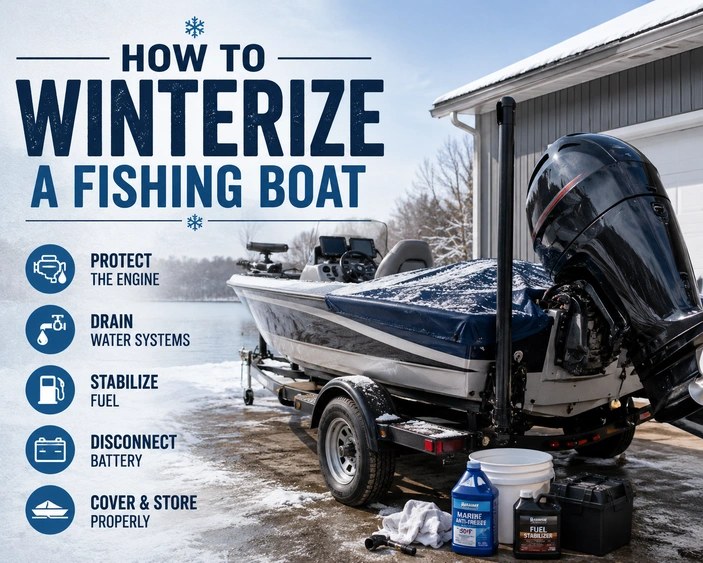
How to Winterize a Fishing Boat
Winterizing a fishing boat is one of the most important maintenance steps an angler can take before freezing weather arrives. A good winterization routine helps protect the outboard, fuel system, batteries, trolling motor, livewell, bilge, electronics, trailer, seats, storage compartments, and fishing gear.
The goal is simple: keep water out, prevent freeze damage, reduce corrosion, protect the fuel system, store batteries properly, and make spring startup easier.
For anglers in Virginia, Pennsylvania, Maryland, West Virginia, and nearby areas, winter storage matters because temperatures can swing quickly. One warm fall weekend can turn into freezing nights before the next fishing trip. If the boat sits with water in the wrong place, a small oversight can become a costly spring repair.
MotoMember helps shoppers and owners compare fishing boats, G3 aluminum boats, jon boats, SunCatcher pontoons, Yamaha outboards, marine trailers, accessories, parts, service, financing, and trade-ins. MotoMember serves customers through locations in Purcellville, Manassas, and Chambersburg, and its team supports powersports and marine customers with sales and service guidance.
Why Winterizing a Fishing Boat Matters
Fishing boats collect water in more places than many owners realize. Water can sit in the bilge, livewell, drain lines, pump housings, trailer bunks, carpet, storage compartments, transducer mounts, seat bases, and engine cooling passages.
When that water freezes, it expands. That can damage pumps, hoses, fittings, seals, livewell components, lower-unit parts, and other systems. Moisture also encourages corrosion, mold, mildew, stale odors, and electrical problems.
Discover Boating’s winterization guidance emphasizes removing water from engines, plumbing, livewells, bilge pumps, and other systems, adding fuel stabilizer, consulting the owner’s manual, and covering or storing the boat properly. It also notes that water and moisture are major off-season threats because they can lead to freeze damage, mold, mildew, and corrosion.
Many shoppers start by asking, “Do I really need to winterize an aluminum fishing boat?” The answer is yes. Aluminum hulls are durable, but the outboard, fuel system, pumps, batteries, wiring, trailer, seats, and accessories still need winter storage preparation.
Start With the Owner’s Manuals
Before winterizing any fishing boat, check the owner’s manuals for the boat, engine, trolling motor, batteries, charger, electronics, trailer, and accessories.
This matters because winterization is not identical for every setup. A small tiller jon boat, bass-style aluminum boat, deep-V fishing boat, and fishing pontoon may all need different steps.
G3 Boats tells owners that a G3 boat is supplied with component manufacturer information, including instructions, warranties, and other important materials, and that owners should read those materials carefully.
If the boat has a Yamaha outboard, Mercury outboard, other outboard brand, livewell system, onboard charger, lithium battery setup, or connected electronics network, do not rely only on generic advice. Use the manufacturer’s instructions for your exact model.
Step 1: Clean the Boat Before Storage
Start winterization by cleaning the boat inside and out.
Remove rods, tackle, bait containers, trash, soft plastics, wet towels, food, drinks, life jackets, rain gear, and anything else that can trap moisture or attract pests. Open compartments and look for wet carpet, damp gear, hidden hooks, fish residue, spilled scent, and soft plastics that may have leaked.
Wash the hull, deck, seats, storage areas, livewell lids, trailer frame, wheels, fenders, and bunks. Let everything dry as much as possible before covering the boat.
For anglers, this is also a great time to reorganize tackle. Pull out rusty hooks, damaged jig heads, wet tackle boxes, old line, cracked pliers, and expired safety items. Spring prep is easier when the boat goes into winter storage clean.
Step 2: Drain All Water-Holding Areas
The most important winterization principle is to remove water.
Check:
- Bilge area
- Livewell
- Baitwell
- Drain lines
- Pump housings
- Cooler compartments
- Storage compartments
- Deck drains
- Anchor locker
- Transom area
- Any freshwater system, if equipped
Remove the drain plug when appropriate for storage and make sure the boat is positioned so water can escape. In most storage situations, the bow should be slightly elevated so rainwater or melted snow does not sit inside the hull.
MotoMember’s G3 jon boat winterization guidance recommends cleaning, draining, inspecting, protecting the fuel system, servicing the outboard, maintaining batteries, checking the trailer, and storing the boat so water can escape.
Do not forget small water-holding areas. Livewell hoses, bilge pump pockets, and drain fittings can be easy to overlook.
Step 3: Protect the Outboard
The outboard is one of the most important systems to winterize correctly.
Outboard winterization may include fuel system preparation, oil and filter service, lower-unit gear oil service, fogging where recommended, prop shaft inspection, grease points, corrosion protection, battery care, and storage position. Mercury Marine’s official outboard winterization checklist includes fuel system prep, oil and filter change, engine fogging, gear lube change, prop shaft check, trim fluid check, anode check, lubrication, corrosion barrier, paint touch-up, battery check, and engine storage prep.
Yamaha’s official winterization guidance for four-cylinder outboards includes cleaning the boat, checking Maintenance Matters and the owner’s manual, changing crankcase oil, draining and refilling lower-unit lubricant, inspecting for milky lower-unit oil, checking for fishing line behind the prop, replacing fuel filters, stabilizing fuel, distributing treated fuel through the system, lubricating grease fittings, applying protectant, trimming the engine fully in for storage, and storing batteries fully charged in a cool but non-freezing dry place.
That does not mean every owner should perform every step themselves. Some winterization jobs are simple. Others are better handled by a trained technician, especially if you are unsure about fuel systems, fogging procedures, gearcase service, seals, water intrusion, or model-specific requirements.
Step 4: Stabilize the Fuel System
Fuel can create spring problems if it is ignored before storage.
Follow the outboard manufacturer’s guidance for fuel stabilizer, fuel level, filters, and running treated fuel through the system. Do not guess at fuel treatment ratios. Use the correct product and amount for the fuel and engine setup.
For many anglers, fuel problems show up in spring as hard starting, rough idle, poor acceleration, or fuel system service needs. A little preparation in fall helps reduce those frustrations.
Before storage, inspect fuel lines, primer bulb, fittings, tank area, venting, and any fuel/water separator. If you smell fuel or see cracking, leaks, stiffness, or damage, schedule service before storing the boat.
Step 5: Change Fluids Before Storage
For many outboards, winterization is the right time to service oil and lower-unit gear lube. Used oil can contain contaminants, and gear lube inspection can reveal water intrusion.
Milky lower-unit gear oil may indicate water getting into the gearcase. That needs attention before freezing temperatures because trapped water can expand and cause damage.
Follow the outboard owner’s manual for oil type, filter type, gear lube, drain plug gaskets, torque specifications, and service intervals. If you are not comfortable doing this work, schedule service with the MotoMember team or a qualified marine technician.
Step 6: Inspect the Prop and Prop Shaft
Fishing boats spend time around weeds, stumps, rocks, shallow ramps, docks, brush, and fishing line. Before winter storage, inspect the prop.
Look for:
- Nicks
- Bent blades
- Cracks
- Fishing line behind the prop
- Weeds or rope
- Gear lube leaks
- Unusual shaft movement
- Missing hardware
Yamaha’s winterization guide specifically notes that discarded fishing line behind the propeller is a common cause of lower-unit water ingestion, and it recommends removing the propeller, clearing line or debris, and greasing the propshaft during winterization.
This is a smart habit for bass, crappie, catfish, and multi-species anglers because fishing line can hide where you will not notice it during normal use.
Step 7: Winterize the Trolling Motor
A trolling motor needs winter attention too.
Clean the shaft, mount, prop, lower unit, foot pedal, remote, cables, plug, and battery connections. Remove weeds and fishing line from the prop area. Check for cracks, loose mounting hardware, worn cables, damaged plugs, and signs of corrosion.
If the trolling motor is removable, decide whether to store it on the boat or indoors based on the manufacturer’s guidance and your storage space. Protect it from moisture, snow load, rodents, and impact damage.
Do not leave a trolling motor plugged in where accidental activation or electrical drain can happen. Follow the manufacturer’s instructions for disconnecting power and storing the system.
Step 8: Store Batteries Correctly
Battery winter storage is one of the biggest differences between an easy spring launch and a frustrating one.
A fishing boat may have a starting battery, one or more trolling motor batteries, an electronics battery, and an onboard charger. Each battery type may have different storage needs, especially if the boat uses flooded lead-acid, AGM, gel, or lithium batteries.
Minn Kota’s marine battery guidance recommends charging after every use, allowing batteries to receive a full charge, avoiding uncharged long-term storage, keeping terminals clean, maintaining proper water levels for flooded lead-acid batteries, and avoiding very cold or very hot storage. It specifically recommends bringing batteries inside over winter when the boat is in storage and avoiding storage where they can freeze.
Before storage:
- Fully charge batteries
- Clean terminals
- Inspect cables
- Disconnect batteries if recommended
- Store in a cool, dry, non-freezing location when appropriate
- Use a compatible maintainer if recommended
- Follow lithium battery manufacturer guidance if applicable
- Label cables before disconnecting multiple batteries
Do not assume every charger is correct for every battery. Battery type and charger compatibility matter.
Step 9: Protect Fish Finders and Electronics
Modern fishing boats often carry expensive electronics. Winter is a good time to protect them.
Remove fish finder displays if they are designed to be removed. Store them indoors in a dry, temperature-stable place. Cover exposed plugs, protect transducer cables, and inspect wiring for rub points or loose connections.
Check:
- Display mounts
- Power cables
- Transducer cables
- Networking cables
- Trolling motor integration cables
- Battery connections
- Fuse holders
- Cable routing
- Corrosion around plugs
Do not yank connectors apart or leave plugs hanging where water can collect. Electronics problems in spring often start with moisture, corrosion, weak batteries, or poor cable storage.
Step 10: Clean and Dry the Livewell
Anglers should pay special attention to the livewell and baitwell.
Drain the system completely. Remove fish scales, bait residue, vegetation, mud, scent products, and standing water. Clean screens and strainers if equipped. Let the compartment dry before closing it for the season.
If the livewell system uses pumps or lines that can hold water, follow the boat and component manufacturer’s winterization instructions. Some systems may require antifreeze procedures, while others may require draining and drying. Do not pour products into the system without confirming they are appropriate for marine use and compatible with your boat.
Step 11: Check the Trailer
A winterized boat is not fully prepared if the trailer is ignored.
Inspect:
- Tire pressure
- Tire sidewalls
- Spare tire
- Lug nuts
- Wheel bearings
- Hubs
- Brakes if equipped
- Bunks or rollers
- Winch strap
- Bow stop
- Safety chains
- Coupler
- Jack
- Trailer lights
- Wiring
- Frame corrosion
- License plate and registration
If the boat will sit for months, consider how the trailer tires will be supported and protected. Inflate tires to the proper pressure, store on a firm surface, and check for sidewall cracking. If you have concerns about bearings, brakes, or tires, handle them before spring fishing season.
Step 12: Cover and Store the Boat Properly
Storage matters as much as winterization.
Discover Boating recommends winter storage out of the water, under cover, and ideally in a climate-controlled storage area when possible. If that is not practical, it recommends shrink-wrapping or using a sturdy cover, while also checking the boat and motor owner’s manuals for winterization recommendations.
A good storage setup should:
- Keep water out
- Allow ventilation
- Prevent pooling
- Protect seats and electronics
- Reduce sun exposure
- Discourage rodents
- Allow drainage
- Keep the boat secure
- Avoid trapping moisture
Do not use a cover that allows water or snow to sag into the boat. Standing water can stretch covers, soak interiors, and add weight. If the boat is stored outside, check it after storms.
Step 13: Protect Seats, Carpet, and Storage Compartments
Fishing boat interiors can suffer during winter if moisture is trapped.
Remove wet life jackets, towels, gloves, clothing, bait containers, food, drinks, and soft plastics. Prop open compartments when safe and practical. Let carpet and seats dry before covering.
Clean vinyl seats and inspect stitching, bases, hinges, and pedestal mounts. Remove cushions or store them upright if appropriate. If rodents are a concern, remove anything that could attract them and check the boat periodically.
Step 14: Review Safety Gear
Winterization is a good time to inspect safety equipment.
BoatUS notes that recreational boats must carry U.S. Coast Guard-approved personal flotation devices in good, serviceable condition and properly sized for intended users. Wearable PFDs should be readily accessible, and throwable devices should be immediately available.
Before storage, check:
- Life jackets
- Throwable flotation device
- Fire extinguisher
- Sound-producing device
- Navigation lights
- First-aid kit
- Anchor and rope
- Paddle or backup propulsion
- Registration documents
- Visual distress signals where required
- Emergency tools
Replace expired, damaged, wet, moldy, or missing gear before spring.
MotoMember Expert Tip
Do not wait until the first hard freeze to winterize your fishing boat.
Many boat owners plan one last fall trip, then the weather changes before they get back on the water. By then, the boat may still have water in the livewell, a low battery, untreated fuel, damp storage compartments, and an outboard that has not been prepared for storage.
For anglers in VA, PA, MD, WV, and nearby areas, a good rule is to schedule winterization as soon as you know your regular boating season is finished. If you may still fish late fall, at least keep batteries charged, fuel treated, water drained, and the boat stored bow-up between trips.
Our team can help you compare what should be handled at home and what should be handled by a service technician.
Large selection. Straightforward shopping. Real powersports and marine expertise.
Winterization Checklist for Fishing Boats
Use this checklist as a practical starting point.
Boat and Hull
- Remove rods, tackle, food, trash, and wet gear
- Wash the hull, deck, and compartments
- Drain bilge, livewell, baitwell, and storage areas
- Remove the drain plug when appropriate
- Store bow-up for drainage
- Open compartments to dry
- Inspect seats, hinges, cleats, and hardware
- Protect from rodents and moisture
Outboard
- Follow the owner’s manual
- Stabilize fuel
- Run treated fuel through the system if recommended
- Change engine oil and filter if required
- Change lower-unit gear lube if required
- Inspect for milky gear lube
- Check prop and prop shaft
- Remove fishing line
- Grease fittings
- Apply corrosion protection where recommended
- Store the motor in the proper position
Batteries
- Fully charge batteries
- Clean terminals
- Disconnect if recommended
- Store in a cool, dry, non-freezing place when appropriate
- Use a compatible maintainer if recommended
- Follow lithium battery instructions if applicable
Trolling Motor and Electronics
- Clean trolling motor shaft, prop, and mount
- Remove weeds and line
- Disconnect power
- Inspect plugs and wiring
- Remove electronics displays if appropriate
- Protect exposed cables and connectors
- Store electronics indoors when recommended
Trailer
- Check tires and spare
- Inspect bearings and hubs
- Test lights
- Inspect wiring
- Check winch strap
- Inspect safety chains and coupler
- Check bunks or rollers
- Look for rust or corrosion
- Service brakes if equipped
Storage
- Use a breathable, secure cover
- Prevent water pooling
- Allow ventilation
- Keep the boat secure
- Check after storms
- Avoid trapping damp gear inside
Common Winterization Mistakes
The most common mistakes are simple ones.
Anglers often forget to drain the livewell, leave the drain plug in, store batteries discharged, ignore lower-unit oil, leave electronics on the boat, cover the boat while wet, or assume the outboard is fine because it ran well on the last trip.
Other mistakes include leaving life jackets damp inside compartments, leaving soft plastics on seats or carpet, letting snow load collapse a cover, and forgetting to inspect trailer tires before months of storage.
The best winterization routine is not complicated. It is consistent.
Call to Action
Ready to winterize your fishing boat the right way?
Contact MotoMember to talk through fishing boat service, Yamaha outboard care, G3 boat ownership, trailers, batteries, accessories, parts, financing, trade-ins, and seasonal maintenance support. Current service needs, parts, inventory, and equipment can vary, so check with the MotoMember team before planning around one exact boat, motor, or accessory setup.
Your fishing boat ownership support starts at MotoMember.
Stop dreaming. Start fishing.
Conclusion
Winterizing a fishing boat protects your investment and makes spring easier. Start by cleaning and drying the boat. Drain water from the bilge, livewell, and storage areas. Stabilize the fuel, service the outboard, inspect the prop, store batteries correctly, protect electronics, check the trailer, and cover the boat properly.
The right winterization steps depend on your boat, motor, battery type, trailer, electronics, and storage location. Always follow manufacturer instructions and schedule professional service when you are unsure.
For anglers across Virginia, Pennsylvania, Maryland, West Virginia, and nearby areas, MotoMember can help with fishing boat ownership, service planning, marine accessories, trailers, parts, financing, trade-ins, and long-term support.
A careful winterization routine helps prevent freeze damage, protects key systems, and gives you a better shot at a smooth first launch next season.
FAQ
When should I winterize my fishing boat?
Winterize your fishing boat before freezing temperatures arrive and once your regular boating season is finished. Do not wait for the first hard freeze. If you fish late into fall, keep the boat drained, batteries charged, and fuel protected between trips.
Do aluminum fishing boats need winterization?
Yes. The aluminum hull may be durable, but the outboard, fuel system, batteries, livewell, bilge pump, trailer, wiring, electronics, and accessories still need winter storage preparation.
Should I remove the boat drain plug during winter storage?
In many storage situations, yes. Removing the drain plug and storing the boat bow-up helps water escape. Make sure the boat is positioned safely and check the storage setup after rain, snow, or ice.
Should I remove batteries from my fishing boat for winter?
Often, yes, especially if the boat is stored in very cold conditions. Fully charge batteries, clean terminals, and follow the battery and charger manufacturer’s instructions. Minn Kota recommends avoiding very cold or hot storage and bringing batteries inside over winter when the boat is in storage.
Can MotoMember help winterize a fishing boat?
Yes. MotoMember can help anglers with fishing boat ownership questions, Yamaha outboard service planning, G3 boat guidance, trailers, batteries, accessories, parts, financing, trade-ins, and seasonal maintenance support. Current service needs and availability can vary, so contact the team for current guidance.