
How to Set Up a G3 Jon Boat for Fishing

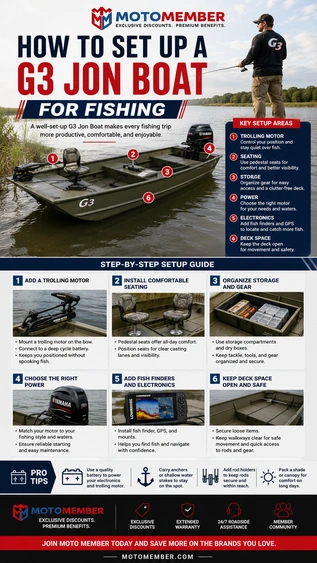
How to Set Up a G3 Jon Boat for Fishing
A well-planned G3 jon boat fishing setup can make every trip easier, cleaner, safer, and more productive.
The key is not adding every accessory at once. The key is setting up your G3 jon boat around how you actually fish. A bass angler casting shallow cover does not need the same layout as a crappie angler spider-rigging, a catfish angler anchoring at night, or a river smallmouth angler running skinny water.
G3 makes setup planning easier because the Gator Tough Jon Series includes Package Jon, Tunnel/Jet Jon, and Loose Jon paths. G3 says Package Jon boat, motor, and trailer packages are available in center-console or side-console layouts from 17 to 20 feet, while Loose Jons are available in riveted or welded versions and can be customized through a dealer with options such as consoles, floor inserts, storage boxes, and more.
For shoppers in Virginia, Pennsylvania, Maryland, West Virginia, and nearby areas, MotoMember can help compare G3 models, Yamaha power, trailers, trolling motors, electronics, accessories, financing, trade-ins, service, and long-term ownership support.
Start With Your Fishing Style
Before buying accessories, decide how you fish most often.
Do you cast for bass? Drift for catfish? Spider-rig for crappie? Fish shallow rivers? Anchor near channel edges? Work docks and brush piles? Carry live bait? Fish at night?
That answer should shape the entire setup. Rod holders, electronics, trolling motor choice, battery placement, anchor storage, livewell use, seating, and deck layout all depend on your fishing style.
Many shoppers make the mistake of rigging the boat before using it. A better approach is to plan the essentials first, fish from the boat a few times, then add permanent accessories once you know where everything naturally belongs.
Choose the Right G3 Jon Boat Layout
The best fishing setup starts with the right layout.
A side-console G3 jon boat keeps more of the center floor open. That can be helpful for crappie anglers, catfish anglers, hunters who also fish, and anyone who carries tackle bags, coolers, rods, anchor gear, or bulky equipment.
A center-console G3 jon boat gives the operator a more central helm position, easier walkaround movement, good visibility, and a practical place for electronics and controls. G3’s 18 CC includes a center console with Yamaha throttle, switch panel, cupholder, space for optional electronics, battery storage underneath, six upright rod holders, side rod storage, and two aerated livewells.
A Loose Jon works best if you want a custom fishing build. A Tunnel or Jet Jon works best if shallow rocky river access is central to where you fish. G3’s Tunnel/Jet Jon Series includes center-console boat, motor, and trailer packages in 17- to 20-foot lengths for fishing and hunting.
Keep the Deck Open
Open floor space is one of the biggest advantages of a jon boat.
A cluttered deck makes fishing harder. Rod tips get stepped on. Anchor lines tangle. Tackle bags slide around. Nets disappear under coolers. Passengers block each other when a fish is on.
Start with the rule: everything needs a home.
Rods should have holders or storage. Tackle should be sorted into trays or boxes. Tools should be clipped or stored. Safety gear should be reachable. Batteries should be secured. Anchors should have a dedicated space. Coolers should not block walkways.
G3’s 18 SC is a good example of a fishing-friendly side-console layout because it includes under-seat compartments and standard tackle trays in front of the console to help keep gear organized.
Plan Rod Storage First
Rod storage should be one of the first setup decisions.
Bass anglers may need quick access to several casting rods. Crappie anglers may carry long rods that need careful placement. Catfish anglers may need heavy rod holders mounted where rods can load safely. River anglers may want rods secured before running shallow water.
G3 center-console models are useful here because they include rod organization features from the factory. The 18 CC includes side rod storage and six upright rod holders at the helm, while the 20 CC includes upright rod holders for six rods and a 14-gallon livewell under the console seat.
For custom setups, think through rod length before mounting anything. Long crappie rods, catfish rods, and fly rods need more room than standard bass rods.
Add Rod Holders Based on Technique
Rod holders should match your fishing style.
For catfishing, position rod holders along the side or stern where rods can load under pressure without blocking passengers. Think about anchor position, current direction, net access, and where you will stand when fighting a fish.
For crappie fishing, rod holders may need to support spider-rigging, long-line trolling, or vertical jigging. Bow placement, electronics visibility, and trolling motor control are critical.
For bass fishing, you may need fewer mounted rod holders and more secure rod storage. Bass anglers usually benefit from clean decks and quick rod access more than a large rod spread.
For multi-species fishing, use removable or adjustable rod-holder systems when possible. That keeps the boat flexible.
Choose the Right Trolling Motor Setup
A trolling motor is often the most important fishing accessory on a jon boat.
Bass anglers use it to work shorelines, grass edges, docks, and shallow cover. Crappie anglers use it for slow control around brush piles, standing timber, creek channels, and bridges. Catfish anglers may use it for positioning before anchoring or controlled drifting.
Before choosing a trolling motor, think about boat size, battery space, shaft length, mounting location, control style, and how much time you spend fishing in wind or current. G3 build information for models such as the 18 CC lists Minn Kota trolling motor options, showing how trolling motor planning can be part of the boat setup rather than an afterthought.
MotoMember can help you compare trolling motor options based on your model, fishing style, battery needs, and deck layout.
Set Up Electronics the Smart Way
Electronics should be easy to see, easy to reach, and safely wired.
A basic fish finder may be enough for pond fishing, small lakes, and casual trips. More serious anglers may want GPS mapping, down imaging, side imaging, or larger screens. Crappie anglers may prioritize structure and fish location. Catfish anglers may want depth, channel edges, holes, and current seams. Bass anglers may want mapping, waypoints, and shallow-cover awareness.
The G3 17 CC includes a spacious center console with room for optional electronics, while the 18 CC also provides space for optional electronics and battery storage underneath the console.
Think about glare, seating position, cable routing, transducer placement, and whether you need a bow screen, console screen, or both.
Battery Placement and Charging
Batteries affect boat balance, storage, and fishing performance.
A trolling motor battery, electronics battery, starting battery, and onboard charger can take up more space than shoppers expect. Battery weight also changes how the boat sits in the water and how it performs.
Secure every battery properly. Keep wiring protected. Use marine-grade components. Plan charger access so you can plug in easily at home. Make sure battery boxes, cables, and terminals are protected from water, tackle, tools, and passenger movement.
A clean battery setup is not exciting, but it is one of the biggest differences between a boat that feels professionally rigged and one that feels thrown together.
Organize Tackle Storage
Tackle storage should match your species.
Bass anglers often need plastics, jigs, crankbaits, spinnerbaits, terminal tackle, line, pliers, and several rod setups. Crappie anglers need jig boxes, plastics, hooks, floats, minnows or bait supplies, and long-rod organization. Catfish anglers need hooks, sinkers, swivels, leader material, bait knives, towels, gloves, and heavy-duty tools.
G3’s 18 SC includes standard tackle trays in front of the console and under-seat compartments for gear and essentials. The 20 SC adds under-seat storage, side rod holders, bow storage, a livewell, and tackle tray storage, making it a strong fit for anglers who carry more gear.
Use storage to keep the deck clean. The easier it is to find tackle, the more time you spend fishing.
Think Through Livewell Use
Livewell needs vary by angler.
Some anglers use livewells for tournament-style bass fishing. Crappie anglers may use them for legal fish during the day. Catfish anglers may use coolers instead, depending on fishing style and local rules. Some anglers use livewell space for bait.
G3 Package Jon models offer useful livewell setups. The 20 CC includes a 14-gallon livewell under the console seat and a 31-gallon bow divided livewell with side storage. The 18 CC includes two aerated livewells and a built-in 19-gallon fuel system.
Before choosing a model or accessory setup, decide whether livewell capacity is central to your fishing or simply a nice feature.
Add Anchoring Gear for Your Water
Every fishing setup needs an anchor plan.
Pond anglers may only need a simple anchor. Catfish anglers may need bow and stern anchor control. River anglers may need quick, safe anchor access and careful rope management. Crappie anglers may use anchors less often if they rely heavily on trolling motors.
Never leave anchor rope loose across the walking path. Store it in a bucket, bag, box, or dedicated compartment. Keep knives or line cutters accessible in case of emergency, especially when fishing current.
If you fish shallow water, discuss shallow-water anchoring options with MotoMember. The right system depends on bottom type, boat size, and how you fish.
Lighting for Early, Late, and Night Fishing
Lighting matters more than many first-time buyers expect.
Navigation lights are safety equipment. Interior lighting helps with tackle, rods, bait, netting fish, and moving around the boat after dark. Courtesy lights can reduce the need for bright flashlights that ruin night vision.
The G3 20 SC includes a console courtesy light for low-light conditions, along with a fishing-friendly open layout.
For night fishing, keep lighting useful but not excessive. You want enough light to move safely without creating glare, attracting bugs unnecessarily, or making it harder to see outside the boat.
Seating and Comfort
Fishing comfort affects how long you stay on the water.
Bass anglers may want casting seats or leaning posts. Crappie anglers may prefer bow seating for long periods of slow fishing. Catfish anglers often want comfortable seating near rod holders. Multi-species anglers may need flexible seating that can move or be removed.
Do not add seats just because there is room. Every seat changes deck flow. A seat that feels comfortable at the dock may block movement when rods, tackle, cooler, and passengers are onboard.
The best setup gives each angler a safe place to sit and stand without crowding the boat.
Trailer and Launch Setup
A fishing setup is not complete until the trailer works for your routine.
Trailer guides, spare tire, transom saver, tie-down straps, winch condition, lighting, bunks, and tongue length all matter. A well-set-up trailer makes solo launching easier and reduces stress at the ramp.
Also think about storage. Measure your garage, barn, driveway, or storage unit before choosing accessories that add length, height, or width. Trolling motors, electronics, trailer guides, covers, and spare tires can all change how the boat fits at home.
MotoMember can help shoppers think through boat, motor, trailer, storage, and towing as one complete ownership package.
Set Up by Species
Bass Fishing Setup
For bass, prioritize casting space, trolling motor control, electronics, rod access, and clean deck movement.
A G3 17 CC, 18 CC, or 20 CC can work well depending on how much room you want. The 17 CC offers wide open deck space, Yamaha controls, room for optional electronics, and livewell storage under the front console seat.
Crappie Fishing Setup
For crappie, prioritize trolling motor control, electronics visibility, long-rod storage, tackle trays, and seating.
A G3 18 SC or 20 SC is a strong direction because side-console layouts preserve open floor space. This helps with spider-rigging, long-line trolling, brush pile fishing, and dock fishing.
Catfishing Setup
For catfish, prioritize rod holders, anchor systems, open floor space, lighting, cooler placement, bait storage, and safety gear.
The G3 20 SC is especially appealing because its side-console design, under-seat storage, side rod holders, bow storage, livewell, and tackle storage help keep gear organized.
River Fishing Setup
For shallow rivers, prioritize access, hull choice, motor setup, gear security, and safe weight distribution.
If rocky water, riffles, shoals, or shallow runs are part of your normal fishing, compare G3 Tunnel and Jet Jon models before setting up a standard prop boat. G3’s Tunnel/Jet Jon category exists for fishing and hunting buyers who need specialized shallow-water options.
MotoMember Expert Tip
Set up your G3 jon boat in phases.
Start with the essentials: life jackets, throwable device if required, anchor, dock lines, battery setup, basic tools, trolling motor plan, electronics plan, rod storage, and a safe trailer setup.
Then fish from the boat several times before drilling permanent holes for rod holders, lights, electronics mounts, storage boxes, or custom accessories.
Many shoppers rig a boat based on what looks good online. A better setup comes from noticing where you actually stand, where rods pile up, where tackle gets used, where passengers sit, and what gets in the way.
Our team can help you compare layouts and accessories before you commit to a permanent setup.
Service, Accessories, and Financing Support
MotoMember can support more than the initial boat purchase.
MotoMember is a full-service powersports and marine dealership group serving customers through sales, financing, service, and parts support. MotoMember’s G3 buyer resources also describe support for new inventory, used inventory, service, parts, accessories, financing resources, and straightforward contact options across locations in Virginia and Pennsylvania.
That matters because a good fishing setup may include dealer-installed electronics, trolling motor rigging, battery service, trailer accessories, covers, storage accessories, seasonal prep, and future upgrades.
Current availability can vary by season, location, model year, motor package, trailer setup, color, and accessories, so check MotoMember inventory or contact the team before planning around one exact configuration.
Safety Gear Setup
Safety gear should be part of the layout, not an afterthought.
The U.S. Coast Guard says recreational vessels must have a Coast Guard-approved wearable PFD for each person onboard. Pennsylvania’s Fish and Boat Commission states that all boats must have a serviceable USCG-approved life jacket for each person, and boats 16 feet and over must also carry an immediately available USCG-approved throwable device onboard.
Virginia DWR states that all operators of motorboats with a 10 hp or greater engine need to take a boating safety course.
Keep PFDs accessible. Keep the throwable device easy to grab. Check navigation lights. Carry a first-aid kit, whistle or sound device, basic tools, dock lines, paddle or backup propulsion where appropriate, phone protection, and weather awareness.
A clean, organized fishing boat is usually a safer fishing boat.
Call to Action
Your G3 Gator Tough Headquarters starts at MotoMember.
Explore current G3 availability, compare Loose Jon, Package Jon, side-console, center-console, Tunnel Jon, and Jet Jon options, and talk with the MotoMember team about Yamaha power, trailers, trolling motors, electronics, rod holders, livewell needs, storage, lighting, financing, trade-ins, service, towing, and storage.
Large selection. Straightforward shopping. Real powersports and marine expertise.
Stop dreaming. Start riding—and boating—with MotoMember.
Conclusion
The best way to set up a G3 jon boat for fishing is to build around your actual fishing style.
Start with the right layout. Keep the deck open. Plan rod storage early. Choose a trolling motor and electronics setup that fits your water. Organize tackle. Think through batteries, anchors, lighting, seating, trailer setup, and safety gear before adding permanent accessories.
A bass setup, crappie setup, catfish setup, and river setup should not look exactly the same. That is why G3’s Gator Tough lineup is so useful: shoppers can compare Loose Jon, Package Jon, side-console, center-console, Tunnel Jon, and Jet Jon paths before rigging the boat.
For shoppers in VA, PA, MD, WV, and nearby areas, MotoMember can help you build a fishing-ready G3 jon boat that fits your water, gear, trailer, storage space, and season.
FAQ
What is the first accessory to add to a G3 jon boat for fishing?
Start with safety gear, then focus on the trolling motor, battery setup, rod storage, anchor system, and basic tackle organization. Electronics and permanent rod holders should be planned around how you actually fish.
Is a side-console or center-console G3 jon boat better for fishing?
A side-console layout is great if you want more open floor space. A center-console layout is better if you want central helm control, walkaround movement, electronics space, and organized rod storage. The right choice depends on your fishing style.
What G3 jon boat is easiest to set up for fishing?
A G3 Package Jon is often easiest because it starts as a more complete boat, motor, and trailer package. A G3 Loose Jon is better if you want a custom fishing build from a simpler hull platform.
Should I install electronics at the bow or console?
Bass and crappie anglers often benefit from bow electronics because they fish from the front deck. Console electronics are useful for running, navigation, depth, and waypoint management. Some anglers use both.
How do I get help setting up a G3 jon boat at MotoMember?
Check current MotoMember inventory or contact the team directly. Availability, model year, motor package, trailer setup, electronics, trolling motors, accessories, pricing, and incoming units can change by season and location.