Camo Jon Boats: What Hunters Should Consider

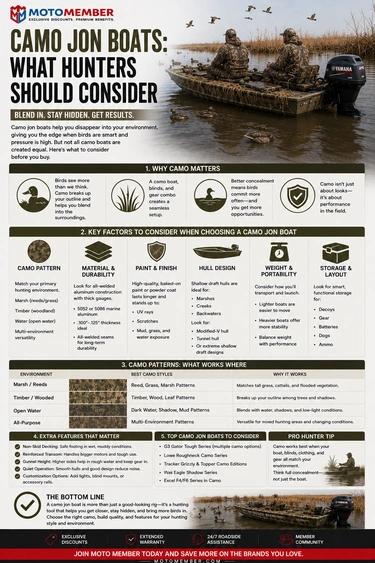
Camo Jon Boats: What Hunters Should Consider Before Buying
A camo jon boat can be one of the most useful tools a waterfowl hunter owns. It can run shallow water, haul decoys, carry a retriever, hide along marsh grass, and double as a fishing or utility boat outside hunting season.
But not every camo jon boat is right for every hunter.
Before buying, think beyond the paint pattern. The best camo jon boat for hunting depends on where you launch, how shallow you run, how many people hunt with you, whether you use a dog, what motor you need, and how much gear you carry on a real cold-weather morning.
For hunters in Virginia, Pennsylvania, Maryland, West Virginia, and nearby areas, conditions can vary widely. One buyer may need a simple flat-bottom jon boat for protected creeks. Another may need a larger modified-V setup for backwaters, rivers, or tidal marsh edges.
MotoMember helps shoppers compare boats, marine accessories, trailers, motors, service needs, financing, trade-ins, and related powersports equipment. Current availability can vary, so browse MotoMember inventory or contact the team before planning your hunting setup. MotoMember has also published jon boat buying guidance for G3 shoppers, reinforcing its role as a marine and powersports resource for customers comparing fishing, hunting, and utility boats.
Why Hunters Like Camo Jon Boats
Jon boats are popular with hunters because they are simple, practical, and easy to customize. Their open interiors give you room for decoys, blind bags, dogs, anchors, batteries, and safety gear.
A camo finish adds another advantage: concealment. A boat that already has a dull, natural-looking finish is easier to hide than a bright aluminum or glossy recreational boat.
That matters when you are tucked into reeds, backed against a creek bank, sitting in timber, or brushed into a marsh edge.
Camo Helps, But It Does Not Do Everything
A factory camo finish can help break up the boat’s outline, but it is not a complete blind by itself. Ducks, geese, and other game can still pick up shape, movement, shine, and shadows.
Think of camo paint as the base layer. The rest of the setup may include grass rails, brush clips, a low-profile blind, natural vegetation where allowed, matte accessories, and careful boat placement.
A camo jon boat should disappear into the cover around it. That requires more than choosing a pattern that looks good online.
Start With Where You Hunt
The first question is not “Which camo pattern looks best?” It is “Where will this boat actually be used?”
A hunter running narrow creeks needs something different from a hunter crossing open river water. A marsh hunter working shallow mud and grass needs different features than someone hunting protected farm ponds.
Marsh Hunting
For marsh hunting, shallow draft and concealment matter. Flat-bottom jon boats, mud boats, and low-profile hunting layouts are often popular because they can work in shallow water and brush into natural cover.
Think about mud, grass, cattails, reeds, tidal movement, and how far you need to run from the ramp. If you often push into very shallow areas, hull shape and motor choice become especially important.
Creek Hunting
Creek hunting usually rewards maneuverability. A boat that is too wide, too long, or too hard to turn can be frustrating in tight bends, logjams, and narrow channels.
For smaller creeks, a compact jon boat may be easier to hide and handle. For deeper creeks with current or occasional chop, a modified-V jon boat may offer a more comfortable ride.
Backwater Hunting
Backwaters often require versatility. You may deal with shallow flats, stumps, flooded timber, current seams, mud, and open pockets of water.
A mid-size jon boat or modified-V jon boat is often a practical choice for backwater hunters because it can carry gear while still staying manageable.
Tidal and Larger Water
If you hunt near larger rivers, bays, or tidal water, be cautious about going too small. Wind, chop, current, tide, and distance from the ramp all matter.
A camo jon boat can still work, but you may need more hull size, more freeboard, careful weight distribution, and a motor setup appropriate for the conditions.
Maryland DNR highlights the state’s long waterfowl tradition and provides waterfowl hunting resources, which is useful for hunters who need to verify local rules and plan around regional water conditions.
Choose the Right Hull Style
The hull is the foundation of the boat. Paint, accessories, and blinds can be changed later. Hull choice is harder to fix.
Flat-Bottom Jon Boats
A flat-bottom jon boat is a classic shallow-water hunting platform. It can be stable at rest, easy to customize, and efficient in protected water.
Flat-bottom boats are often useful for:
Marshes
Ponds
Shallow creeks
Backwater sloughs
Short hunting runs
Calm protected water
The tradeoff is ride quality in chop. A flat-bottom boat can pound in rough water, especially when lightly loaded or running across wind-driven water.
Modified-V Jon Boats
A modified-V jon boat has a shaped bow that can help it handle light chop better than a completely flat front. It may be a smart choice for hunters who split time between creeks, backwaters, rivers, and fishing.
Modified-V boats can offer a good middle ground: shallow-water utility with improved ride comfort in mixed conditions.
They may not run as shallow as some flat-bottom setups, but they can feel more versatile for hunters who use the boat beyond duck season.
Wide-Body Jon Boats
A wide-body jon boat can provide more stability and interior room. That is helpful for hunters carrying decoys, dogs, blind frames, and multiple people.
The added width can also make the boat feel more secure when someone shifts weight, reaches for decoys, or helps a retriever back into the boat.
The tradeoff is that a wider boat may be harder to hide in tight cover and may require more motor, trailer, and storage space.
Size: Bigger Is Not Always Better
The right camo jon boat size depends on how you hunt. Many buyers are tempted to go small for easy towing or go large for maximum room. Both can work, but both have tradeoffs.
Smaller Camo Jon Boats
Smaller jon boats are easier to tow, easier to store, easier to hide, and easier to launch in tight areas. They can be great for solo hunters, two-person hunts, and protected water.
They also fill up fast. Add two hunters, waders, shotguns, blind bags, decoys, fuel, battery, anchor, safety gear, and a dog, and the available room can disappear quickly.
Mid-Size Camo Jon Boats
A mid-size jon boat is often the most practical option for many hunters. It can provide enough space for a blind and gear while still being manageable at ramps, creeks, and storage areas.
For many shoppers, this is the sweet spot: big enough to be useful, not so big that it becomes hard to hide or handle.
Larger Camo Jon Boats
A larger camo jon boat can be a better choice for bigger water, longer runs, multiple hunters, and heavier decoy spreads.
The downsides are weight, cost, towing needs, storage, and concealment. A larger boat may need a more thoughtful blind setup so it does not look like a big rectangle in the marsh.
Think About Real Hunting Weight
One of the biggest buying mistakes is judging a boat while it is empty. Hunting boats are rarely used empty.
A real duck hunting load may include:
Hunters
Dog
Waders and heavy clothing
Shotguns and cases
Shells
Decoys
Decoy anchors and lines
Blind bags
Boat blind
Grass mats or brush
Fuel tank
Battery
Trolling motor
Push pole
Anchor
Safety gear
Heater, when safe and appropriate
Food, water, and dry clothing
That load affects how the boat floats, accelerates, turns, and stops. It also affects how much freeboard remains once everyone is onboard.
Before choosing a camo jon boat, check manufacturer capacity information and think through your heaviest realistic hunting day.
Motor Choice Matters
The right motor depends on depth, distance, vegetation, current, mud, and how often you use the boat outside hunting season.
Standard Outboard
A standard outboard is a strong choice for many hunters. It works well in creeks, rivers, reservoirs, ponds, and protected bays where water depth is sufficient.
An outboard is also versatile if you plan to fish, scout, crab, or use the boat recreationally after hunting season.
Mud Motor
A mud motor can be useful in shallow, muddy, grassy, or obstacle-heavy areas. It may help hunters reach places a traditional outboard cannot.
But not every hunter needs a mud motor. Mud motors can affect handling, noise, weight balance, maintenance, and budget.
Before choosing one, ask whether your hunting area truly requires it or whether a conventional outboard would serve you better.
Trolling Motor
A trolling motor can help with quiet positioning, scouting, final approaches, and decoy pickup. It can also be useful if the boat doubles as a fishing rig.
Battery placement is important. A heavy battery can affect trim and balance, especially in a smaller boat.
Camo Pattern and Finish: What to Look For
Camo is not just decoration. The right finish can reduce glare, break up the outline, and help the boat blend into hunting environments.
Match the Region and Cover
For hunters in VA, PA, MD, and nearby areas, cover can change through the season. Early-season marsh grass may be greener, while late-season cover may be brown, gray, tan, or muddy.
Choose a pattern or finish that gives you a flexible base. Earth tones, marsh grass colors, bark-like tones, and matte finishes usually matter more than a highly detailed pattern.
Avoid Shine
Shine is a problem. Glossy paint, polished aluminum, bright hardware, reflective decals, and exposed metal can stand out in low-angle morning light.
A good hunting boat should have a dull, low-glare finish. That includes the hull, blind frame, motor, accessories, and anything mounted above the waterline.
Plan for Wear
Duck boats get abused. Mud, decoy weights, dog claws, boots, ice, brush, trailers, and shallow launches can scratch paint.
A camo finish should be durable and easy to touch up. Ask about care, cleaning, and how the finish may hold up under the type of hunting you do.
Blind Compatibility
A camo jon boat should work with the blind system you plan to use. Do not assume every boat is easy to blind.
Low-Profile Blinds
Low-profile blinds are useful in marshes, open grass, and areas where tall cover is limited. They help reduce the boat’s silhouette.
They can be excellent for hiding, but they must still allow safe movement, visibility, and shooting lanes.
Scissor Blinds and Flip Blinds
Scissor-style and flip-style boat blinds are common because they can open and close quickly. They can also provide a fuller hide for multiple hunters.
Before buying a boat, think about where blind supports will mount and whether they will interfere with seats, storage, steering, fuel lines, batteries, lights, or dog movement.
Grass Rails and Brush Clips
Grass rails and brush clips can make a big difference. They allow you to add natural or synthetic cover to break up the outline.
For local hunting, think about the vegetation you actually use. A boat brushed for cattails may not blend into a wooded creek bank.
Interior Layout and Storage
A good camo jon boat should be easy to move around in while wearing waders and gloves. The interior layout matters as much as the outside appearance.
Open Floor Space
Open floor space is valuable. It gives you room for decoys, blind bags, a dog, and safe movement.
Avoid overloading the boat with permanent boxes or accessories unless they solve a real problem.
Storage Boxes
Storage boxes can help organize shells, tools, safety gear, ropes, lights, and dry clothing. They can also provide seating if designed and installed correctly.
However, storage boxes add weight and reduce open space. Make sure they do not make the boat feel crowded.
Gun and Gear Storage
Firearms should be handled and stored safely at all times. A dedicated dry storage area or secure gun box can help keep the boat organized.
Make sure storage does not block emergency exits, driver controls, or access to safety gear.
Dog-Friendly Setup
If you hunt with a retriever, your camo jon boat needs a dog plan.
A dog needs traction, a defined place to sit, and a safe way to enter and exit the boat. Wet aluminum can be slick, especially in cold weather.
Consider:
Non-slip flooring
Dog platform
Dog ladder
Low entry point
Dog blind or cover
Space away from fuel and battery areas
Clear path for retrieves
A dog that has to climb over decoy bags, blind frames, and hunters can create safety problems. Plan the dog zone before choosing accessories.
Trailer and Launch Considerations
The boat is only part of the package. A camo jon boat also needs a trailer that works for your ramps, towing vehicle, and storage situation.
Ramp Conditions
Hunting ramps can be shallow, muddy, icy, remote, or poorly lit. Trailer guides, good lighting, reliable tires, and a properly working winch matter.
Cold-weather launching is not the time to discover weak bearings, bad wiring, or a worn winch strap.
Towing and Storage
Think about where the boat will live. Will it fit in your garage, under a carport, beside the house, or at a hunting camp?
A larger boat may be more comfortable on the water but harder to store and maneuver at home.
Safety Should Shape the Buying Decision
Waterfowl hunters often operate before daylight, in cold water, and in changing weather. Safety should influence boat size, layout, motor choice, and gear storage.
The U.S. Coast Guard says wearable personal flotation devices must be readily accessible and that a USCG-approved life jacket or buoyancy aid should be worn while the vessel is underway.
Virginia DWR states that boats must have one wearable U.S. Coast Guard-approved life jacket for each person onboard, and each life jacket should be in good, serviceable condition and properly fitted.
Safety Gear to Plan For
A camo jon boat setup should leave room for:
Life jackets for every person
Throwable flotation device when required
Sound-producing device
Navigation lights
Waterproof flashlight or headlamp
First aid kit
Fire extinguisher when required
Paddle or push pole
Anchor and rope
Bilge pump or hand pump
Spare drain plug
Basic tool kit
Tow rope
Dry bag with emergency clothing
Phone or communication device in waterproof storage
Do not bury safety gear under decoy bags. It should be easy to reach when conditions are bad.
New vs. Used Camo Jon Boats
Both new and used camo jon boats can make sense. The right choice depends on budget, availability, condition, and how much customization you want to do.
Buying New
A new camo jon boat may give you a cleaner starting point, known condition, current options, and easier planning for motor, trailer, and accessories.
You can also think through the full package from the beginning instead of working around someone else’s modifications.
Buying Used
A used camo jon boat can be a smart value, especially if it already includes a trailer, blind, flooring, or accessories.
Inspect carefully. Look at the hull, transom, rivets or welds, trailer, wiring, lights, flooring, blind frame, paint condition, and motor setup. A cheap boat can become expensive if it needs major repairs.
MotoMember can help shoppers compare new and used inventory, trade-in options, and ownership considerations before making a decision.
MotoMember Expert Tip
Before buying a camo jon boat, bring a realistic gear list to the dealership.
Include how many hunters usually go, whether you hunt with a dog, how many decoys you carry, what water you run, how far you travel from the ramp, and whether the boat will also be used for fishing.
Many shoppers focus on camo pattern first. Our team usually recommends starting with hull size, stability, capacity, motor needs, and layout. Once those are right, concealment becomes much easier to solve.
Questions to Ask Before Buying
Before you choose a camo jon boat, ask:
Where will I hunt most often?
Will I run shallow water, mud, vegetation, or current?
How many hunters will usually be onboard?
Will I hunt with a dog?
How many decoys do I carry?
Do I need a removable or permanent blind?
Will I use the boat for fishing?
What motor makes sense for my water?
Can my vehicle tow the full package?
Where will I store it?
What service support will I need?
What safety gear must be carried?
These questions help narrow the search quickly and prevent buying based only on appearance.
How MotoMember Can Help
MotoMember supports customers across Virginia, Pennsylvania, Maryland, West Virginia, and surrounding areas with marine and powersports shopping guidance. Whether you are comparing a camo jon boat, trailer, outboard, ATV, side-by-side, accessories, financing, or service needs, the team can help you think through the full ownership picture.
Our team can help you compare:
New inventory
Used inventory
Boat and trailer packages
Motor options
Accessories and setup ideas
Service needs
Financing options
Trade-ins
Related powersports equipment for hunting property access
Current availability can vary, so start at MotoMember.com or browse current inventory before visiting.
Large selection. Straightforward shopping. Real powersports and marine expertise.
Call to Action
Ready to compare camo jon boats for hunting season? Contact MotoMember or browse current inventory to explore boats, trailers, motors, accessories, financing, trade-ins, and service support.
For hunters across VA, PA, MD, WV, and nearby areas, MotoMember can help you choose a setup that fits your water, your gear, your dog, and your long-term ownership needs.
Stop dreaming. Start riding — and get your boat ready for the next morning in the marsh.
Conclusion
A camo jon boat is a smart choice for many hunters, but the best boat is not chosen by camo pattern alone. Hull shape, size, stability, capacity, motor compatibility, blind setup, storage, trailer fit, and safety gear all matter.
Start with your hunting environment. Think about marshes, creeks, backwaters, ponds, rivers, or tidal areas. Then build the boat around your real load: hunters, dog, decoys, fuel, batteries, blind bags, and emergency gear.
A well-chosen camo jon boat should be easy to hide, safe to operate, practical to tow, simple to organize, and useful beyond one season.
MotoMember can help shoppers compare options and build a better plan before buying.
FAQ
Is a camo jon boat worth it for duck hunting?
Yes, a camo jon boat can be worth it if you hunt shallow water, marshes, creeks, ponds, or backwaters. The camo finish helps with concealment, while the jon boat layout gives you room for decoys, dogs, blinds, and gear.
What size camo jon boat should I buy?
Choose size based on your hunting crew, dog, decoy load, motor, blind, and water conditions. Smaller boats are easier to hide and tow, while larger boats usually offer more space and stability. Always check capacity information before buying.
Is a flat-bottom or modified-V jon boat better for hunting?
A flat-bottom jon boat is often better for shallow, protected water. A modified-V jon boat may be better if you run creeks, rivers, or backwaters with light chop. The right choice depends on where you hunt most often.
Do I need a blind if my jon boat is already camo?
Usually, yes. Camo paint helps, but a blind or added cover can better break up the boat’s shape and hide hunter movement. Grass rails, brush clips, and low-profile blinds can improve concealment.
Can MotoMember help with camo jon boat setup?
Yes. MotoMember can help shoppers compare boats, trailers, motors, accessories, service support, financing, and trade-ins. Current availability can vary, so check MotoMember inventory or contact the team for current options.