
Best Pontoon Layout for Fishing & Family Use

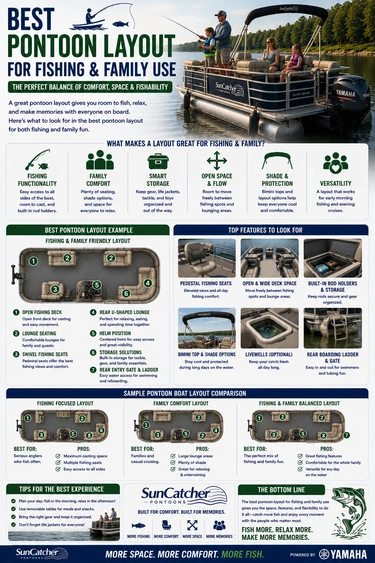
Best Pontoon Layout for Fishing and Family Use
The best pontoon layout for fishing and family use is the one that gives anglers real fishing functionality without making passengers feel like they are sitting in the way.
A great fishing pontoon should do both jobs well. It should give anglers room for rods, tackle, bait, livewell access, electronics, and safe casting areas. It should also give family members comfortable seating, shade, storage, clear walkways, easy boarding, and space to relax between fishing spots.
That balance is why many freshwater buyers compare fishing pontoons before choosing a traditional aluminum fishing boat. A pontoon may not be the most specialized option for technical bass fishing or tight river use, but it can be one of the most enjoyable choices for lake and reservoir families.
For shoppers in Virginia, Pennsylvania, Maryland, West Virginia, and nearby areas, MotoMember can help compare SunCatcher pontoon layouts, Yamaha-powered packages, trailers, accessories, financing, trade-ins, and service support. MotoMember lists new marine inventory across its dealership network, and current availability, model year, equipment, pricing, and location can change, so shoppers should check current inventory or contact the team before planning around a specific unit.
Quick Answer: What Pontoon Layout Is Best for Fishing and Family Use?
For most families who also fish, the best pontoon layout includes front or rear fishing stations, comfortable lounge seating, under-seat storage, a livewell or baitwell, rod holders, shade, an easy boarding ladder or gate setup, open deck space, and a helm that allows safe visibility and control.
A good family-fishing pontoon should have three zones:
The fishing zone gives anglers a place to cast, watch rods, use bait, and access gear.
The family zone gives passengers comfortable seating, shade, cupholders, storage, and room to relax.
The movement zone keeps walkways clear so people can move safely without stepping over rods, tackle, bags, coolers, or life jackets.
SunCatcher describes its pontoon lineup as built for cruising, fishing, entertaining, and family comfort with Yamaha power and layouts for different days on the water. That is the exact mix many MotoMember shoppers are looking for when they want one boat for fishing and family time.
Start With How the Boat Will Actually Be Used
Before choosing a pontoon layout, think about your normal day on the water.
Will you fish first and cruise later? Will kids be on board? Will grandparents or guests need comfortable seating? Will you fish with live bait? Will you anchor for catfish? Will you cast for bass in coves? Will you spend long afternoons on lakes or reservoirs?
Many shoppers focus only on seating capacity or boat length. Those things matter, but layout matters more in daily use.
A pontoon with plenty of seats can still feel frustrating if rods block walkways, the livewell is hard to reach, or passengers have nowhere to put bags and towels. A fishing-friendly layout can still disappoint family members if every seating area is designed only around angling.
The right layout should fit your next 20 trips, not just one perfect fishing day.
Bow Fishing Seats With Family Seating Behind Them
One of the most useful pontoon layouts for fishing and family use places fishing seats toward the bow while keeping lounge or bench seating behind them.
This setup works well because anglers can fish from the front of the boat while passengers relax farther back. The bow fishing area can support casting toward shorelines, docks, coves, points, or brush, while the main seating area remains comfortable for family members.
MotoMember’s SunCatcher Select 18F listing describes bow fishing stations with a fold-down fish seat, upright rod holders, and a nearby cubby with a cup holder. The same listing also describes a bench seat with storage underneath, a helm seat, bimini, ladder, livewell, and stern fishing center with rod holders, though shoppers should verify current equipment on any specific unit.
Why This Layout Works
Bow fishing seats help anglers feel like the boat was actually designed for fishing. They create dedicated space instead of forcing someone to fish from a lounge seat or crowded corner.
Family seating behind the fishing area keeps the boat comfortable. Kids can sit, guests can relax, and anglers can keep rods and tackle away from the main seating zone.
This is often a strong layout for crappie, panfish, casual bass, and relaxed lake fishing.
Rear Fishing Station With Front Lounge Seating
Another strong family-fishing layout uses a rear fishing station with more lounge space toward the front.
This layout can work well for trolling, catfish, panfish, and social fishing. Anglers can manage rods from the stern while passengers enjoy the forward lounge area.
A rear fishing station may also be useful when the boat is anchored. Catfish anglers, for example, often like having rods set toward the back of the boat with room for bait, nets, coolers, and rod holders.
The key is keeping the stern area organized. Rod holders should not block boarding points, gates, or walkways. The livewell or baitwell should be easy to access without forcing passengers to move every time someone handles fish or bait.
Dual Fishing Stations: Best for Angler-Heavy Families
Some families have more than one serious angler. In that case, a pontoon layout with fishing positions at both the bow and stern can make sense.
This gives multiple anglers room to fish without crowding one corner. It can also help when one person wants to cast while another watches bait rods or fishes from a seated position.
A dual-station layout can be especially helpful for crappie, panfish, catfish, and multi-species anglers. It gives the boat more flexibility throughout the day.
The tradeoff is lounge space. More fishing stations may mean less dedicated relaxation seating. That is not a problem if most passengers fish, but it may matter if several people on board mostly want to cruise, snack, and relax.
Lounge-Forward Layouts for Family-First Buyers
Some buyers want a pontoon that fishes well but still feels like a family boat first. For them, a lounge-forward layout may be best.
This type of layout prioritizes comfortable seating, open deck space, shade, and social use. Fishing features may still be included, but the boat does not feel like a dedicated fishing platform.
That can be the right choice when fishing is only part of the day. You may cruise, anchor, swim, eat lunch, relax, and then fish again before heading back to the ramp.
For lake and reservoir families, this layout can be a better long-term fit than a fishing-only layout. A boat that everyone enjoys usually gets used more often.
Open Deck Space Matters More Than You Think
Pontoon buyers often love space, but not all space is equally useful.
The best family-fishing layout keeps the deck open enough for people and gear to move safely. Rods, tackle bags, coolers, towels, dock lines, anchors, and life jackets should not all end up in the same walkway.
Open deck space helps anglers land fish, manage rods, reach storage, and help kids fish. It also makes the pontoon more comfortable for guests who may not be used to boating.
Before choosing a layout, imagine the boat fully loaded. Add rods, tackle, bait, cooler, snacks, towels, bags, safety gear, passengers, and a net. If the deck still feels organized, the layout may be a good fit.
Rod Holders Should Be Useful, Not In the Way
Rod holders are important on a fishing pontoon, but placement matters.
A good rod-holder layout supports your fishing style without blocking seats, gates, storage lids, walkways, or boarding areas. This is especially important on family boats because passengers may not notice rods, hooks, or lines as easily as experienced anglers do.
Crappie anglers may want rod holders near fishing seats. Catfish anglers may want rod holders positioned for anchored fishing. Trolling anglers may want holders that allow rods to spread safely. Casual anglers may only need a few simple, well-placed holders.
More rod holders are not always better. The best layout uses rod holders where they make sense.
Livewell and Baitwell Placement
A livewell or baitwell can make a fishing pontoon much more practical. But if it is placed poorly, it may become frustrating.
The livewell should be easy to reach from the fishing area. It should not force an angler to step over passengers, move coolers, or open a hatch in the middle of a walkway every few minutes.
For crappie and panfish anglers, livewell access may be used throughout the day. For catfish anglers, bait management may matter more. For casual family fishing, a simple and easy-to-clean setup may be enough.
When comparing layouts, open the livewell and picture the boat in use. If the location feels awkward while the boat is empty, it may feel worse once family and gear are on board.
Storage Is the Secret to a Better Family-Fishing Pontoon
Storage may be the most underrated feature in a pontoon layout.
Families bring more gear than they expect. Anglers bring more gear than they admit. Together, that means the boat needs smart places for life jackets, tackle, towels, snacks, bags, anchors, dock lines, tools, cleaning supplies, and extra clothing.
Under-seat storage can be especially useful because it keeps items out of walkways. Storage near fishing stations can help anglers stay organized. Dry storage can help protect phones, wallets, licenses, and extra layers.
BoatUS explains that recreational boats must carry Coast Guard-approved personal flotation devices that are in good, serviceable condition and appropriately sized for the intended user, and wearable PFDs must be readily accessible. That means storage should keep safety gear easy to reach, not buried under bags or tackle.
Shade Makes the Layout More Family-Friendly
Shade is one of the features that turns a fishing pontoon into a full-day family boat.
A bimini or shade system can make summer lake days more comfortable for kids, older passengers, and guests. It also gives anglers a place to take a break when the bite slows or the sun is high.
The best shade layout should work with the way you fish. It should provide real coverage without making casting impossible or blocking fishing stations all day.
Ask how easily the shade deploys, whether one person can manage it, and whether it covers the most-used seating area. Shade that is difficult to use may not get used often.
Helm Placement and Visibility
The helm should make the boat easy to operate while preserving space for passengers and anglers.
A good helm layout gives the captain clear visibility, comfortable seating, easy access to controls, and room for electronics. It should not create a bottleneck where passengers, coolers, and anglers all compete for the same space.
SunCatcher’s Select Series features page notes that Select models include a helm with Yamaha gauges and throttle, an electronics panel, rocker switches, and Garmin equipment on the series; buyers should confirm exact equipment by model, year, and listing.
For family use, the helm also matters because the captain often manages more than driving. They may watch kids, monitor weather, handle docking, communicate with anglers, and keep the boat organized.
Electronics Placement for Fishing and Navigation
Electronics can be helpful on a family-fishing pontoon, especially when fishing reservoirs, unfamiliar lakes, brush piles, channels, docks, or depth changes.
A helm-mounted fishfinder can help with navigation and depth awareness. Anglers who fish more seriously may want a display positioned closer to fishing areas.
Before choosing a layout, ask where electronics are mounted and whether they are visible from the places where you actually fish. A screen that is perfect for the captain may not help someone fishing from the bow.
Also think about future upgrades. Mounting space, wiring access, battery capacity, chargers, and transducer placement should be part of the conversation before accessories are added later.
Trolling Motor Compatibility
A trolling motor can make a pontoon more fishable, but the layout has to support it.
The bow needs room for mounting, operation, and safe movement. Batteries need a practical storage and charging plan. Wiring should be clean and protected. Anglers should be able to use the trolling motor without blocking passengers or creating a trip hazard.
A pontoon will not usually feel as nimble as a dedicated bass boat in tight cover. But for lake and reservoir fishing, a well-planned trolling motor setup can help anglers work shorelines, docks, brush, and quiet coves more effectively.
Ask the MotoMember team about trolling motor planning before choosing a layout. It is easier to plan accessories early than to work around a crowded deck later.
Boarding, Gates, and Walkways
Family use makes boarding and movement especially important.
Look closely at gates, ladder placement, seating flow, deck space, and clear walkways. Kids, grandparents, and guests need predictable paths through the boat. Anglers need room to move with rods, nets, and tackle.
An excellent fishing layout can become stressful if passengers have to step over rods to reach a seat. A comfortable family layout can become frustrating if anglers have no clean path to the livewell or fishing station.
The U.S. Coast Guard states that recreational vessels must have a U.S. Coast Guard-approved wearable PFD for each person onboard, and the best life jacket is the one people will actually wear. For families, the layout should make life jackets easy to reach and easy to use.
Easy-Clean Flooring
Fishing and family boating both create messes.
Bait, fish slime, mud, sunscreen, spilled drinks, wet towels, sand, snacks, and lake water all end up on the deck. Easy-clean flooring can make the boat more pleasant to own.
Look for a surface that feels secure when wet and can be cleaned without turning every trip into a major chore. This matters even more if you fish for catfish, use live bait, bring kids, or launch from muddy areas.
A layout that is easy to clean is more likely to stay enjoyable over time.
Best Layout for Crappie and Panfish Families
For crappie and panfish, a strong pontoon layout usually includes fishing seats, rod holders, livewell access, electronics, shade, and comfortable passenger seating.
These trips often involve slower fishing, seated presentations, live bait, brush piles, docks, and multiple anglers. A pontoon works well because people can spread out without feeling cramped.
Families with kids may especially appreciate the space. Newer anglers can fish from a seat, take breaks, and move around more comfortably than they might in a smaller fishing boat.
Best Layout for Catfish Families
For catfish, prioritize open deck space, strong rod-holder placement, bait access, storage, easy-clean flooring, seating, and anchor management.
Catfish trips often last longer and involve more gear. A pontoon layout gives anglers room for rods, bait, nets, coolers, and passengers.
A rear fishing station can be especially useful for catfish anglers, but the best choice depends on whether you fish anchored, drift, or move between spots.
Best Layout for Casual Bass Fishing
For casual bass fishing, a bow fishing layout can work well.
Look for forward fishing seats, open casting space, rod storage, electronics visibility, and trolling motor compatibility. This setup can support shoreline casting, docks, coves, points, and weed edges.
Serious bass anglers who need maximum precision may still prefer a traditional aluminum fishing boat. But for families who fish bass as part of a broader lake day, a pontoon layout can make a lot of sense.
Compact vs Larger Pontoon Layouts
Compact pontoons can be easier to tow, store, and manage. They may be a smart fit for smaller families, first-time buyers, and shoppers who fish protected lakes.
Larger pontoons usually offer more seating, storage, comfort, and passenger space. They can be better for bigger families, longer reservoir days, and mixed fishing-and-cruising use.
MotoMember’s SunCatcher inventory examples include compact Select models such as the Select 18F and larger Select listings such as the Select 22SL, but availability, location, pricing, and equipment can change.
Do not choose size by length alone. Compare usable layout, trailer fit, storage space, tow vehicle comfort, and how many people normally ride with you.
New vs Used Pontoon Layouts
New and used pontoons can both be good choices.
A new pontoon may help you compare current layouts, clean ownership history, dealer support, and accessory planning from the start. A used pontoon may help manage upfront cost or include accessories like covers, rod holders, electronics, or trailer upgrades.
When comparing used pontoons, inspect the tubes, deck, flooring, seating, fencing, wiring, batteries, motor, trailer, livewell, electronics, cover, and title paperwork.
MotoMember’s inventory and dealership resources include new and pre-owned vehicles, service, parts, financing, and support across its dealership group.
MotoMember Expert Tip
Shop the layout as if the pontoon is already loaded.
Picture your rods, tackle, cooler, towels, life jackets, bait, dock lines, anchor, snacks, kids’ bags, electronics, batteries, passengers, and fishing partner all on board at the same time.
Then ask the real questions. Can anglers fish without blocking the family? Can passengers move safely? Can the livewell be reached? Can rods stay organized? Is shade useful? Are life jackets accessible? Will the boat still be easy to tow, launch, clean, and store?
The best pontoon layout is not the one with the most features. It is the one where every feature is placed where your family and fishing crew will actually use it.
Service and Accessory Support
A pontoon layout should also support ownership after the sale.
You may eventually want to add electronics, rod holders, battery upgrades, chargers, a trolling motor, lighting, covers, or additional storage solutions. Planning those upgrades is easier when the layout has room to grow.
MotoMember’s service page lists support such as routine maintenance and inspections, fluid and filter changes, battery service, accessory installation, pickup and delivery, detailing, and seasonal prep. That support can matter when you want to keep your pontoon ready for the next lake weekend.
Call to Action
Your fishing pontoon headquarters starts at MotoMember.
Explore current MotoMember marine inventory, compare SunCatcher pontoon layouts, ask about Yamaha-powered packages, and talk with the team about fishing seats, lounge layouts, livewell access, rod holders, shade, trailers, electronics, accessories, financing, trade-ins, and service support.
Current availability, pricing, model year, equipment, and promotions can vary, so check MotoMember inventory or contact the team before planning around a specific pontoon.
Large selection. Straightforward shopping. Real powersports and marine expertise.
Stop dreaming. Start riding—and fishing—with MotoMember.
Conclusion
The best pontoon layout for fishing and family use gives both groups what they need.
Anglers need useful fishing seats, rod holders, livewell or baitwell access, open deck space, electronics options, trolling motor planning, and storage for tackle and gear. Families need comfortable seating, shade, safe walkways, easy boarding, under-seat storage, clear access to life jackets, and room to relax.
For many buyers, the best choice is a balanced layout with bow or stern fishing stations, a comfortable lounge area, smart storage, shade, and a deck that stays organized when fully loaded.
For shoppers in VA, PA, MD, WV, and nearby areas, MotoMember can help compare pontoon layouts side by side so you choose a boat that fits your water, your family, your fishing style, and your long-term ownership plan.
FAQ
What is the best pontoon layout for fishing and family use?
The best layout usually combines fishing seats, rod holders, livewell or baitwell access, lounge seating, shade, storage, clear walkways, and easy boarding. The right layout depends on how many people ride, what species you fish for, and whether fishing or family comfort comes first.
Is a front fishing layout or rear fishing layout better?
A front fishing layout is often better for casting, casual bass fishing, crappie, and shoreline fishing. A rear fishing layout can work well for trolling, catfish, panfish, and anchored fishing. Families who fish often may prefer fishing stations at both ends.
Are pontoons good for families who fish?
Yes. Pontoons can be excellent for families who fish because they offer seating, space, shade, storage, stability, and a comfortable deck while still supporting fishing features like rod holders, fishing seats, and livewell access.
What pontoon features matter most for kids and guests?
For kids and guests, prioritize comfortable seating, shade, safe walkways, easy boarding, accessible life jackets, storage, cupholders, and clear separation between fishing gear and passenger areas.
Can MotoMember help compare pontoon layouts?
Yes. MotoMember can help shoppers compare SunCatcher pontoon layouts, Yamaha-powered packages, trailers, fishing features, family seating, accessories, service support, financing, and trade-ins across VA, PA, MD, WV, and nearby areas.