
Best Pontoon Boat Setup for Fishing

Best Pontoon Boat Setup for Fishing
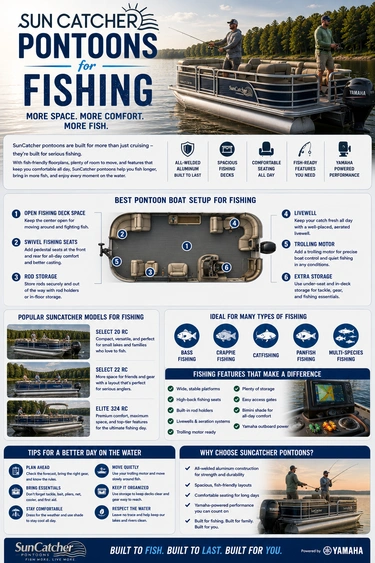
The best pontoon boat setup for fishing starts with one goal: make the boat easy to fish from without losing the comfort, space, and family-friendly feel that makes pontoons so popular.
A good fishing pontoon should feel organized when the rods, tackle, coolers, passengers, life jackets, bait, towels, electronics, dock lines, and anchor are all on board. It should give anglers room to cast, troll, drift, anchor, manage rods, use bait, access the livewell, and land fish safely. It should also give family members and guests a comfortable place to sit, move, relax, and enjoy the water.
For shoppers in Virginia, Pennsylvania, Maryland, West Virginia, and nearby areas, MotoMember can help compare SunCatcher pontoon boats, Yamaha-powered packages, trailers, rod holders, electronics, trolling motor planning, accessories, financing, trade-ins, and service support. MotoMember’s inventory has included SunCatcher pontoon models such as the Select 18F, though current availability, equipment, pricing, and location can change.
Quick Answer: What Is the Best Pontoon Fishing Setup?
The best pontoon boat setup for fishing usually includes a fishing-friendly layout, dedicated fishing seats, well-placed rod holders, livewell or baitwell access, electronics, smart storage, battery access, trolling motor planning, clear walkways, shade, safety gear, and a trailer that fits your tow and storage plan.
A strong setup should support the way you actually fish. Crappie anglers may prioritize rod holders, seating, electronics, and livewell access. Catfish anglers may want open deck space, strong rod holders, bait storage, anchor control, and easy-clean surfaces. Bass anglers may want bow fishing space, trolling motor compatibility, tackle storage, and electronics visibility. Family anglers may need all of that plus seating, shade, safe boarding, and room for kids or guests.
SunCatcher describes its pontoon lineup around cruising, fishing, entertaining, family comfort, Yamaha power, and multiple layouts, which is exactly the combination many fishing pontoon buyers are trying to build around.
Start With the Right Layout
A pontoon’s layout matters more than almost any single accessory.
A fishing pontoon should have clear zones. The fishing zone gives anglers a place to cast, watch rods, access bait, and land fish. The passenger zone gives family and guests seating, shade, storage, and comfort. The movement zone keeps walkways clear so people can move safely without stepping over rods, tackle, coolers, bags, or life jackets.
A bow fishing setup can work well for casting, casual bass fishing, crappie, and shoreline fishing. A stern fishing setup can be useful for trolling, catfish, panfish, and anchored fishing. A dual-station layout can work well when multiple anglers fish at the same time.
MotoMember’s SunCatcher Select 18F listing describes a compact fishing pontoon with practical fishing features, Yamaha power, trailer convenience, comfortable seating, and a manageable 18-foot package. Current details should always be confirmed on the specific unit before choosing a boat.
Add Fishing Seats Where They Actually Help
Fishing seats should be placed where anglers can use them naturally.
A bow fishing seat can help when casting toward docks, coves, shorelines, weed edges, or brush. A stern fishing seat can help when trolling, watching bait rods, drifting, or catfishing. Corner fishing seats can work well when two anglers want separation.
Before choosing a setup, sit in each fishing position and picture the boat loaded. Can you cast safely? Can another person walk past you? Can you reach tackle? Can you use the livewell? Are passengers out of the casting zone?
The best pontoon fishing seat is not simply comfortable. It is comfortable, useful, and placed where it supports the way you fish.
Use Rod Holders the Right Way
Rod holders are one of the most important parts of a pontoon fishing setup.
They are especially useful for trolling, crappie, catfish, panfish, live bait, and multi-rod fishing. But placement matters more than quantity. A rod holder should not block a gate, walkway, ladder, livewell lid, storage compartment, or lounge seat.
Crappie anglers may want multiple holders near the fishing seats. Catfish anglers may need stronger holders positioned for heavier rods. Trolling anglers need spacing that helps keep lines separated. Casual family anglers may only need a few well-placed holders.
A good setup keeps rods secure and visible while keeping the deck safe for passengers.
Plan Rod Storage Before the Deck Gets Crowded
Rod holders are for rods in use. Rod storage is for rods between spots, during cruising, while trailering, or when passengers are moving around.
This is especially important on a pontoon because families and guests often move through the boat more than they would in a traditional fishing boat. Loose rods on the deck can get stepped on, tangled, or damaged.
Before buying or accessorizing, count how many rods you normally bring. Then decide where each rod goes when it is not being fished. If the only answer is “on the floor,” the setup needs more planning.
Choose Livewell or Baitwell Access Carefully
A livewell or baitwell can make a fishing pontoon much more practical, especially for crappie, panfish, bait fishing, and catfish trips.
The important detail is access. A livewell should be easy to reach from the fishing area without forcing passengers to move or making an angler step over rods and tackle. If the livewell lid opens into a main walkway, it may become frustrating during a real fishing day.
Open the livewell before choosing a boat. Picture the pontoon with rods out, kids seated, coolers on board, towels under seats, and tackle bags open. If the livewell still feels easy to use, the layout is on the right track.
Set Up Electronics for How You Fish
Electronics can make a pontoon more useful for fishing, especially on lakes and reservoirs. A fishfinder or GPS can help with depth, structure, channels, brush piles, points, ledges, navigation, and safe route planning.
The best electronics placement depends on who needs the screen. A helm display helps the captain while running or navigating. An angler fishing from the bow or stern may need a screen positioned closer to the fishing area.
SunCatcher’s Select Series features page lists Yamaha gauges, throttle, electronics panel features, rocker switches, and Garmin equipment for Select models, but buyers should always verify exact equipment by model, year, trim, and listing.
Ask about mounting space, wiring access, battery capacity, charger placement, and transducer options before adding electronics. Planning early can prevent clutter later.
Think Through Trolling Motor Compatibility
A trolling motor can make a pontoon much more fishable for shorelines, docks, coves, points, brush piles, and slower presentations.
A pontoon can be set up for trolling motor use, but it needs planning. Consider mount location, battery placement, charging access, wiring routes, deck space, and how the operator will control the boat while fishing.
A pontoon may not feel as precise as a dedicated bass boat or smaller aluminum fishing boat in tight cover or wind. But for many lake and reservoir anglers, a properly planned trolling motor setup can make a fishing pontoon much more versatile.
Ask the MotoMember team about accessory installation and battery planning before deciding on a specific setup.
Build Storage Around Real Gear
Storage is what keeps a pontoon fishing setup from becoming messy.
Anglers need room for tackle trays, rods, pliers, nets, bait, tools, rain gear, anchors, dock lines, batteries, chargers, and cleaning supplies. Families need room for towels, snacks, sunscreen, bags, extra clothes, kids’ items, and life jackets.
Under-seat storage can be very useful because it keeps gear out of walkways. Storage near fishing stations helps anglers work efficiently. Dry storage can help protect phones, licenses, wallets, and extra layers.
Safety gear storage matters too. BoatUS explains that recreational boats must carry Coast Guard-approved personal flotation devices in good, serviceable condition and sized for the intended users, with wearable PFDs readily accessible.
Keep Walkways Clear and Safe
A pontoon can feel stable, but hooks, rods, loose line, wet flooring, bait containers, coolers, and open hatches can still create hazards.
A good fishing setup keeps traffic paths open from the helm to seating, gates, fishing stations, storage, and boarding areas. Passengers should not have to step over rods or tackle to sit down. Anglers should not have to climb around coolers to reach the livewell.
The U.S. Coast Guard states that recreational vessels must have a U.S. Coast Guard-approved wearable PFD for each person onboard, and it emphasizes that the best life jacket is the one people will wear.
For family fishing, the setup should make life jackets easy to reach and easy to use.
Add Shade Without Blocking Fishing
Shade can make longer fishing days much more enjoyable.
A bimini or shade system can help kids, guests, and older passengers stay comfortable on hot lake and reservoir days. It also gives anglers a place to rest when the bite slows.
The best shade setup should work with the fishing layout. It should not block every casting angle, interfere with rod holders, or make it hard to land fish. Ask how the shade deploys, how easy it is to manage, and whether it covers the main seating area.
For many families, shade is not a luxury. It is one of the features that makes the boat usable for more of the day.
Match the Setup to Your Fishing Style
Different anglers need different pontoon setups.
Crappie and Panfish Setup
For crappie and panfish, prioritize comfortable fishing seats, rod holders, livewell access, electronics, open deck space, and room for multiple anglers.
These trips often involve slower presentations, live bait, brush piles, docks, bridge areas, and light tackle. A pontoon works well because everyone can spread out and fish comfortably.
Catfish Setup
For catfish, prioritize stronger rod holders, bait access, anchor storage, open deck space, easy-clean flooring, a landing net location, lighting options, and comfortable seating for longer sessions.
Catfish gear can take up more space than expected, so keep the deck organized and avoid blocking walkways with coolers or tackle bags.
Bass Setup
For bass fishing, prioritize bow fishing space, rod storage, tackle access, electronics visibility, and trolling motor planning.
A pontoon can work well for casual bass fishing around shorelines, coves, points, weed edges, and docks. For highly technical bass fishing in tight cover, a traditional aluminum fishing boat may still be more efficient.
Family Fishing Setup
For family fishing, prioritize seating, shade, safe movement, accessible life jackets, storage, easy boarding, cupholders, and separation between fishing gear and passenger areas.
A family-friendly setup should let one person fish while others relax without feeling crowded or unsafe.
Do Not Forget the Trailer and Tow Setup
A pontoon fishing setup has to work on land too.
Before choosing a boat, think about your tow vehicle, driveway, storage facility, ramp access, marina slip, and comfort backing a trailer. The full boat-and-trailer package matters more than pontoon length alone.
Ask about trailer fit, overall storage length, guide posts, spare tire placement, motor position, and whether the setup works for solo launching. A pontoon that is great on the water but stressful at the ramp may not get used as often as planned.
Service and Accessory Support Matter
A fishing pontoon setup is not always finished on day one. You may eventually add rod holders, electronics, batteries, chargers, a trolling motor, lighting, covers, storage solutions, or seasonal upgrades.
MotoMember’s service page lists routine maintenance and inspections, oil, fluid, and filter changes, battery service, accessory installation, pickup and delivery, wash/detail, and seasonal prep.
That support matters because a great fishing setup should be easy to maintain, improve, and enjoy season after season.
New vs. Used Pontoon Fishing Setups
New and used pontoons can both make sense for fishing.
A new pontoon may appeal to buyers who want a clean ownership history, current layouts, dealer guidance, and a setup planned around their fishing style from the start. MotoMember’s SunCatcher pontoon resources note that availability, pricing, equipment, and location can change, so shoppers should verify live inventory before making plans around a specific unit.
A used pontoon may help manage upfront cost or include valuable accessories such as rod holders, electronics, a cover, upgraded seating, trailer upgrades, or a trolling motor. Used buyers should inspect the pontoons, deck, flooring, seats, fencing, wiring, batteries, motor, trailer, livewell, electronics, title paperwork, and service history.
Whether new or used, the layout matters most. A pontoon with a weak fishing setup may disappoint even if it looks comfortable.
MotoMember Expert Tip
Set up a pontoon by picturing a real fishing day, not an empty deck.
Imagine rods in holders, tackle near the fishing seats, a cooler under a bench, kids moving around, passengers relaxing, life jackets accessible, electronics powered on, bait ready, and a net within reach. Then ask whether the boat still feels organized.
If rods block the gate, the livewell is hard to reach, or the trolling motor battery plan feels awkward, the setup needs adjustment. If anglers can fish comfortably while passengers stay relaxed and safe, you are getting close to the right pontoon fishing setup.
Our team can help you compare SunCatcher pontoon layouts, Yamaha-powered packages, trailers, rod holders, electronics planning, trolling motor compatibility, battery service, accessory installation, financing, trade-ins, and long-term service needs.
Call to Action
Your fishing pontoon headquarters starts at MotoMember.
Explore current MotoMember marine inventory, compare SunCatcher pontoon models, ask about Yamaha-powered packages, and talk with the team about rod holders, fishing seats, livewell access, electronics, trolling motor planning, trailers, batteries, accessories, financing, trade-ins, and service support.
Current availability, pricing, model year, equipment, and promotions can vary, so check MotoMember inventory or contact the team before planning around a specific pontoon.
Large selection. Straightforward shopping. Real powersports and marine expertise.
Stop dreaming. Start riding—and fishing—with MotoMember.
Conclusion
The best pontoon boat setup for fishing combines comfort with function.
Start with the right layout. Add fishing seats where anglers can actually use them. Place rod holders carefully. Plan rod storage before the deck gets crowded. Make the livewell easy to reach. Put electronics where they help. Think through trolling motor compatibility, battery access, shade, storage, safety gear, trailer fit, and long-term service support.
For crappie, panfish, catfish, casual bass, trolling, and family lake days, a well-set-up pontoon can be an excellent fishing platform. It gives anglers room to fish while giving passengers room to enjoy the trip.
For shoppers in VA, PA, MD, WV, and nearby areas, MotoMember can help compare pontoon setups side by side so you choose a boat that fits your fishing style, family needs, water, towing plan, and ownership goals.
FAQ
What is the best pontoon setup for fishing?
The best setup usually includes fishing seats, rod holders, rod storage, livewell or baitwell access, electronics, trolling motor planning, battery access, smart storage, shade, safe walkways, and a trailer that fits your towing and storage needs.
Can you add rod holders to a pontoon boat?
Yes, many pontoon owners add or adjust rod holders, but placement matters. Rod holders should support your fishing style without blocking gates, walkways, seating, storage lids, or boarding areas.
Does a fishing pontoon need a trolling motor?
Not always. A trolling motor can help with shoreline fishing, coves, docks, brush, and slow presentations, but the right choice depends on your water, fishing style, battery setup, wiring, and layout.
What electronics should a fishing pontoon have?
Many anglers consider a fishfinder, GPS, depth display, sonar, or mapping system. The best setup depends on where you fish and whether the screen needs to be visible from the helm, bow, stern, or fishing station.
Can MotoMember help set up a pontoon for fishing?
Yes. MotoMember can help shoppers compare SunCatcher pontoons, Yamaha-powered packages, trailers, rod holders, electronics, trolling motor planning, battery service, accessory installation, financing, trade-ins, and service support across VA, PA, MD, WV, and nearby areas.