
Best Fishing Boat for Virginia Fishing Trips

Best Fishing Boat for Virginia Fishing Trips
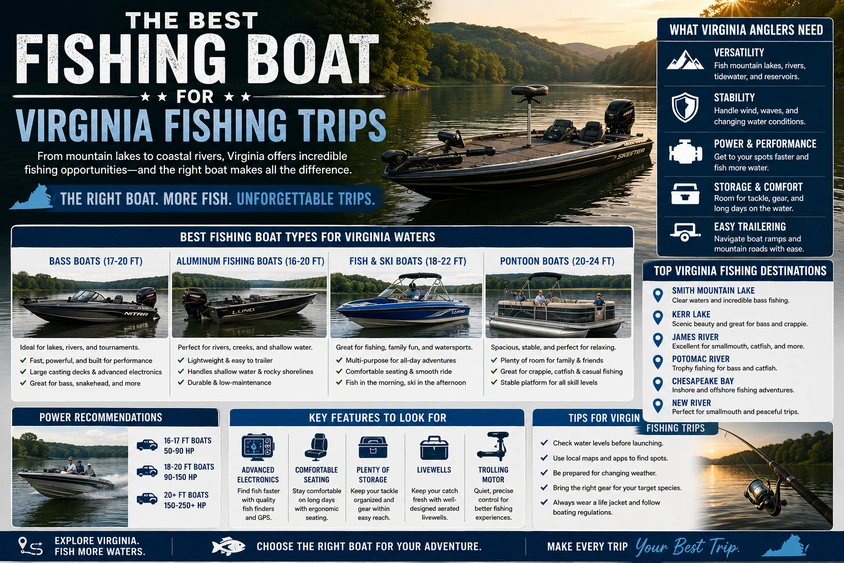
The best fishing boat for Virginia fishing trips depends on where you launch, what you fish for, how shallow you run, and whether your boat needs to support family recreation along with serious angling.
Virginia gives anglers plenty of variety. One trip may mean bass fishing on a larger lake. Another may mean working a shallow river, exploring a quiet cove, fishing a small reservoir, or bringing family along for a relaxed weekend on the water. That variety makes boat choice important.
For many Virginia anglers, the best fishing boat is an aluminum jon boat, modified-V fishing boat, deep-V multi-species boat, bay-style boat, or fishing pontoon. Each one solves a different problem.
MotoMember helps shoppers across Virginia, Pennsylvania, Maryland, West Virginia, and nearby areas compare fishing boats, G3 Boats, SunCatcher pontoons, trailers, outboard packages, accessories, financing, trade-ins, parts, and service support. MotoMember lists locations in Purcellville, VA; Manassas, VA; and Chambersburg, PA.
Start With the Virginia Water You Fish Most
Before choosing a boat, start with your real fishing routine.
Do you fish small lakes, larger reservoirs, rivers, tidal water, creeks, coves, ponds, or backwaters? Do you target bass, crappie, catfish, panfish, perch, or multiple species? Do you fish alone, with one partner, or with family?
A boat for shallow river fishing should not be chosen the same way as a boat for open-water family trips. A boat for small protected water should not be chosen the same way as a boat for longer runs on bigger lakes.
For Virginia fishing trips, the best boat should fit your top three use cases. If most of your trips are bass fishing and crappie fishing on freshwater, a modified-V aluminum fishing boat may be a strong fit. If you regularly run shallow rivers, a jon boat or tunnel/jet setup may deserve attention. If family comfort matters, a deep-V fishing boat or pontoon may be the better choice.
Best Overall: Aluminum Multi-Species Fishing Boat
For many Virginia anglers, an aluminum multi-species fishing boat is the best overall choice.
This style gives buyers a practical mix of casting space, storage, seating, trolling motor compatibility, electronics support, livewell access, and manageable towing. It can work for bass, crappie, catfish, panfish, and relaxed family fishing.
G3’s Sportsman Series is a strong example of this category. G3 describes the Sportsman Series as all-aluminum fishing boats with modified-V hulls for bass, crappie, catfish, and other species.
Why It Works for Virginia
Virginia anglers often fish more than one kind of water. A modified-V aluminum fishing boat can feel practical on smaller lakes and protected coves while offering more fishing features than a basic utility boat.
This category may be ideal if you want casting decks, rod storage, tackle organization, trolling motor support, electronics planning, and enough comfort for longer days.
G3’s broader lineup also includes Sportsman, Angler V, Bay, Gator Tough Jon, and SunCatcher pontoon categories, which gives buyers several ways to match the boat to the trip.
What to Compare
Look closely at deck space, storage, seat placement, electronics mounting, trolling motor fitment, battery access, livewell layout, and trailer fit.
Step into the boat and picture a real Virginia fishing day. Add rods, tackle, life jackets, cooler, anchor, net, electronics, batteries, and a fishing partner. The right layout should still feel organized and easy to move around in.
Best for Virginia Rivers: Aluminum Jon Boat
For many Virginia rivers, creeks, ponds, coves, and backwaters, an aluminum jon boat is the best starting point.
Jon boats are practical, open, easy to clean, and useful for anglers who want simple fishing access without unnecessary complexity. They can work well for bass, catfish, crappie, panfish, hunting, utility use, and quiet-water exploring.
G3 describes its Gator Tough Jon Series as all-welded aluminum jon boats built for fishing, hunting, utility use, and shallow-water confidence.
Why Jon Boats Work
A jon boat can make sense if your fishing trips include shallow water, current seams, laydowns, muddy banks, rocky areas, grass edges, or smaller ramps.
The open layout also works well for anglers who carry anchors, ropes, bait buckets, coolers, catfish rods, crappie rods, tackle bags, hunting gear, or utility equipment.
For first-time buyers and weekend anglers, a jon boat can also feel less intimidating. It may be easier to tow, launch, clean, and store than a larger fishing boat.
Tradeoffs to Consider
A jon boat may not offer the same built-in storage, seating comfort, wind protection, or ride quality as a more finished fishing boat.
That does not make it the wrong choice. It simply means the boat should match your expectations. If most of your Virginia trips are simple, shallow, and close to home, a jon boat can be a very practical answer.
Best for Skinny Water: Tunnel or Jet Jon Boat
Some Virginia anglers need more shallow-water capability than a standard prop setup provides.
If you regularly fish shallow rocky rivers, skinny backwaters, gravel bars, low-water routes, or areas with submerged obstacles, compare tunnel and jet jon options. G3 lists Tunnel and Jet Jon models as center-console boat, motor, and trailer packages in 20-foot to 17-foot lengths.
When This Setup Makes Sense
A tunnel or jet-style setup may be useful if shallow access is part of nearly every trip. This can matter for river bass anglers, catfish anglers, waterfowl hunters, and buyers who regularly fish hard-to-reach water.
These setups should be chosen based on real conditions, not just the idea of running shallow. Think about bottom type, current, water depth, passenger count, gear load, maintenance expectations, and how often you fish outside skinny water.
Tradeoffs to Consider
Not every Virginia angler needs a tunnel or jet boat.
If you mostly fish small lakes, ponds, coves, and deeper freshwater, a standard jon boat or modified-V aluminum fishing boat may be more practical. Before choosing, talk with MotoMember about your normal ramps, water depth, fishing style, and ownership goals.
Best for Larger Lakes: Deep-V Fishing Boat
If you fish larger lakes, reservoirs, or open freshwater where wind and boat traffic matter, a deep-V fishing boat may be the better fit.
G3 describes its Angler V Series as rugged deep-V models built for big fish and family fun.
Why Deep-V Boats Work
A deep-V layout can offer more comfort and confidence when conditions change. That can matter when you bring family, fish longer days, or make longer runs.
Virginia has larger fishing destinations where comfort, storage, and passenger confidence can matter. Virginia DWR notes that Smith Mountain Lake has numerous boat ramps and that black bass are among the most sought-after species there.
Tradeoffs to Consider
A deep-V boat may be more than you need for tight creeks, shallow rivers, small ponds, or narrow backwaters. It may also require more storage space, towing confidence, and ramp planning.
Choose this direction if your normal water justifies the added size and comfort.
Best for Tidal and Open Deck Fishing: Bay-Style Boat
A bay-style boat may make sense for Virginia anglers who want open deck space, center-console visibility, and flexibility across different fishing styles.
G3 describes its Bay Series as featuring wide, deep hulls, handling, performance, and fishing features expected from G3 and Yamaha.
Why Bay Boats Work
Bay-style boats can appeal to anglers who want room to move, cast, work around the console, and fish from different parts of the boat.
This style may be worth comparing if your fishing includes tidal rivers, protected open water, mixed species, and trips where visibility from the helm matters.
Tradeoffs to Consider
A bay boat may be more boat than you need for small freshwater lakes and ponds. It may also be less lounge-friendly than a pontoon and less simple than a jon boat.
Ask MotoMember how the exact boat fits your water, trailer plan, storage space, passenger needs, and long-term service plan.
Best for Family Fishing: Fishing Pontoon
For many Virginia families, the best fishing boat may be a fishing pontoon.
A pontoon can be ideal if your boating life includes casual fishing, cruising, kids, guests, coolers, snacks, shade, and relaxed days on calm water. G3 lists SunCatcher pontoons as part of its lineup, including Elite, Fusion, and Select model families.
Why Pontoons Work
Pontoons offer seating, stability, and room to move. That matters when not everyone onboard is a serious angler.
A fishing pontoon can be a smart choice for calm freshwater, protected coves, family lake days, and relaxed panfish, crappie, or perch fishing.
Tradeoffs to Consider
A pontoon may not be ideal for shallow rocky water, tight river channels, heavy current, or anglers who need precise trolling motor control around cover.
Choose this direction if comfort and recreation matter as much as fishing efficiency.
Match the Boat to Your Target Species
Different fish create different boat priorities.
Bass Fishing
Bass anglers should focus on casting decks, trolling motor setup, rod storage, tackle organization, electronics placement, and stability.
A modified-V aluminum fishing boat may be a strong fit for many Virginia bass anglers. A jon boat may be better for shallow rivers, ponds, and backwaters.
Crappie and Panfish
Crappie and panfish anglers should compare comfortable seating, rod management, electronics visibility, livewell access, bait storage, and quiet boat control.
A multi-species aluminum fishing boat is often a good fit. A jon boat can work well for small lakes and protected coves.
Catfishing
Catfish anglers should prioritize open cockpit space, stern access, rod holder placement, bait storage, cooler room, anchor storage, stability, and night-fishing lighting.
A jon boat or open aluminum fishing boat may be the best direction. Bigger-water catfish anglers may want a deeper, more comfortable layout.
Family Recreation
Families should focus on seating, storage, shade, boarding access, safety gear, and easy cleanup.
A deep-V fishing boat or SunCatcher pontoon may fit better than a fish-first layout if passengers matter as much as the catch.
Virginia Boating Rules Buyers Should Know
Virginia boat buyers should plan for safety education, registration, titling, and required equipment before launching.
Virginia DWR says all PWC operators age 14 and older and all operators of motorboats with a 10 hp or greater engine need to take a boating safety course.
Virginia DWR also states that boat owners in Virginia must apply for a certificate of title at the same time they apply for registration.
For safety gear, Virginia DWR says there must be one wearable U.S. Coast Guard-approved life jacket for each person on the boat, and each life jacket should be in good, serviceable condition and properly fit the passenger.
Rules can change, and local waterways may have additional restrictions. Always check current Virginia DWR guidance before launching.
Trailer, Storage, and Ramp Fit Matter
Virginia fishing trips often depend on the trailer as much as the boat.
Some ramps are wide and easy. Others may be shallow, steep, crowded, narrow, gravel, or affected by seasonal water levels. A boat that is easy to tow and launch will get used more often.
Ask about trailer length, bunks, tires, lights, spare tire options, tie-downs, tongue weight, garage fit, driveway storage, and tow vehicle match.
Before buying, think about your most common launch. If your favorite ramp is tight or shallow, that should influence the boat and trailer you choose.
New vs. Used Fishing Boats for Virginia Anglers
A new fishing boat may make sense if you want current availability, dealer setup support, and a clean starting point for motor, trailer, trolling motor, electronics, batteries, charger, safety gear, and accessories.
A used fishing boat may be a smart buy if the condition, layout, motor, trailer, and price fit your needs.
When comparing used boats, inspect the hull, transom, motor, prop or jet components, trailer tires, lights, wiring, batteries, flooring, seats, steering, bilge pump, livewell, electronics, trolling motor, and service history.
MotoMember’s website includes new inventory, used inventory, service, parts, financing, trailers, outboard motors, and marine shopping resources for buyers comparing current options.
MotoMember Expert Tip
Do not buy a Virginia fishing boat based only on the biggest water you might visit.
Buy for the water you fish most.
If you mostly fish shallow rivers, coves, and backwaters, a jon boat may make sense. If you fish mixed freshwater, a modified-V aluminum fishing boat may be the better fit. If you fish bigger lakes or bring family often, compare deep-V boats and pontoons. If tidal versatility matters, ask about bay-style layouts.
Before visiting MotoMember, write down your top three fishing locations, target species, ramp conditions, passenger count, gear list, tow vehicle, storage plan, and whether you want new or used.
That gives the MotoMember team a practical way to compare boats around your real Virginia fishing trips.
Why Shop Fishing Boats at MotoMember
MotoMember gives Virginia anglers a regional dealership resource for comparing fishing boats, G3 Boats, SunCatcher pontoons, trailers, outboard packages, accessories, financing, trade-ins, parts, and service support.
That matters because the best fishing boat is not just a hull. It is the full setup: motor, trailer, trolling motor, electronics, batteries, charger, rod storage, anchor gear, safety equipment, cover, and long-term service plan.
For shoppers in Virginia and nearby areas, MotoMember’s Purcellville and Manassas locations are especially convenient, while Chambersburg supports buyers across the broader Mid-Atlantic region.
Large selection. Straightforward shopping. Real powersports and marine expertise.
Your fishing boat search starts at MotoMember.
Call to Action
Ready to compare the best fishing boat for Virginia fishing trips?
Contact MotoMember or visit the team in Purcellville, Manassas, or Chambersburg to compare current fishing boat inventory, G3 Boats, Gator Tough Jon boats, Sportsman models, Angler V options, Bay-style boats, SunCatcher pontoons, trailers, outboard packages, accessories, financing, trade-ins, parts, and service support.
Tell the team how you fish: shallow rivers, small lakes, larger reservoirs, coves, backwaters, bass fishing, crappie fishing, catfishing, panfish trips, family cruising, or weekend recreation.
MotoMember can help you narrow the choices and find a fishing boat that fits your Virginia water, gear, passengers, tow vehicle, and ownership plan.
Stop dreaming. Start riding — and boating — with MotoMember.
Conclusion
The best fishing boat for Virginia fishing trips depends on your water, fishing style, passengers, and ownership needs.
For many buyers, an aluminum multi-species fishing boat offers the best balance of fishability, comfort, storage, and versatility. A jon boat may be better for shallow water, rivers, creeks, backwaters, ponds, and protected coves. A tunnel or jet jon may fit skinny-water anglers. A deep-V boat may be smarter for larger lakes and family use. A pontoon may be the right answer when relaxed recreation is the priority.
Before choosing, compare hull shape, motor setup, shallow-water needs, deck space, stability, storage, rod management, trailer fit, ramp access, safety equipment, Virginia boating requirements, service support, and real-world convenience.
For Virginia anglers and families, MotoMember can help make the buying process clearer, easier, and more confidence-building.
FAQ
What is the best type of fishing boat for Virginia anglers?
For many Virginia anglers, the best type is an aluminum multi-species fishing boat because it balances fishing features, comfort, storage, and freshwater versatility. Jon boats, deep-V boats, bay-style boats, tunnel/jet boats, and pontoons may be better depending on your water and use.
Is a jon boat good for Virginia fishing?
Yes. A jon boat can be a strong choice for Virginia rivers, creeks, ponds, shallow backwaters, protected coves, and small lakes. Compare hull width, motor setup, deck space, stability, trailer fit, and storage before choosing.
Do Virginia anglers need a tunnel or jet boat?
Not always. A tunnel or jet setup may make sense for shallow, rocky, or current-driven rivers. Many anglers are better served by a standard jon boat or modified-V aluminum fishing boat. Match the setup to the water you fish most often.
What boating rule should Virginia buyers know?
Virginia DWR says operators of motorboats with a 10 hp or greater engine need to take a boating safety course. Virginia also requires one wearable U.S. Coast Guard-approved life jacket for each person on the boat.
Can MotoMember help me choose a fishing boat for Virginia?
Yes. MotoMember can help shoppers compare current fishing boat inventory, G3 Boats, SunCatcher pontoons, trailers, outboard packages, accessories, financing, trade-ins, parts, and service support. Current availability can vary, so contact the team for details.