
Best Electronics for G3 Gator Tough

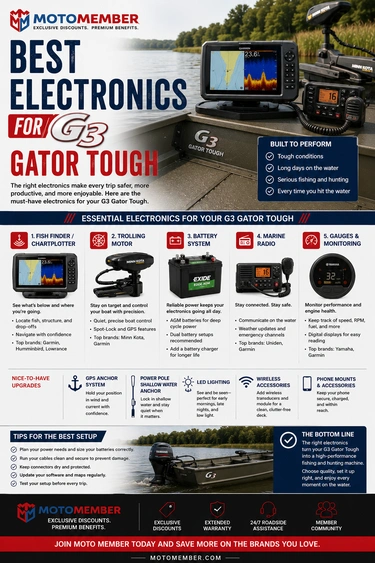
Best Electronics for a G3 Gator Tough Jon Boat
The best electronics for a G3 Gator Tough jon boat depend on how you fish, where you run, and how much technology you actually want at the helm and bow.
For many anglers, the best starting setup is simple: a quality fish finder with GPS at the console, a bow-mounted trolling motor, clean battery wiring, a charging plan, and enough lighting to fish safely early, late, or after dark. From there, you can step up to side imaging, down imaging, bow electronics, GPS mapping, networked units, and advanced trolling motor integration.
G3 makes electronics planning easier because several Gator Tough models offer space for optional electronics and factory-listed Humminbird and Minn Kota options. The G3 18 SC and 20 SC, for example, list Humminbird console and bow electronics options along with Minn Kota trolling motor choices.
For shoppers in Virginia, Pennsylvania, Maryland, West Virginia, and nearby areas, MotoMember can help compare G3 models, electronics packages, Yamaha power, trolling motors, batteries, chargers, trailers, accessories, financing, trade-ins, service, and long-term ownership support.
Quick Answer: Best Electronics for a G3 Jon Boat
For most G3 Gator Tough owners, the best electronics setup is the one that matches the boat size and fishing style.
| Fishing Need | Electronics Setup to Consider |
|---|---|
| Simple pond and small-lake fishing | Basic fish finder, 12V power, simple bow trolling motor |
| Bass fishing | Console GPS/sonar, bow fish finder, strong trolling motor |
| Crappie fishing | Bow electronics, GPS, trolling motor control, clear screen visibility |
| Catfishing | Console sonar/GPS, night lighting, battery capacity, anchor awareness |
| River fishing | GPS, depth awareness, rugged wiring, secure mounts, trolling motor control |
| Serious multi-species use | Console and bow displays, side/down imaging, onboard charger |
| Shallow-water Jet Jon use | Secure wiring, GPS mapping, optional trolling motor, clear console layout |
The best setup is not always the most expensive setup. It is the setup that helps you fish cleaner, navigate safer, and keep the boat organized.
Start With the Boat Layout
Before choosing electronics, look at the boat layout.
A center-console G3 jon boat usually gives you a natural place to mount a display near the helm. The G3 18 CC includes a center console with Yamaha throttle, switch panel, cupholder, space for optional electronics, and battery storage underneath. It also includes upright rod holders and side rod storage, which helps keep the helm area organized.
A side-console G3 jon boat keeps more floor space open while still giving you a console for electronics, gauges, and switches. The G3 20 SC is designed with open casting room, under-seat storage, side rod holders, bow storage, livewell utility, and Humminbird electronics options.
A Tunnel or Jet Jon may need electronics mounted more carefully because river use can be rougher. G3’s 18 CCJ adds an optional trolling motor path for precise, quiet control while fishing skinny water.
Best First Upgrade: A Fish Finder With GPS
For most anglers, the first electronics upgrade should be a fish finder with GPS.
A basic fish finder helps you read depth, structure, bottom changes, fish activity, drop-offs, brush, ledges, channels, and bait. GPS adds navigation value by helping you mark spots, return to productive areas, and understand where you are on unfamiliar water.
For simple setups, a Humminbird PiranhaMAX-style unit may be enough. Humminbird says the PiranhaMAX 4 uses Dual Beam Sonar, with narrow and wide beam options to help identify fish, structure, and contours.
For anglers who want more capability, the Humminbird HELIX 5 CHIRP DI GPS G3 adds Down Imaging, Dual Spectrum CHIRP sonar, internal GPS, Humminbird Basemap, and AutoChart Live.
Console Electronics: What to Look For
A console fish finder is useful for running, idling, navigation, marking structure, and checking depth.
For a G3 17 CC, 18 CC, 20 CC, 18 SC, or 20 SC, console electronics should be easy to see from the driver’s position without blocking controls, switches, steering, or visibility. G3’s 20 CC center console is designed to provide clear visibility, easy steering, electronics mounting space, and controls within reach.
A console display is especially useful for:
Finding creek channels.
Marking brush piles.
Watching depth while running.
Navigating larger coves or river sections.
Returning to waypoints.
Checking water temperature.
Tracking safe routes.
For casual anglers, one console-mounted display may be enough. For serious bass, crappie, or multi-species anglers, a second bow-mounted display may be worth considering.
Bow Electronics: When They Matter
Bow electronics matter most when you fish from the front deck.
Bass anglers use bow displays while casting shorelines, docks, grass, laydowns, rock, and shallow cover. Crappie anglers use bow electronics to stay on brush piles, standing timber, bridge pilings, suspended schools, and trolling paths. Multi-species anglers use them to fish vertically or control the boat around structure.
G3’s 18 SC and 20 SC pages list Humminbird bow-mount electronics options, which makes those side-console layouts especially attractive for crappie, bass, and multi-species anglers who want electronics where they actually fish.
Bow electronics should be mounted where they are visible while standing, seated, or operating the trolling motor. Do not mount the screen where it blocks the trolling motor pedal, creates a tripping point, or interferes with rod tips.
Side Imaging and Down Imaging
Side imaging and down imaging can be extremely useful on a jon boat.
Down Imaging helps you see structure directly below the boat. That can be helpful for brush piles, bridge pilings, timber, rock, ledges, and depth changes.
Side Imaging helps you scan out to the sides while idling or moving slowly. That can help you locate cover without driving directly over it.
Humminbird says the HELIX 7 SI GPS G4 includes CHIRP Side Imaging, CHIRP Down Imaging, Dual Spectrum CHIRP sonar, AutoChart Live, internal GPS, and Humminbird Basemap.
For many G3 owners, side imaging is most valuable on larger lakes, reservoirs, river pools, and unfamiliar water. For small ponds or short creek trips, a simpler sonar/GPS unit may be enough.
Best Electronics for Bass Fishing
Bass anglers usually benefit from a two-display setup if the budget allows.
A console display helps with navigation, mapping, and scanning. A bow display helps when casting, working cover, or using the trolling motor. A strong trolling motor and clean battery setup are just as important as the display itself.
For a G3 18 CC or 20 CC, electronics should support casting, waypoint marking, shoreline fishing, and structure fishing. The 18 CC already provides space for optional electronics and battery storage under the console, while the 20 CC adds a larger platform with a wide bow deck and room for an optional trolling motor.
A good bass setup may include:
Console fish finder with GPS.
Bow fish finder.
Bow-mounted trolling motor.
Mapping.
Side imaging or down imaging.
Clean rod and cable management.
Best Electronics for Crappie Fishing
Crappie anglers should prioritize bow visibility, slow-speed control, and mapping.
A bow display can be more important than a console display if you spend most of the day fishing from the front deck. Spider-rigging, vertical jigging, long-line trolling, and brush-pile fishing all benefit from electronics that are easy to see while controlling the boat.
A HELIX 7-style unit can be a strong middle ground because a 7-inch display is easier to read than many smaller screens, and Humminbird lists HELIX 7 models with internal GPS, mapping, side imaging, down imaging, and split-screen viewing capability depending on version.
For crappie anglers, do not overlook power. Long days on the trolling motor and electronics can drain batteries faster than expected.
Best Electronics for Catfishing
Catfish anglers often need a different setup than bass or crappie anglers.
A console fish finder with GPS may be more important than a bow display. Catfish anglers often use electronics to find channel edges, holes, current seams, ledges, flats, bait, and deeper structure before anchoring or drifting.
Night fishing also changes the electronics plan. You may need clean navigation lights, console lighting, battery confidence, phone charging, and organized wiring. G3’s 20 SC includes a console courtesy light for low-light situations, which is useful for anglers who fish early, late, or after dark.
For catfishing, the best electronics are not just about sonar. They are about staying organized and safe during long, gear-heavy trips.
Best Electronics for River Fishing
River anglers should prioritize reliability, secure mounting, GPS awareness, and simple operation.
A river setup may include a console display with GPS, a bow or console sonar unit, a trolling motor for quiet positioning, and wiring that can handle vibration, shallow-water impacts, and frequent loading.
G3’s 20 CCJ is built for shallow water, river running, backwater fishing, and adventure beyond the main channel. It also includes rod storage, a durable aluminum console, Yamaha controls, and a divided stern livewell, making it a serious platform for river anglers who need electronics to support more demanding water.
For shallow rivers, do not rely only on electronics. Learn your water, watch levels, read current, and avoid running unfamiliar shallow routes at speed.
Trolling Motor Integration
A trolling motor is part of the electronics plan.
For many anglers, boat control catches more fish than a bigger screen. A trolling motor helps you hold position, work a shoreline, stay on a brush pile, control a drift, or quietly fish shallow cover.
G3’s 18 SC and 20 SC list Minn Kota options, including 70- and 80-pound-class trolling motor choices, along with Humminbird electronics options.
For simple fishing, a basic trolling motor may be enough. For serious bass or crappie fishing, talk with MotoMember about thrust, voltage, shaft length, battery placement, onboard charging, and whether advanced positioning features make sense.
Battery and Charging Setup
Electronics are only as good as the power behind them.
Fish finders, GPS displays, trolling motors, livewell pumps, bilge pumps, courtesy lights, phone chargers, and accessory switches all draw power. If you add electronics without planning batteries, you may end up with weak performance or frustrating electrical issues.
A clean setup should include:
Secure battery mounting.
Marine-grade wiring.
Correct circuit protection.
Accessible charging.
Protected terminals.
Good cable routing.
Enough battery capacity for your normal fishing day.
Avoid wiring accessories randomly over time. A planned system is easier to service and safer to use.
Transducer Placement
Transducer placement can make or break electronics performance.
A fish finder may be excellent, but a poor transducer installation can lead to weak readings, interference, poor imaging, or unreliable bottom tracking. Transducer location depends on hull design, motor setup, trailer bunks, turbulence, side imaging needs, and whether the unit is used at idle, trolling speed, or running speed.
On G3 jon boats, transducer planning should happen before final rigging when possible. This is especially important on Jet Jon, Tunnel Jon, and shallow-water setups where hull shape, motor setup, and usage can affect performance.
MotoMember can help you think through transducer placement before the boat leaves the dealership.
Switches, Lighting, and Accessory Power
Electronics are not limited to fish finders.
A strong G3 jon boat setup may include courtesy lights, navigation lights, accessory switches, USB charging, 12V outlets, bilge pump access, livewell controls, and clean wiring runs. G3’s 18 CCJ DLX, for example, places master power and accessory switches on the console within easy reach.
Lighting is especially important for catfish anglers, crappie anglers, hunters who also fish, and anyone who launches before sunrise or returns after sunset.
Keep lighting useful, not excessive. You want enough light to move safely without glare, poor night vision, or wires scattered across the deck.
What About Advanced Electronics?
Advanced electronics can be valuable, but they are not necessary for every G3 owner.
Humminbird’s XPLORE series offers a Full-HD display with Cross Touch interface, MEGA Side Imaging+, MEGA Down Imaging+, and advanced sonar and chart detail depending on the model.
That kind of system may make sense for serious anglers who fish frequently, use multiple techniques, and want a more advanced display platform. It may be overkill for a first-time jon boat buyer who fishes small ponds, short creek trips, or casual weekend outings.
The smartest electronics setup is the one you will actually use.
Electronics by G3 Model Type
G3 Loose Jon
A Loose Jon is best for simple or custom setups. Start with a basic fish finder, battery, trolling motor, and clean wiring. Add more only after you know where you stand, sit, cast, and store gear.
G3 17 SC or 17 CC
A 17-foot Gator Tough is a great fit for a single console unit, basic bow trolling motor, and maybe a bow display if you fish seriously from the front deck. G3’s 17 CC console provides room for optional electronics.
G3 18 SC or 18 CC
An 18-foot Gator Tough is the sweet spot for many anglers. This is where a console display, bow trolling motor, and optional bow display start to make a lot of sense.
G3 20 SC or 20 CC
A 20-foot Gator Tough can justify more electronics because it has more deck space, more fishing room, and more capacity for anglers who spend long days on the water.
G3 Tunnel and Jet Jon Models
Tunnel and Jet Jon electronics should focus on navigation, depth awareness, secure mounting, and durable wiring. Optional trolling motor control can be especially useful once you reach shallow fishing areas.
MotoMember Expert Tip
Do not buy electronics before you map the boat.
Stand in the boat and picture your fishing day. Where do you run the boat? Where do you fish? Where does the trolling motor pedal go? Where will the screen be visible? Where do rods sit? Where will batteries be secured? Where will cables run?
Many shoppers ask, “What is the best fish finder?” The better question is: What electronics setup fits my G3 model, fishing style, battery space, and deck flow?
Our team can help you compare Humminbird options, Minn Kota trolling motors, chargers, wiring, mounts, and layout decisions before you commit.
Regional Buying Advice for VA, PA, MD, WV, and Nearby Areas
For anglers in Virginia, Pennsylvania, Maryland, West Virginia, and nearby areas, electronics needs can vary widely.
Small-lake anglers may only need simple sonar and GPS. Crappie anglers may want bow electronics and precise trolling motor control. Catfish anglers may need console sonar, GPS, lighting, and battery capacity for night trips. River anglers may prioritize secure mounting, GPS awareness, and reliable power.
MotoMember’s website lists marine, outboard motors, trailers, service and parts, maintenance and repairs, parts and accessories, and financing resources, which helps shoppers plan the full electronics and ownership picture.
Current availability can vary by season, location, model year, motor package, electronics option, trolling motor option, trailer setup, and accessories. Check MotoMember inventory or contact the team before planning around one exact configuration.
Safety Considerations
Electronics should support safety, not distract from it.
Know your water, keep your eyes up, and do not rely on a screen alone in shallow rivers, low light, fog, current, or unfamiliar areas. Keep navigation lights working, batteries charged, wires secured, and safety gear reachable.
Pennsylvania’s Fish and Boat Commission states that all boats must have a serviceable USCG-approved life jacket for each person, and boats 16 feet and over must have an immediately available USCG-approved throwable device onboard. Virginia DWR states that operators of motorboats with a 10 hp or greater engine need to take a boating safety course.
Before launching, inspect life jackets, lights, battery charge, wiring, bilge function, and accessory switches.
Call to Action
Your G3 Gator Tough Headquarters starts at MotoMember.
Explore current G3 availability, compare electronics-ready jon boat layouts, and talk with the MotoMember team about Humminbird fish finders, Minn Kota trolling motors, Yamaha power, batteries, chargers, mounts, wiring, lighting, trailers, accessories, financing, trade-ins, service, towing, and storage.
Large selection. Straightforward shopping. Real powersports and marine expertise.
Stop dreaming. Start riding—and boating—with MotoMember.
Conclusion
The best electronics for a G3 Gator Tough jon boat are the electronics that help you fish better without cluttering the boat.
Start with a fish finder and GPS that match your water. Add bow electronics if you fish from the front deck. Choose side imaging or down imaging when structure scanning matters. Plan the trolling motor, batteries, charger, wiring, transducer placement, lighting, and switches before drilling permanent holes.
For many anglers, a G3 18 SC, 18 CC, 20 SC, or 20 CC can support a strong electronics setup. A Loose Jon may be better for a simple custom build. A Tunnel or Jet Jon may need a more rugged shallow-water electronics plan.
For shoppers in VA, PA, MD, WV, and nearby areas, MotoMember can help build an electronics setup that fits your G3 jon boat, fishing style, budget, trailer, storage space, and season.
FAQ
What fish finder is best for a G3 jon boat?
For simple fishing, a basic Humminbird PiranhaMAX-style fish finder may be enough. For more serious fishing, a HELIX 5 or HELIX 7-style unit with GPS, Down Imaging, or Side Imaging may be a better fit. The right choice depends on your water, species, and mounting location.
Do I need electronics at the bow and console?
Not always. Casual anglers may only need a console display. Bass and crappie anglers who fish from the bow often benefit from a bow display because it is easier to see while casting, jigging, trolling, or controlling the trolling motor.
Is side imaging worth it on a jon boat?
Side imaging can be worth it if you fish lakes, reservoirs, river pools, brush piles, docks, ledges, or unfamiliar water. It may be less necessary for simple pond fishing or short shallow-water trips.
Can MotoMember help install electronics on a G3 jon boat?
Yes. MotoMember can help shoppers compare electronics, trolling motor options, battery placement, chargers, wiring, mounts, accessories, and service support. Current options and availability can vary by model year and location.
What electronics should I add first?
Start with a fish finder/GPS, then plan the trolling motor, battery setup, charger, wiring, and lighting. Add advanced displays or networked electronics only after you know how and where you fish most often.