
18-Foot vs 20-Foot Jon Boat: When Bigger Makes Sense

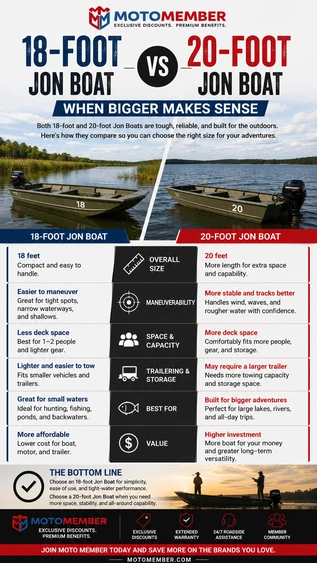
18-Foot vs 20-Foot Jon Boat: When Bigger Makes Sense
Choosing between an 18-foot vs 20-foot jon boat is about more than two extra feet of aluminum.
A 20-foot-class jon boat can give you more beam, more horsepower rating, more passenger capacity, more load capacity, more deck room, and more confidence when the boat is loaded with people, tackle, batteries, decoys, dog gear, coolers, tools, and safety equipment. But bigger also means more trailer, more storage space, more tow-vehicle planning, and more boat to handle at the ramp.
G3’s Gator Tough lineup makes this comparison especially useful because shoppers can compare 18- and 20-foot models in side-console, center-console, and Jet Jon configurations. G3 lists the 2026 18 SC with an 18'1" boat length, 87" beam, 5-person capacity, 90 max horsepower, and 1,300-pound max weight capacity, while the 2026 20 SC steps up to a 19'10" boat length, 94" beam, 6-person capacity, 115 max horsepower, and 1,550-pound max weight capacity.
For shoppers in Virginia, Pennsylvania, Maryland, West Virginia, and nearby areas, MotoMember can help compare current G3 availability, Yamaha power, trailers, accessories, financing, trade-ins, service, and long-term ownership support.
Quick Answer: 18-Foot vs 20-Foot Jon Boat
Choose an 18-foot jon boat if you want a strong all-around size that still feels manageable for towing, storage, solo launching, small lakes, protected rivers, fishing, hunting, and utility use.
Choose a 20-foot jon boat if you regularly carry more people, heavier gear, bigger tackle loads, more batteries, larger decoy spreads, a dog, tools, or need more beam and capacity for longer days on the water.
| Buyer Priority | Better Fit |
|---|---|
| Easier towing and storage | 18-foot jon boat |
| More room for passengers | 20-foot jon boat |
| More gear capacity | 20-foot jon boat |
| First console jon boat | Often 18-foot |
| Serious multi-angler fishing | 20-foot |
| Mixed fishing and hunting | Either, depending on load |
| Heavier duck hunting gear | 20-foot |
| Smaller ramps and tighter storage | 18-foot |
| More horsepower potential | Often 20-foot |
| More manageable ownership | 18-foot |
The best choice is not automatically the biggest boat. It is the boat that fits your water, gear, trailer, tow vehicle, storage space, and confidence level.
Why Bigger Makes Sense in a Jon Boat
Bigger makes sense when your normal boat load demands it.
An 18-foot jon boat may look roomy when it is empty. Add a trolling motor, batteries, charger, fish finder, rods, tackle bags, anchor, fuel, cooler, life jackets, rain gear, two passengers, and a dog, and that same boat can feel much smaller.
A 20-foot jon boat gives you more margin. More beam usually means more usable floor space and more room to move. More capacity can help when you are carrying real-world loads instead of showroom-empty weight.
The question is not, “Can I afford more boat?” The better question is, “Will I actually use the extra space enough to justify the bigger trailer, storage footprint, and ownership responsibility?”
When an 18-Foot Jon Boat Is the Right Size
An 18-foot jon boat is often the sweet spot for buyers who want serious capability without going too large.
It can be a strong fit for anglers who fish small lakes, protected rivers, coves, backwaters, ponds, and moderate-size water. It also works well for hunters and utility users who need room for gear but still want a boat that is manageable at home and at the ramp.
The G3 18 SC is a good example. It has an 18'1" boat length, 22'1" package length, 87" width on trailer, 936-pound dry weight, 1,716-pound package weight, 90 max horsepower, 5-person capacity, 19-gallon fuel capacity, and a 31-gallon livewell.
An 18-foot jon boat may be right if you usually fish with one or two people, carry moderate gear, store at home, launch alone often, or want one boat for fishing, hunting, and weekend utility without stepping into the biggest package.
When a 20-Foot Jon Boat Is Worth It
A 20-foot jon boat makes sense when you need more room and regularly use that room.
The G3 20 CC is a strong example of what the 20-foot class adds. G3 lists the 2026 20 CC with a 19'10" boat length, 24'6" package length, 94" beam, 94" width on trailer, 1,040-pound dry weight, 2,020-pound package weight, 115 max horsepower, 6-person capacity, 1,550-pound max weight capacity, 19-gallon fuel capacity, and two livewells.
That added size is useful for anglers who carry more rods, tackle, electronics, batteries, coolers, anchors, and passengers. It is also useful for outdoorsmen who need room for decoys, blind bags, dog gear, tools, fuel, safety equipment, and storage.
A 20-foot jon boat may be worth it if you often think, “I wish we had just a little more space.” It may not be worth it if you usually fish alone, use smaller ramps, store in a tight garage, or do not need the added capacity.
Fishing: 18-Foot vs 20-Foot Jon Boat
For fishing, 18 feet is enough for many anglers.
An 18-foot G3 side-console or center-console jon boat gives you room for casting, storage, a trolling motor, electronics, livewell use, and a partner or two. The G3 18 CC includes side rod storage and a center console with Yamaha throttle, switch panel, cupholder, space for optional electronics, battery storage underneath, and upright rod holders.
A 20-foot jon boat becomes more appealing when you regularly fish with more people or more gear. More beam and capacity can make the boat feel less crowded when several anglers are casting, moving around rods, grabbing tackle, netting fish, or working from different parts of the boat.
If you fish local ponds and small lakes with one partner, an 18-footer may be plenty. If you fish bigger rivers, larger protected water, or regularly bring extra people and equipment, a 20-footer may be the better long-term choice.
Hunting: When the Bigger Boat Helps
Duck hunters often benefit from extra room.
A realistic hunting load may include decoys, blind bags, waders, gun cases, dog gear, anchors, lights, fuel, batteries, life jackets, cooler, tools, and cold-weather clothing. That gear fills space quickly.
An 18-foot jon boat can work well for many hunters, especially if the load is moderate and the owner values easier towing and storage. But a 20-foot jon boat can make more sense if you carry a retriever, larger spreads, multiple hunters, and bulky gear.
The key is safe movement. A boat that is packed so tightly that passengers are stepping over gear is not the right setup, even if the capacity plate says the load is allowed.
Side Console: 18 SC vs 20 SC
The 18 SC and 20 SC comparison is ideal for buyers who want side-console control and open interior space.
The G3 18 SC is listed with an 18'1" length, 87" beam, 5-person capacity, 90 max horsepower, 1,300-pound max weight capacity, and 31-gallon livewell.
The G3 20 SC is the bigger side-console option. G3 describes the 20 SC as a spacious platform with wide open areas for casting and movement, plus under-seat storage, side rod holders, bow storage, livewell, and side-console layout.
Choose the 18 SC if you want side-console comfort in a more manageable package.
Choose the 20 SC if you want bigger jon boat utility, more room for gear, and a more spacious side-console layout.
Center Console: 18 CC vs 20 CC
The 18 CC and 20 CC comparison is for buyers who want a fishing-focused center-console layout.
The G3 18 CC gives anglers a central helm, side rod storage, space for optional electronics, battery storage under the console, and upright rod holders.
The G3 20 CC adds size, beam, capacity, and power potential. G3 lists the 20 CC with a 94-inch beam, 6-person capacity, 115 max horsepower, 1,550-pound max weight capacity, and two livewells.
Choose the 18 CC if you want center-console control but still care about easier towing and storage.
Choose the 20 CC if you want maximum room in a standard Gator Tough center-console Package Jon.
Jet Jon Buyers: 18 CCJ vs 20 CCJ
For serious river users, the 18-foot vs 20-foot decision can be even more important.
The G3 18 CCJ is built for skinny water and is positioned for fishing, hunting, or exploring waters that may be off-limits to traditional boats. It includes rod storage, optional trolling motor capability, and a helm seat that doubles as a livewell.
The G3 20 CCJ is the bigger Jet Jon choice. G3 describes it as built tough for shallow water, river running, backwater fishing, and adventure beyond the main channel. It also highlights a 31-gallon divided stern livewell, jump seats, port-side rod storage, and Yamaha 704 control with locking neutral.
Choose the 18 CCJ if you want a more manageable shallow-water jet boat.
Choose the 20 CCJ if serious river use, heavier loads, more anglers, more fuel, and more onboard room justify the bigger platform.
Towing, Storage, and Ramp Handling
This is where many buyers come back to the 18-foot option.
An 18-foot jon boat is usually easier to store, tow, back into a driveway, maneuver at a ramp, and launch solo. The G3 18 SC has a listed package length of 22'1" and width on trailer of 87 inches.
A 20-foot jon boat gives you more space, but it also requires more space. The G3 20 CC has a listed package length of 24'6", width on trailer of 94 inches, and package weight of 2,020 pounds.
Before buying, measure your garage, barn, driveway, or storage unit. Account for the trailer tongue, outboard position, spare tire, trailer guides, cover, trolling motor, electronics, and walking room around the boat.
A boat that fits your fishing life but not your storage life can become frustrating fast.
First-Time Buyers: Should You Go 18 or 20?
Most first-time jon boat buyers should start by comparing 18-foot models.
An 18-footer gives you useful size without immediately stepping into the biggest Gator Tough Package Jon footprint. It can be easier to learn, easier to launch, easier to store, and easier to manage around smaller ramps.
A 20-footer can still make sense for a first-time buyer who already knows they need the room. If your normal use includes several passengers, bigger water, heavier gear, serious fishing, or hunting loads, buying too small can lead to regret.
The better first boat is not always the smaller boat. It is the boat you can operate confidently and use safely.
Cost and Value
Bigger usually costs more, but value depends on use.
A 20-foot jon boat may cost more upfront, require more storage space, need more tow-vehicle confidence, and carry more accessory costs. But it may also reduce crowding, improve long-term usefulness, and give you more room to grow.
An 18-foot jon boat may be the better value if it already handles your normal gear load. Paying for space you rarely use does not make sense.
Current availability, model year, pricing, freight, setup, taxes, registration, motor package, trailer setup, accessories, financing, trade-in value, and promotions can vary, so check MotoMember inventory or contact the team for current details.
MotoMember Expert Tip
Before choosing an 18-foot or 20-foot jon boat, make a “full day” load list.
Include every person, rod, tackle box, cooler, fish finder, trolling motor battery, charger, anchor, fuel, life jacket, decoy bag, blind bag, dog item, tool, and storage box that may go onboard.
Then ask: Will the boat still feel organized when everything is loaded?
Many shoppers compare length first. Our team can help you compare beam, layout, capacity, Yamaha power, trailer size, accessory fit, storage space, and real ownership needs before you buy.
Regional Buying Advice for VA, PA, MD, WV, and Nearby Areas
For shoppers in Virginia, Pennsylvania, Maryland, West Virginia, and nearby areas, local water should guide the size decision.
An 18-foot jon boat can be excellent for small lakes, protected rivers, ponds, backwaters, fishing, hunting, and mixed outdoor use. A 20-foot jon boat makes more sense for bigger gear loads, more passengers, longer river days, larger protected water, serious fishing, and utility use where room matters.
MotoMember is a full-service powersports and marine dealership group with locations in Purcellville and Manassas, Virginia, and Chambersburg, Pennsylvania, and represents major powersports and marine brands including G3, Yamaha, SunCatcher, Can-Am, Sea-Doo, Polaris, Kawasaki, Slingshot, and others.
MotoMember’s site also lists marine, outboard motors, and trailers among new vehicle categories, along with financing resources that can help shoppers compare full ownership costs.
Safety Considerations
Both 18-foot and 20-foot jon boats need a complete safety plan.
The U.S. Coast Guard says recreational vessels must have a U.S. Coast Guard-approved wearable PFD for each person onboard. Pennsylvania’s Fish and Boat Commission states that boats 16 feet and over must also have an immediately available USCG-approved throwable device onboard.
Before launching, check state and waterway rules, inspect life jackets, confirm navigation lights, avoid overloading the boat, watch weather and water levels, and keep safety gear reachable instead of buried under tackle, decoys, coolers, tools, or storage boxes.
Call to Action
Your G3 Gator Tough Headquarters starts at MotoMember.
Explore current G3 availability, compare 18-foot and 20-foot jon boats, and talk with the MotoMember team about Yamaha power, trailers, trolling motors, electronics, center-console layouts, side-console layouts, Jet Jon options, fishing setups, hunting gear, financing, trade-ins, service, towing, and storage.
Large selection. Straightforward shopping. Real powersports and marine expertise.
Stop dreaming. Start riding—and boating—with MotoMember.
Conclusion
So, 18-foot vs 20-foot jon boat: when does bigger make sense?
Choose an 18-foot jon boat if you want a capable, versatile, easier-to-own size for fishing, hunting, utility use, protected rivers, small lakes, and manageable storage.
Choose a 20-foot jon boat if you regularly carry more passengers, more tackle, bigger hunting loads, a dog, more batteries, more electronics, or need the extra beam, capacity, and horsepower rating.
For many shoppers, 18 feet is the practical all-around choice. For heavier users, 20 feet is the better long-term platform. MotoMember can help you compare both in the G3 Gator Tough lineup so you choose the boat that fits your water, gear, trailer, storage space, and season.
FAQ
Is an 18-foot jon boat big enough?
Yes, an 18-foot jon boat is big enough for many anglers, hunters, and utility users. It is often the best balance of room, capability, towing, storage, and everyday manageability.
Is a 20-foot jon boat worth it?
A 20-foot jon boat is worth it if you regularly carry more people, more gear, bigger tackle loads, hunting equipment, a dog, or need more beam and capacity for longer days on the water.
Which is better for fishing, an 18-foot or 20-foot jon boat?
An 18-foot jon boat is great for most two- or three-person fishing trips. A 20-foot jon boat is better if you fish with more anglers, carry more rods, run more electronics, or want more room around the console.
Which is easier to tow, an 18-foot or 20-foot jon boat?
An 18-foot jon boat is usually easier to tow, store, launch, and handle at smaller ramps. A 20-foot jon boat gives you more space but needs more trailer and storage planning.
How do I compare 18-foot and 20-foot G3 jon boats at MotoMember?
Check MotoMember’s current inventory or contact the team directly. Availability, model year, motor package, trailer setup, color, equipment, pricing, and incoming units can change by season and location.